Table of Contents
Find Authorised Broadband by PIN — citizen guide 2026
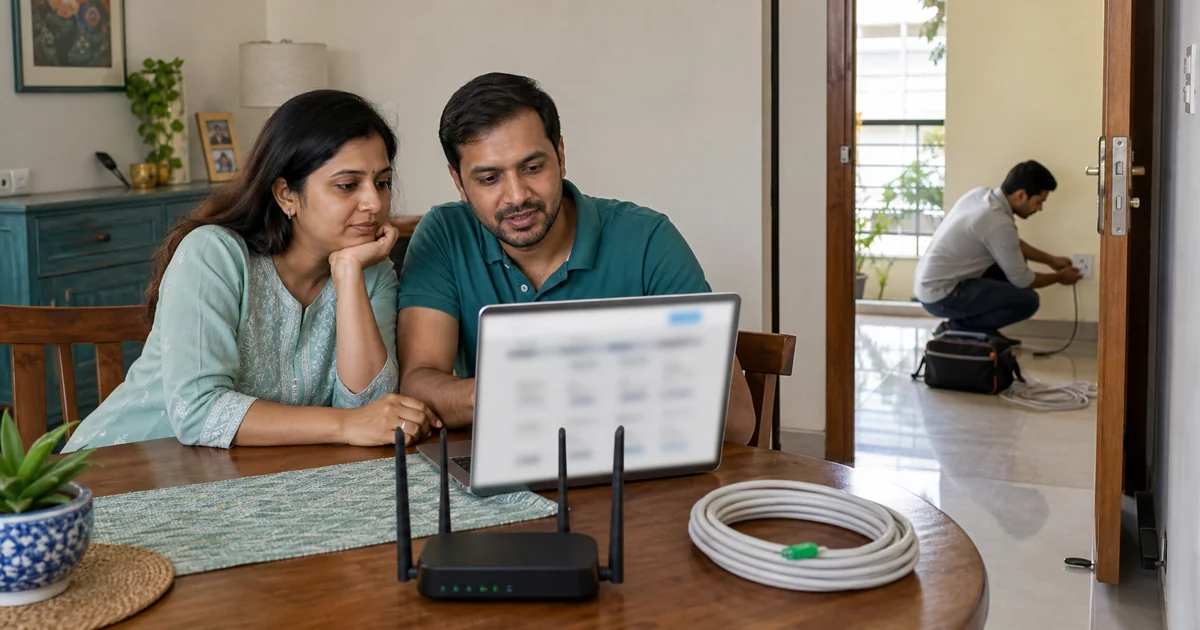
Quick answer: Open the official Sanchar Saathi KYI page and search by your six-digit PIN code, address, or ISP name. The result lists provider contact details, website, licence category, and service areas. Use it to identify authorised wireline providers, then confirm actual availability, price, installation time, and terms directly with the provider.
Searching for “fibre broadband near me” can produce advertisements, resellers and similarly named businesses. The Department of Telecommunications (DoT) offers a better starting point: Know Your Internet Service Provider, or KYI, on Sanchar Saathi. This government directory helps you examine recorded wireline providers before paying or sharing identity documents.
Independent guidance: RTI Wiki is not a DoT, Sanchar Saathi, TRAI, ISP or government website. Use only the official domain sancharsaathi.gov.in for the KYI search. A KYI result is a directory record, not a promise of connection availability, speed, price, installation time or service quality at your building.
Three searches, three different questions
| Search route | Best question to answer | What you enter |
|---|---|---|
| PIN Code | Which recorded wireline ISPs cover this postal area? | A six-digit PIN code |
| Address | Which providers are recorded for this State, district or town/village? | State/UT first, then district and town/village where needed |
| ISP Name | Where does a provider with this name operate? | At least three characters, plus a name-match option |
Start with PIN Code for a new connection. Use Address to change the location scope, or ISP Name to check a company already suggested to you.
Search by PIN: the fastest route
- Open the official KYI search page.
- Keep the Search by PIN Code tab selected.
- Enter all six digits of the installation address PIN code. The field accepts digits only, and the page begins offering matches after five digits.
- Select the matching PIN suggestion or press Enter after entering the complete PIN.
- Read the result table. Do not stop at the provider name: check its contact details, website, category and service areas.
- Open Service Areas for the relevant row to see the listed circle, State/UT, district and PIN-code details.
- Contact more than one provider and ask each to confirm serviceability at the exact building.
If the entry is not six digits, the live page displays: “Please enter a 6-digit PIN Code.” The search is currently available without account creation, OTP, document upload or payment.
When a PIN search is not enough
Search by address
The address tab uses cascading location lists. Select the State/UT first. The page then lets you choose a district and town/village to make the result more specific. On the interface checked for this guide, State/UT is the required first selection; the narrower fields can be used when appropriate.
Search by ISP name
Enter at least three characters of the provider’s name. KYI offers three match settings:
- Anywhere, when you know only part of the name;
- Starting With, when you know its opening words; or
- Ending With, when you know the final word or suffix.
Pressing Enter can start the search. Compare the directory name with the quotation, website, payment request and receipt. A similar logo alone does not establish that a salesperson represents the listed entity.
Read every useful part of the result
KYI displays ISP Name, Email, Contact Number, Website Link, License Category, Service Areas and a serial number. “License Category” is the exact UI label.
| Result field | How to use it safely |
|---|---|
| ISP Name | Match it against the legal or business name on the quotation and receipt. Ask the seller to explain any difference. |
| Email and Contact Number | Use the listed channel to verify whether a local agent or franchise is genuine and whether your address is serviceable. |
| Website Link | Prefer the provider website reached through the official directory over a sponsored or copied search result. Check the domain before entering personal data. |
| License Category | Read it with the geographical categories explained below. It does not grade speed, reliability or customer service. |
| Service Areas | Open the detail view and compare the circle, State/UT, district and PIN code with the proposed installation address. |
The screen also supports field filters, an A/B/C category filter, page-size choices, and Excel or PDF export. Treat an export as a dated copy and recheck the live directory before payment.
What categories A, B and C mean
The KYI page explains its displayed licence categories geographically:
- Category A: national area;
- Category B: a telecom circle or metro area defined for the licensing framework; and
- Category C: a Secondary Switching Area, or SSA, defined for that framework.
The page also says that a Category C operator wishing to serve more than four SSAs in one circle requires Category B. The letters describe geographical scale, not speed, price or service quality.
Section 3(1) of the Telecommunications Act, 2023 places telecommunication services under Central Government authorisation. Section 3(6) allows older licences, registrations and permissions to continue for their stated period or migrate. DoT made the 2026 authorisation and migration framework operational on 25 June 2026. KYI may therefore show License Category while current DoT material uses authorisation.
Do not treat that terminology difference, by itself, as evidence that a provider is unauthorised.
What KYI can and cannot establish
KYI can help you find providers by location or name, obtain directory contact details, examine displayed service areas, and create a dated shortlist.
It cannot by itself establish:
- that a cable reaches your street, building or flat;
- that the provider has spare network capacity;
- the final installation charge, monthly price or taxes;
- the speed, contract, lock-in, refund or equipment-return terms; or
- that every person using the provider’s name is its authorised representative.
An empty search result also does not prove that every provider offering service is illegal. First check the PIN and spelling, try the other search routes, preserve the result, and ask DoT for clarification if the discrepancy matters.
Turn the directory result into a safe buying decision
Once you have a shortlist, ask each provider the same questions in writing.
- Is service available at the complete address, including building and floor?
- What is the total amount payable before activation, with tax and installation?
- Is the router or optical network terminal sold, rented, loaned or refundable?
- What speed and data limits are in the plan document?
- Is there a minimum term or cancellation charge?
- What happens to the deposit and equipment when the connection closes?
- Which complaint-centre number or email will issue a docket number?
Save the KYI result, quotation, plan terms, receipt and complaint dockets. Pay through a traceable provider channel. Do not share Aadhaar, bank details or an OTP merely because somebody knows your address or preferred plan.
Save this checklist: Use your browser’s Print option and choose Save as PDF. Keep the dated copy with the provider quotation and receipt. Reopen the live KYI page before payment because directory records and service areas can change.
If the directory and the salesperson disagree
Use a measured escalation path rather than making an immediate public accusation.
| Situation | Sensible next step |
|---|---|
| The exact ISP name appears, but your PIN is not in the service-area detail | Ask the listed ISP contact to confirm the agent and exact address in writing. |
| The name does not appear in any search route | Check spelling and the legal entity name, then ask the seller for its DoT authorisation or legacy-licence details. |
| Money was taken but installation or refund is disputed | Complain to the provider’s complaint centre and obtain a docket number. |
| The complaint centre does not resolve the matter | Appeal to the provider’s Appellate Authority under the telecom complaint mechanism. |
| A DoT directory record appears inaccurate | Send DoT the URL, search route, date, screenshot or export, and the precise correction requested. |
TRAI’s official complaint guidance says consumers should first use the provider’s two-tier mechanism: the complaint centre and then the Appellate Authority. TRAI does not handle individual consumer complaints. For a fuller route, use our telecom complaint filing guide and telecom complaint overview. If an outage is the issue, see broadband and mobile outage relief.
When RTI can help, and when it cannot
RTI is for records held by a public authority. It is not a substitute for asking a private ISP to install a line, restore service, waive a bill or issue a refund. A private ISP is not automatically a public authority under the RTI Act.
RTI can be useful when you need an existing DoT record about the directory, an authorisation or legacy licence, the service area recorded for an entity, or action taken on a directory-correction representation. Identify the DoT office likely to hold the record and ask for documents, not explanations or opinions.
Adaptable RTI request:
To: The Central Public Information Officer
Department of Telecommunications

Subject: Information regarding KYI entry and service area of [ISP legal name]

Please provide:

1. A certified copy or electronic extract of the authorisation, licence or other
   record under which [ISP legal name] was recorded as entitled to provide
   wireline internet service in [PIN code/district] on [date].
2. A copy of the service-area entry for that entity as held by the office.
3. A copy of the file noting and action-taken record on my representation dated
   [date] concerning the KYI entry, if received by your office.
4. The name and designation of the office responsible for maintaining or
   correcting the relevant KYI data.

Please provide the records electronically. If another public authority holds
any requested record, please transfer that part under section 6(3) of the RTI Act.
Build a focused application with the AI RTI Drafter, check the statutory date with the RTI Timeline Tracker, and use the First Appeal Builder if a due reply is missing or incomplete. For billing-record issues, also see RTI for a telecom bill dispute.
Frequently asked questions
1. Is the Sanchar Saathi KYI search free?
The search showed no fee, account, OTP or document-upload requirement when checked on 12 August 2026. Do not pay a third party merely to run it.
2. Does a KYI listing prove that fibre is available in my flat?
No. It shows recorded provider and service-area information. Building access, local cabling, capacity and commercial availability still need provider confirmation.
3. What should I do if my PIN code returns no provider?
Confirm all six digits, try the address route, and search known providers by name. Keep a dated screenshot or export if a material discrepancy remains. An empty result alone is not proof of unlawful operation.
4. Can I compare broadband prices on KYI?
No. KYI is not a tariff comparison engine. Obtain written quotations and compare installation, equipment, taxes, plan limits, cancellation and refund terms.
5. Why does KYI say “License Category” when the law says authorisation?
India moved to the Telecommunications Act, 2023 authorisation framework, while older licences may continue or migrate. KYI retains legacy category wording in its current results. The label alone does not decide a provider’s present legal status.
6. Can I complain directly to TRAI about a broadband provider?
TRAI says it does not handle individual consumer complaints. First complain to the provider’s complaint centre and obtain a docket. If dissatisfied, appeal to that provider’s Appellate Authority.
7. Can I file RTI directly against a private ISP?
Not ordinarily merely because it supplies internet service. Seek records from DoT or another public authority that holds them. Use the provider’s complaint and appellate channels for installation, service, billing and refund disputes.
Sources
Related on RTI Wiki
Editorial verification: The KYI interface and official sources were checked on 12 August 2026. Dynamic provider records can change. This article gives general citizen information, not legal advice or an endorsement of any ISP.