Table of Contents
Compassionate Appointment Despite Pending Criminal Case
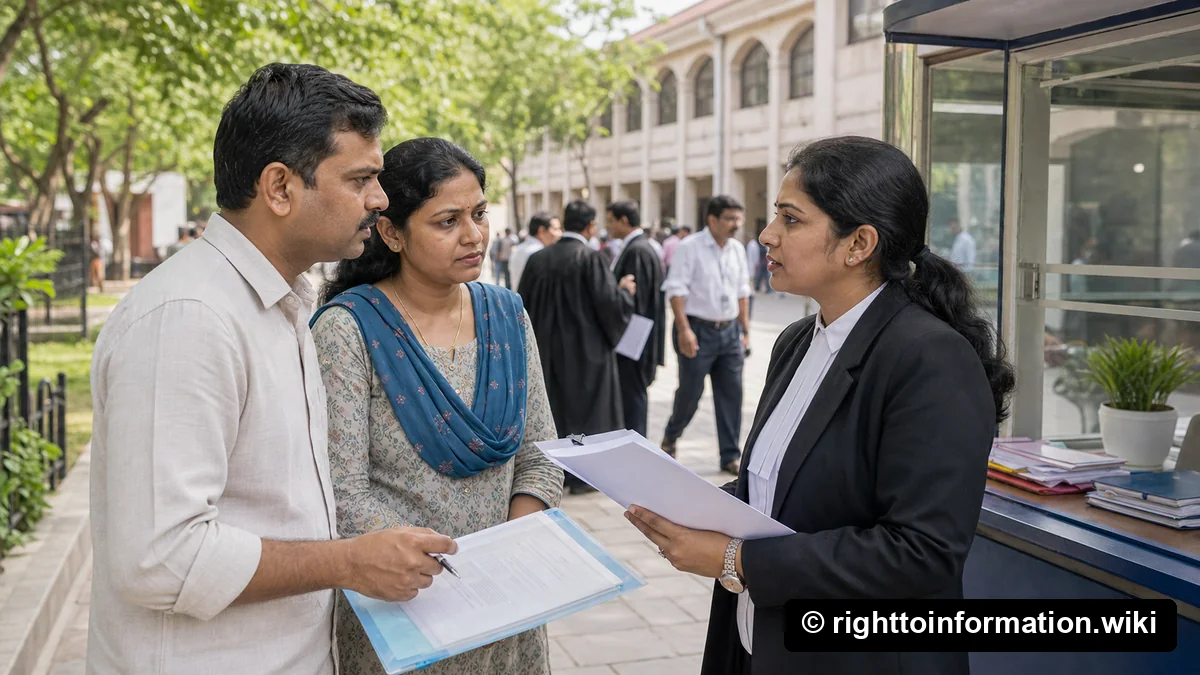
If your sole earning parent died in government service and your compassionate appointment file is frozen only because a criminal case is pending against a family member, a 2026 Supreme Court ruling says that freeze is likely wrong and your claim must still be decided on its own merits.
Picture this. A junior school teacher, the only earning member of his home, dies suddenly in a road accident. His grown son applies for a compassionate appointment so the family can survive. But the department parks the file and says: “There is a criminal case pending in the family, so we cannot move.” Months pass. The rent, the school fees and the loans do not pause. This exact situation reached the Supreme Court, and in June 2026 the Court drew a clear line that every affected family should know.
Financial assistance vs appointment: two different things
The single most important idea in this ruling is that these are two separate benefits, and a pending criminal case does not affect them the same way. Many departments blur the two. Do not let them.
| Compassionate financial assistance | Compassionate appointment |
|---|---|
| A one-time or lump-sum monetary payout to the family | A government job given to a dependent of the deceased employee |
| Under many schemes, this benefit can be suspended or withheld while a criminal trial is pending | The pending-trial bar written for financial assistance does NOT automatically extend to appointment |
| The rule text often uses the words “financial assistance” only | Appointment eligibility is governed by its own separate clause and its own conditions |
| Meant to give quick cash relief | Meant to give a stable livelihood to tide the family over the crisis |
In the words of the Supreme Court, the rule freezing benefits during a criminal case used “the expression compassionate financial assistance, and that expression alone throughout.” So it cannot be stretched to block an appointment claim.
Quick Reply: A pending criminal case, by itself, does not bar a compassionate appointment. In Atul Chauhan v. State of Haryana (2026 INSC 640, judgment dated 11 June 2026), the Supreme Court held that a clause suspending benefits during a pending trial applied only to compassionate financial assistance, not to compassionate appointment. Your appointment claim must be considered on its own eligibility conditions, uninfluenced by the criminal proceedings. If a department refuses only on this ground, use RTI to get the written reason, the scheme rules and the file movement, then challenge it.
The legal position, and what the 2026 ruling settled
Compassionate appointment is not an ordinary job that anyone can claim. It is a narrow exception to the constitutional rule of equal opportunity in public employment under Articles 14 and 16 of the Constitution. Because it lets one family member get a government post without open competition, courts allow it only for a limited humanitarian purpose: to help a family survive the sudden financial crisis caused by the breadwinner's death in service. It is not a vested right, and it is always subject to the eligibility conditions in the relevant scheme.
In Atul Chauhan v. State of Haryana, the deceased was a Junior Basic Teacher and the sole earner. After his death, a criminal case was pending in the family. The department treated the pending case as a reason to keep the son's compassionate-appointment claim on hold, relying on a rule that suspends benefits during a criminal trial.
The Supreme Court (Justices Sanjay Karol and Nongmeikapam Kotiswar Singh) held that:
- The clause suspending benefits during a pending criminal case used the words “compassionate financial assistance” only, so it applied to that monetary benefit alone.
- That clause could not be read to also block a claim for compassionate appointment, which is governed by a different eligibility clause without the same conditional language.
- The son's appointment claim could not be kept pending indefinitely because of a relative's pending criminal appeal.
- The State was directed to consider and decide his appointment claim within three months, strictly on the scheme's appointment eligibility conditions and not on the trial-pending clause meant for financial assistance.
The Court also reaffirmed the settled framework: compassionate appointment exists “to bail out a family facing extreme financial difficulty,” but is subject to strict scrutiny of the prescribed eligibility parameters. It is relief, not an entitlement.
This page is specifically about the pending criminal case hurdle. For the separate question of whether the family is poor enough to qualify, see our page on compassionate appointment and indigence.
Eligibility at a glance
You are broadly in a stronger position to claim a compassionate appointment when:
- The employee died while in service and was the family's main earner.
- You are a dependent of the deceased as defined in the applicable scheme, for example a spouse, son, daughter or, in some schemes, another named dependent.
- You apply within the time limit fixed by the scheme.
- The family genuinely faces financial distress because of the death.
- You meet the post's basic requirements such as minimum age and educational qualification.
- A criminal case is pending in the family, but the scheme's pending-trial bar is written only for financial assistance, not appointment.
Every state and department has its own scheme, so always read the exact rules that apply to your case. Do not assume; verify the text.
What to do if your claim is refused only because of a pending case
- Get the refusal in writing. Ask the department for a written, reasoned order recording exactly why your compassionate-appointment claim was rejected or deferred. A verbal “case is pending” is not a valid order.
- File an RTI for the reason and the rules. Ask the Public Information Officer for (a) the certified copy of the scheme rules or instructions being applied to you, (b) the specific clause relied on to keep your file pending, and © any note or order recording the decision on your file. Our AI RTI draft tool can help you word this cleanly.
- Ask for file movement (notesheet). In the same or a second RTI, ask for the file notings and movement of your application: who received it, on what date, and what each officer wrote. This exposes whether the file was actually examined or just parked.
- Check which clause they used. Compare the clause quoted in the reply with the scheme text. If they blocked an appointment claim using a bar written for financial assistance, that is the exact error the Supreme Court corrected in 2026.
- File a first appeal if the PIO stalls. If the PIO gives no reply, a vague reply, or refuses the documents, file a first appeal within 30 days. Use our first appeal tool to draft it, and the RTI timeline calculator to track your deadlines.
- Represent to the appointing authority citing the 2026 ruling. Send a written representation asking them to decide your appointment claim on its own eligibility, citing Atul Chauhan v. State of Haryana (2026 INSC 640).
- Approach the High Court if still stuck. If the department keeps your claim frozen only on the pending-case ground, a writ petition can seek a direction to decide it on merits within a fixed time, as the Supreme Court itself ordered.
Documents you will usually need
- Death certificate of the employee and proof of death while in service.
- Proof that the deceased was the main earner and of the family's financial position.
- Proof of your relationship as a dependent, such as a family details or service record entry.
- Your educational and age proofs for the post.
- A copy of the scheme rules or instructions that apply to you.
- Any written order or note that refused or deferred your claim, plus your RTI replies.
Common mistakes to avoid
- Accepting a verbal refusal. Always insist on a written, reasoned order. You cannot appeal a rumour.
- Confusing the two benefits. Financial assistance and appointment are separate. A bar on one is not automatically a bar on the other.
- Missing the scheme time limit. Compassionate schemes are strict about deadlines. Apply early and keep proof of the date.
- Not reading your own state scheme. The 2026 ruling turned on the exact words of the rule. Get the certified text through RTI and read which clause mentions “appointment” and which mentions “financial assistance”.
- Letting the file sit silently. Use RTI to force movement. A parked file is not a rejected file, and silence can be challenged.
- Skipping the notesheet. The file notings often reveal that no officer actually applied the correct clause.
A real-life style example
Suman, a young graduate, lost her father, a government office clerk and the only earner at home. She applied for a compassionate appointment. The office told her the file could not move because a criminal case was pending against her uncle over a property dispute linked to the family. Months passed with no order.
Suman filed an RTI asking for the certified scheme rules, the exact clause being used to stall her file, and the file notings. The reply showed the office was applying a clause that, by its own words, spoke only of financial assistance, not appointment. Armed with that, and citing the 2026 Supreme Court ruling, she sent a representation and then a first appeal. The department was made to examine her appointment claim on its own eligibility, separate from the pending case.
As RTI trainer Dr. Shrawan Kumar Pathak often reminds families, the RTI reply is what turns a vague “wait” into a document you can actually challenge.
Frequently asked questions
Does a pending criminal case automatically stop a compassionate appointment?
No. In Atul Chauhan v. State of Haryana (2026 INSC 640), the Supreme Court held that a clause suspending benefits during a pending trial applied only to compassionate financial assistance, not to appointment. Your appointment claim must be decided on its own eligibility.
What is the difference between compassionate financial assistance and compassionate appointment?
Financial assistance is a monetary payout to the family. Compassionate appointment is a government job for a dependent. They are separate benefits with separate conditions, and a pending-trial bar written for one does not automatically apply to the other.
The criminal case is against my mother, not me. Can they still block my appointment?
The 2026 ruling arose from exactly this kind of situation, where the pending appeal concerned a relative. The Court held the appointment claim could not be kept pending indefinitely on that ground and had to be decided on its own eligibility conditions.
Is compassionate appointment a right I can demand?
No. It is a narrow humanitarian exception to the equal-opportunity rule under Articles 14 and 16 of the Constitution, meant to help a family survive the sudden loss of its breadwinner. It is subject to strict eligibility scrutiny and is not a vested right.
How does RTI help me here?
RTI lets you get the written rejection reason, a certified copy of the scheme rules, the exact clause being applied, and the file notings and movement. This turns a vague verbal refusal into documents you can appeal or take to court.
What if the PIO does not reply or refuses my documents?
File a first appeal within 30 days of the reply or of the deadline passing. If that also fails, you can approach the Information Commission in second appeal. Use our tools to draft the appeal and track the timeline.
Does this Supreme Court ruling apply to every state?
The case interpreted a specific Haryana rule, but the reasoning is general: a bar written only for financial assistance cannot be stretched to block appointment. Read your own state or department scheme and check the exact words of each clause.
How quickly must the department decide my claim?
In this case the Supreme Court directed the State to decide the appointment claim within three months. If your file is stuck, you can seek a similar time-bound direction from the High Court.
Sources
- Atul Chauhan v. State of Haryana & Others, 2026 INSC 640, Supreme Court of India, judgment dated 11 June 2026 (Justices Sanjay Karol and Nongmeikapam Kotiswar Singh). Available at Indian Kanoon.
- Constitution of India, Articles 14 and 16 (equality before law and equal opportunity in public employment).
- Haryana Civil Services (Compassionate Financial Assistance or Appointment) Rules, 2019, as interpreted in the above judgment.