Table of Contents
How to Reactivate a Dormant Account 2026
RBI Ombudsman as of 1 July 2026: Bank, certain NBFC, prepaid-instrument and credit-information complaints go under the Reserve Bank - Integrated Ombudsman Scheme, 2026, which replaced RB-IOS 2021 from 1 July 2026. First complain to the entity. If there is no reply in 30 days (or the longer NPCI/card-network window, if it applies) or you reject the reply, file free at cms.rbi.org.in within 90 days. The Ombudsman can award up to Rs 30 lakh for consequential loss and up to Rs 3 lakh for time, expenses and harassment. Complaints received before 1 July 2026 stay under the 2021 scheme. Source: RBI FAQ, updated 1 July 2026 and the RB-IOS 2026 FAQ PDF dated 1 July 2026.

Reviewed on 2026-09-01 by Dr. Shrawan Kumar Pathak.
Quick Reply: Your account turns inoperative after two years with no use. To reactivate, give the bank a written request and update your KYC at any branch or by V-CIP video call. It is free, there is no minimum-balance penalty, your savings interest keeps running, and the bank must reactivate within three working days.
This is a speed-run. No long story. Each block is one move. Do them in order and a frozen account is usually live the same week.
60-second version
- Confirm the account is “inoperative”, not “frozen for fraud”. Two years of no use means inoperative.
- Write one line to the branch: please reactivate my account, KYC enclosed.
- Hand over fresh KYC (Aadhaar, PAN, photo) at any branch, or do V-CIP from your phone.
- Bank does its maker-checker check. No charge.
- Do one small transaction. Account is live.
That is the whole game. The rest of this page is the detail for when something stalls.
Move 1: Know what "dormant" means
The Reserve Bank of India circular dated 1 January 2024 (RBI/2023-24/105) sets one clear line. A savings or current account becomes inoperative when there is no customer-induced transaction for over two years.
A customer-induced transaction is any move you trigger: a debit, a credit, a fund transfer, even a KYC update through net banking or the mobile app. A bank-posted interest credit alone does not count, because you did not initiate it. So a salary account you stopped using, a savings account you opened years ago for one purpose, or an old joint account can all drift into the inoperative bucket without you noticing.
You should get a warning first. Where there is no customer-induced transaction for a full year, the bank is required to alert you by letter, email or SMS that the account will turn inoperative if you do not use it in the next year. If you act on that nudge, even a single rupee transfer, the clock resets and the account never goes dormant.
Good to know up front, straight from the same circular:
- Your savings interest keeps getting credited even while the account sleeps. The money does not stop growing.
- The bank cannot charge a minimum-balance penalty on an inoperative account.
- Reactivation is free. No charge is allowed for activation.
So there is no penalty clock ticking against you. Reactivate when you are ready.
Move 2: Update KYC
KYC is the only real step. The 2024 rules force every bank to offer KYC updation for reactivation at all branches, including non-home branches, and through Video-Customer Identification Process (V-CIP).
Pick the fast lane:
- Branch. Walk in with Aadhaar, PAN and a recent photo. Fill the re-KYC form, sign, hand it over. Carry the originals plus one photocopy each. Done in one visit for most people.
- V-CIP. A video call from home where an officer verifies your face and documents live. No travel, no queue. Keep your Aadhaar and PAN ready on the table and sit in good light.
If your KYC was already current, you may not need fresh documents at all, just the written request. A joint account usually needs every holder to be KYC-compliant, so line up the second holder before you start. See our update bank KYC without a branch visit guide for the digital route.
When the same step also unblocks a debit-freeze
An inoperative tag and a separate debit-freeze are not the same thing. Reactivation lifts the dormant tag. If the account holder has died, you need a deceased account claim instead — the heirs and paperwork are different. If your account is blocked for another reason, read how to unfreeze a frozen bank account as well, because the paperwork differs.
Move 3: Give the written request
Hand the branch a one-line request: reactivate account number XXXX, KYC enclosed. Keep a stamped copy or the email acknowledgement. That copy is your proof and your timeline starts from it.
The bank then runs a two-officer maker-checker check before switching the account on. That is an internal control, not extra work for you.
Move 4: Watch the three-day clock
Once your application is complete, the bank must process the activation within three working days. The word “complete” matters: if KYC is missing a document, the clock has not started, so confirm at the counter that nothing else is pending. After it is live, make one small transaction, a self transfer or a one-rupee UPI payment, so the system logs fresh activity and the account stays operative going forward.
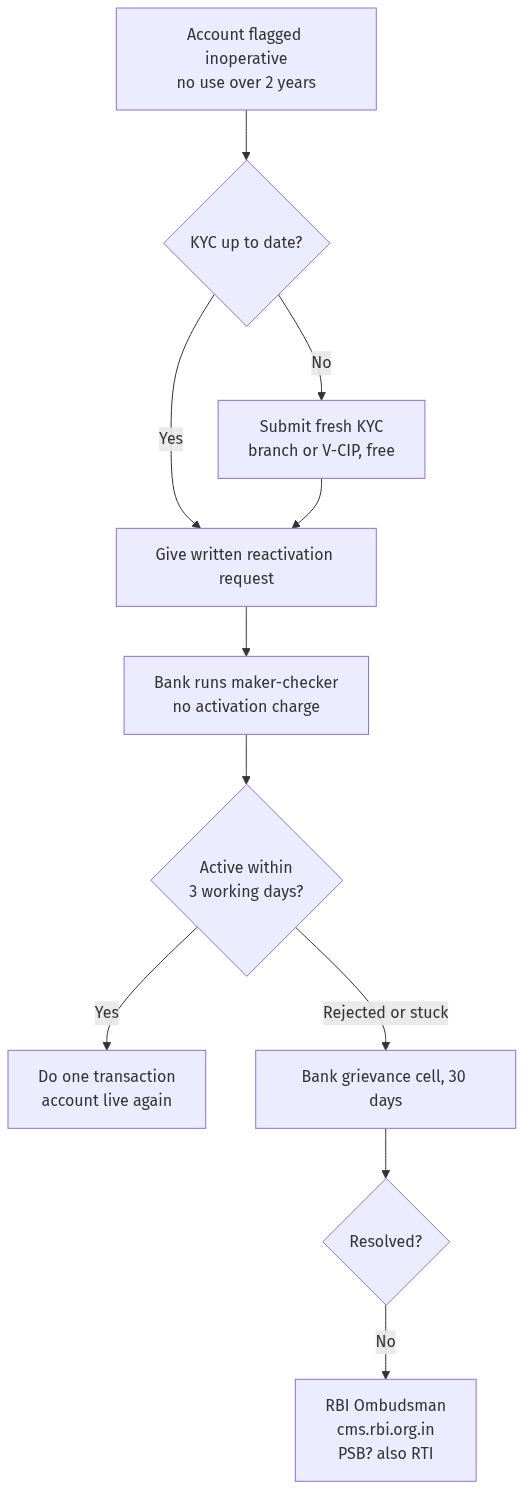
Figure: step-by-step flow. If a step stalls, use the grievance or RTI route shown.
If it stalls: grievance, then Ombudsman
Branch sitting on it past three working days, or refusing without reason? Do not argue at the counter. Escalate:
- Bank grievance cell. File a written complaint with the bank's grievance redressal officer. Give them up to 30 days.
- RBI Ombudsman. Not resolved in 30 days, or you got a reply you do not accept? File free at cms.rbi.org.in under the RBI Integrated Ombudsman Scheme.
- RTI (public-sector banks only). If yours is a public-sector bank, you can also file an RTI asking why the reactivation was delayed and on whose desk the file is stuck. A dated reply often shakes the file loose. Private banks are not public authorities under the RTI Act, so this route does not apply to them; for a private bank, the Ombudsman is your lever.
Keep every acknowledgement, KYC slip and complaint number. A clean paper trail is what makes the Ombudsman step quick.
Dormant for 10 years? That is a different door
Two-year dormant is fixed at the branch. But if an account sat untouched for 10 years or more, the balance is moved to RBI's Depositor Education and Awareness (DEA) Fund. You do not lose it, you trace it.
Search the UDGAM portal at udgam.rbi.org.in, find the entry and its reference number, then claim from that bank. Full walk-through in find unclaimed deposits on UDGAM. RBI also runs special reactivation drives from time to time, so check rbi.org.in for any live campaign.
Frequently asked questions
When does a bank account become dormant or inoperative?
After over two years with no customer-induced transaction, per the RBI circular dated 1 January 2024. A bank-posted interest credit alone does not reset the clock; a debit, credit or KYC update by you does.
Is there any charge or penalty to reactivate a dormant account?
No. The RBI rules say no charge can be levied for activation, and no minimum-balance penalty can be charged while an account is inoperative. Reactivation is free.
How long does reactivation take?
The bank must process a complete activation request within three working days. The clock starts when your application and KYC are complete, so keep a dated acknowledgement.
Do I lose the money or interest in a dormant account?
No. Your funds stay yours, and savings interest keeps getting credited even while the account is inoperative. Nothing is forfeited at the two-year stage.
Can I reactivate without visiting the branch?
Often yes. Banks must offer KYC updation through V-CIP, a video call where an officer verifies you and your documents from home. If your KYC is already current, a written request may be enough.
What if the bank refuses or sits on my request?
Give the bank grievance cell up to 30 days in writing. If still unresolved or wrongly rejected, file free with the RBI Ombudsman at cms.rbi.org.in. For a public-sector bank you can also file an RTI on the delay.
My account has been idle for over 10 years. What now?
The balance has likely moved to RBI's DEA Fund. Search the UDGAM portal at udgam.rbi.org.in, note the reference number and claim it from the bank that holds it. The money is recoverable.