Table of Contents
Cheque Bounce: Your Remedies 2026
RBI Ombudsman as of 1 July 2026: Bank, certain NBFC, prepaid-instrument and credit-information complaints go under the Reserve Bank - Integrated Ombudsman Scheme, 2026, which replaced RB-IOS 2021 from 1 July 2026. First complain to the entity. If there is no reply in 30 days (or the longer NPCI/card-network window, if it applies) or you reject the reply, file free at cms.rbi.org.in within 90 days. The Ombudsman can award up to Rs 30 lakh for consequential loss and up to Rs 3 lakh for time, expenses and harassment. Complaints received before 1 July 2026 stay under the 2021 scheme. Source: RBI FAQ, updated 1 July 2026 and the RB-IOS 2026 FAQ PDF dated 1 July 2026.
Reviewed on 2026-06-20 by Dr. Shrawan Kumar Pathak.
Quick Reply: A cheque given to you bounced. Send a legal demand notice within 30 days of the bank return memo, asking for payment in 15 days. If unpaid, file a Section 138 complaint within one month at the court where your bank branch sits. The court can order interim compensation up to 20 per cent.
A bounced cheque is not a dead end. The law treats it as both a crime and a debt, which means you hold two separate keys. This brief sets out the right you have, the remedy attached to each step, and the time window that protects it. Miss the window and the right lapses, so read the clock dates carefully.
The right you hold when a cheque bounces
When a cheque you deposited is returned unpaid for insufficient funds (or because the amount exceeds the drawer's arrangement with the bank), Section 138 of the Negotiable Instruments Act, 1881 makes that dishonour a criminal offence by the person who signed the cheque. The maximum punishment is imprisonment up to two years, or a fine up to twice the cheque amount, or both. That penalty exists to pressure the drawer to pay you. Your task is simply to follow the procedure that switches the right on.
Step 1: Secure the bank return memo
Your remedy starts the day the cheque comes back. Ask your bank for the cheque return memo, the slip that states the reason for dishonour, for example funds insufficient, signature mismatch, or account closed. Note the date on it. That date starts your 30-day clock and is your core evidence later. Banks also levy a cheque return charge, which differs from bank to bank, so check your own bank tariff for the exact figure.
Step 2: Send the demand notice within 30 days
Within 30 days of receiving that memo, send a written demand notice to the drawer through a lawyer or by registered post or speed post. The notice must demand the exact cheque amount and give the drawer 15 days to pay. This notice is not optional paperwork. Without a valid notice issued inside the 30-day window, you lose the right to file a criminal complaint. Keep the postal receipt and tracking proof.
Step 3: Wait out the 15-day pay window
The drawer now has 15 days from receiving your notice to pay. If the money lands, your remedy has worked and the matter closes. If 15 days pass with no payment, your cause of action is born on the 16th day, and the criminal door opens.
The remedy ladder: criminal, interim and civil
File the Section 138 complaint within one month
From the day the cause of action arises, you have one month to file a criminal complaint before a Magistrate. File it where the branch of your bank, the one that sent the cheque for collection, is located. The Supreme Court reaffirmed in 2025 that jurisdiction follows the payee's bank branch under Section 142(2)(a), so you usually litigate close to home, not in the drawer's city. If you genuinely miss the month, the court may still condone the delay for sufficient cause, but never rely on that.
Ask for 20 per cent interim compensation
Once the case begins, you can ask the trial court for interim compensation under Section 143A, up to 20 per cent of the cheque amount, payable by the drawer within 60 days. The Supreme Court has held this is discretionary, not automatic, so the judge weighs the strength of your case before granting it. If the drawer is later acquitted, you repay the amount with interest at the bank rate. On appeal against a conviction, Section 148 lets the appeal court make the convicted drawer deposit at least 20 per cent more before the appeal is heard.
Run a civil suit to actually recover the money
This is the step most people forget. The Section 138 case punishes the drawer, but a fine paid to the court is not the same as your money in hand. To recover the debt itself, file a summary suit under Order XXXVII of the Code of Civil Procedure, a faster track for money owed on a cheque or written instrument. Many lawyers run the criminal complaint and the civil suit in parallel: the criminal threat creates pressure, and the civil decree gives you a recovery order.
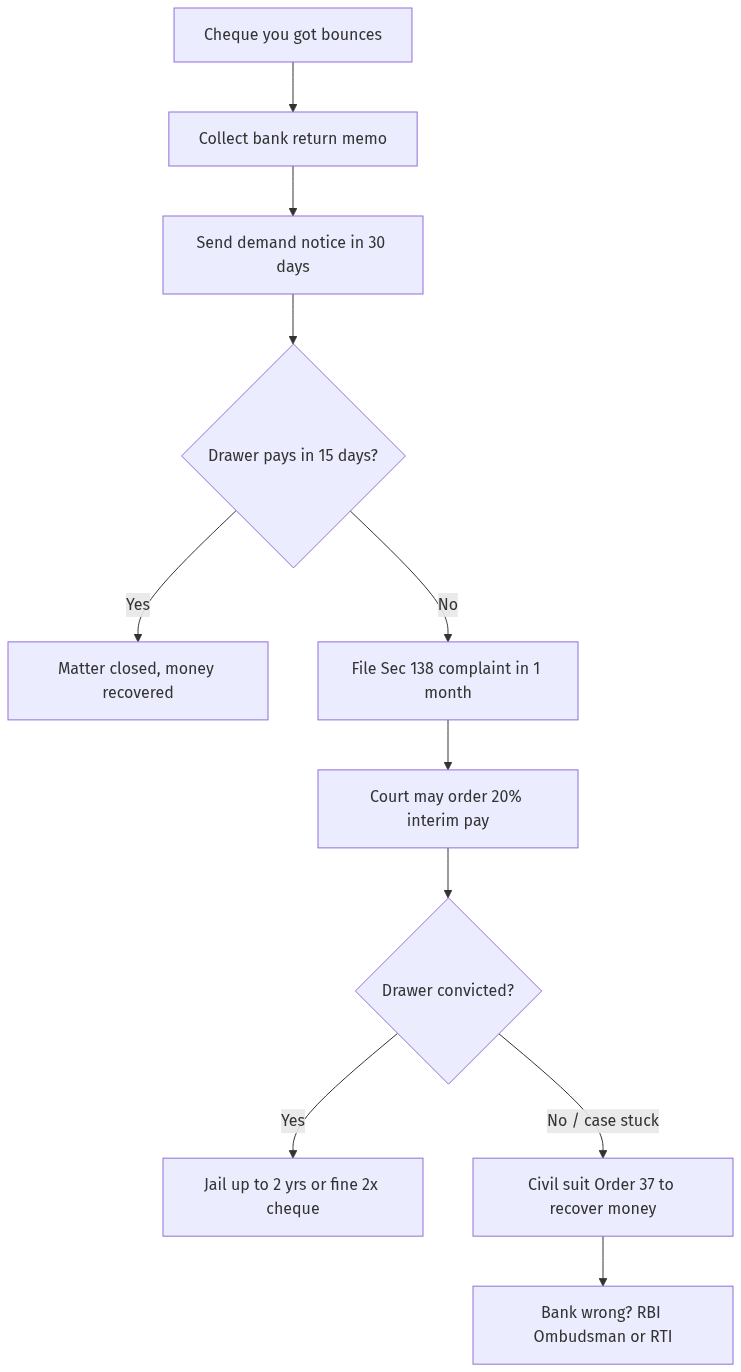
Figure: step-by-step flow. If a step stalls, use the grievance or RTI route shown.
When the bank, not the drawer, is the problem
Sometimes the dishonour is the bank's fault. If a bank wrongly returned a properly funded cheque, or charged you a return fee it should not have, raise a written grievance with the branch first. If it is not resolved in 30 days, or the reply is unsatisfactory, escalate free of cost to the RBI Ombudsman under the Reserve Bank Integrated Ombudsman Scheme at cms.rbi.org.in. For a public-sector bank, you can also file an RTI to obtain its cheque-return policy and the records of your own memo. A failed electronic payment follows a different track, covered in our guide on getting a refund for a failed NEFT or UPI transfer, and a wrongly levied charge can be reversed using the steps in reverse unfair bank charges.
Avoid the trap of giving a weak cheque yourself
If you are the one issuing cheques, two safeguards matter. First, register for the Positive Pay System for high-value cheques. Under the RBI circular effective 1 January 2021, this confirmation applies to cheques of Rs 50,000 and above, and banks may make it mandatory at Rs 5 lakh and above; you re-confirm the cheque details by SMS, app, net banking or ATM so a tampered cheque is caught. Second, never write a cheque you cannot honour, because repeated dishonour of large cheques can cost you your cheque book and a criminal record. If money is locked away rather than spent, our pages on an account that is frozen and on tracing unclaimed deposits on UDGAM may help you free it before the next cheque clears.
Frequently asked questions
Is a cheque bounce a criminal offence in India?
Yes. Under Section 138 of the Negotiable Instruments Act, dishonour of a cheque for insufficient funds is a criminal offence by the person who signed it, punishable with imprisonment up to two years, a fine up to twice the cheque amount, or both. You must follow the notice and complaint procedure to enforce it.
How many days do I have to send the demand notice?
You have 30 days from the date you receive the bank's cheque return memo. Send a written notice demanding the cheque amount within 15 days. If you miss this 30-day window, you lose the right to file a Section 138 criminal complaint, though a civil recovery suit may still be open.
Where do I file the cheque bounce complaint?
File it before the Magistrate in whose area the branch of your own bank, the bank that presented the cheque for collection, is located. The Supreme Court confirmed in 2025 that the payee's bank branch decides jurisdiction under Section 142(2)(a), so you generally litigate near where you banked the cheque.
Will I get my money back from a Section 138 case?
Not automatically. The criminal case punishes the drawer and can yield a fine, but the surest way to recover the actual sum is a parallel civil summary suit under Order XXXVII of the Code of Civil Procedure. You can also seek interim compensation up to 20 per cent of the cheque value under Section 143A while the case runs.
What is interim compensation under Section 143A?
It lets the trial court order the drawer to pay you up to 20 per cent of the cheque amount during the case, within 60 days. The Supreme Court has held it is discretionary, not mandatory, so the judge decides based on your case. If the drawer is acquitted, you repay it with interest at the bank rate.
Can the bank itself be blamed for a bounced cheque?
Yes, if it wrongly returned a properly funded cheque or charged you incorrectly. Raise a written grievance with the branch, and if it is not resolved within 30 days, escalate free to the RBI Ombudsman at cms.rbi.org.in. For a public-sector bank you can also use RTI to get its cheque-return policy and your own records.
What is Positive Pay and does it stop bounces?
Positive Pay is an RBI confirmation system, effective 1 January 2021, for high-value cheques of Rs 50,000 and above, often made mandatory at Rs 5 lakh and above. You re-confirm the cheque date, payee and amount through SMS, app, net banking or ATM. It does not stop a funds-shortage bounce, but it blocks fraud from a tampered cheque.
Sources
- https://www.indiacode.nic.in/ (Negotiable Instruments Act 1881, sections 138, 142, 143A, 148)
- https://www.rbi.org.in/ (Positive Pay System, DPSS.CO.RPPD.No.309, 25 September 2020)
- https://cms.rbi.org.in/ (RBI Integrated Ombudsman Scheme)
For the wider banking rights cluster, see our guide to bank locker rules in 2026.
Cheque bounce remedy: Legal options under Section 138 NI Act (2026)
Cheque bounce: Complete legal remedy under Section 138 NI Act (2026)
- What is a cheque bounce and when is it an offence? (a) Cheque bounce (dishonour): (i) Cheque returned unpaid by bank — due to insufficient funds, account closed, stopped payment, mismatch of signature, (ii) Under Section 138 of Negotiable Instruments Act 1881 — cheque bounce is a criminal offence, (b) Conditions for offence under Section 138: (i) Cheque issued for discharge of legally enforceable debt/liability, (ii) Presented within 3 months — from date on cheque, (iii) Returned unpaid — with bank return memo, (iv) Legal demand notice sent — within 30 days of return memo, (v) Drawer fails to pay — within 15 days of notice, © Penalty: (i) Imprisonment up to 2 years — or fine up to twice the cheque amount — or both, (ii) Compensation: under Section 357 CrPC — can be ordered by court.
- Step-by-step: How to file cheque bounce case. (a) Step 1: Collect bank return memo: (i) Get return memo from bank — stating reason for dishonour, (ii) Keep cheque copy + bank statement, (b) Step 2: Send legal demand notice: (i) Within 30 days — of cheque return date, (ii) Notice must: (1) State cheque amount and date, (2) State reason for dishonour, (3) Demand payment within 15 days, (iii) Send by registered post with AD — keep proof of dispatch + delivery, © Step 3: Wait 15 days: (i) If drawer pays — case closed, (ii) If no payment — file complaint within 30 days — after 15-day period, (d) Step 4: File complaint: (i) File before Metropolitan Magistrate / Judicial Magistrate First Class, (ii) Jurisdiction: court where cheque was presented — or where drawer resides/bank branch is, (iii) Documents: (1) Original cheque + return memo, (2) Legal notice + postal proof, (3) Affidavit + evidence affidavit, (4) Complaint petition — under Section 138 + 200 CrPC/BNSS, (iv) Pre-trial evidence: Section 200 BNSS — pre-summoning evidence — may require affidavit + witness, (e) Step 5: Summons and hearing: (i) Court issues summons to accused, (ii) Accused appears + enters plea, (iii) Trial: evidence of complainant + witnesses + cross-examination, (f) Step 6: Judgment: (i) If convicted: fine + imprisonment, (ii) If acquitted: complainant can appeal — to Sessions Court.
- Alternative remedies for cheque bounce. (a) Section 138 NI Act: (i) Criminal case — as above, (b) Civil suit for recovery: (i) Summary suit under Order 37 CPC — faster than regular civil suit, (ii) Recovery of cheque amount + interest + costs, (iii) No imprisonment — only money recovery, © Arbitration: (i) If agreement has arbitration clause — can initiate arbitration, (ii) Award is enforceable as court decree, (d) Lok Adalat: (i) Cheque bounce cases can be settled — in Lok Adalat, (ii) Settlement is binding — no appeal, (e) Online dispute resolution: (ii) For MSMEs — MSME Samadhaan portal — for delayed payments, (iii) Not directly for cheque bounce — but underlying dispute can be referred.
- Limitation period and timelines. (a) Cheque presentation: within 3 months — from date on cheque, (b) Demand notice: within 30 days — of bank return memo, © Filing complaint: within 30 days — after expiry of 15-day notice period, (d) Total limitation: approximately 75 days — from cheque return date, (e) Important: missing any deadline — bars the complaint.
- Practical tips. (a) Send notice within 30 days — strict deadline, (b) Keep all postal proofs — dispatch + delivery, © File complaint within 30 days — after 15-day period, (d) Get bank return memo immediately — don't delay, (e) Example: Creditor's cheque of Rs 5 lakh bounced; sent notice on day 5; debtor didn't pay in 15 days; filed complaint on day 22 after 15-day period; court issued summons; debtor appeared and settled for Rs 5.5 lakh in first hearing — avoiding trial.
See Cheque Bounce Remedy and How to File RTI.