Table of Contents
Check Today's Mandi Prices 2026

Reviewed on 2026-06-20 by Dr. Shrawan Kumar Pathak.
Quick Reply: To check today's mandi rate, open Agmarknet at agmarknet.gov.in, pick your state, market, crop and date, and read the minimum, maximum and modal price. On a phone, the eNAM app shows nearby mandi prices. Both are free and need no login.
This is a cheat-sheet. Skim the box that matches you, copy the three numbers you need, and go. No jargon, no sign-up.
The 30-second lookup
Cheat-sheet: which tool to open
- Desktop or no app: Agmarknet website (agmarknet.gov.in). Most crops, most markets, daily.
- Phone, on the move: eNAM app. Tap Find Nearby Mandi Price to see mandis around you.
- Phone, want weather too: Kisan Suvidha app. Carries the same Agmarknet rates plus advisory.
All three are government services and free. Pick one and read on.
Cheat-sheet: the three numbers that matter
Every official mandi price comes as three figures for one crop, in one market, on one day:
- Minimum price = the lowest wholesale rate a lot fetched that day.
- Maximum price = the highest rate that day.
- Modal price = the most common, prevailing rate. This is the one to plan around.
Rates are per quintal (100 kg) unless the screen says otherwise. Always note the date and market, because a rate two days old or one mandi away can mislead you.
Steps: Agmarknet (website)
Do this, in order
- Go to agmarknet.gov.in and open the daily price report (Price and Arrivals section).
- Choose State, then Market (APMC mandi).
- Choose your Commodity (crop) and, if asked, the variety.
- Set the Date to today, or the latest day with data.
- Click submit and read the min, max and modal price, with the day's arrival quantity.
If today shows nothing, step the date back a day. Mandis report after trading closes, so the freshest data is often from the previous working day.
Tip: compare two mandis fast
Run the same crop and date for two nearby markets one after the other. If the modal rate in a market 30 km away is meaningfully higher, the extra transport may still leave you ahead. Note both modal figures before you decide.
Cheat-sheet: read the data right
- Match the variety. Wheat, sharbati wheat and dara wheat can carry different rates. Pick the variety closest to your produce or the figure will mislead you.
- Check the arrival quantity. A modal rate set on a tiny arrival is thin. A rate backed by a large arrival is a more reliable signal of the day's true market.
- Mind the grade. Better grade fetches the maximum, poorer grade the minimum. Be honest about your lot when you decide which of the three numbers applies to you.
- Watch the date stamp. A rate is only for the day shown. Never quote last week's figure to a buyer as if it were today's.
Steps: eNAM app (phone)
- Install the eNAM app and open it (you can browse prices without trading).
- Tap Find Nearby Mandi Price to list mandis within roughly 100 km.
- Open a mandi to see its crops, arrivals and rates for the day.
- For a national view, eNAM also carries an Agmarknet price dashboard on enam.gov.in.
eNAM connects more than 1,470 mandis and over 240 commodities across India, though the exact count keeps growing; verify the current figure on enam.gov.in. If you want to actually sell online through eNAM, see our guide to selling on eNAM.
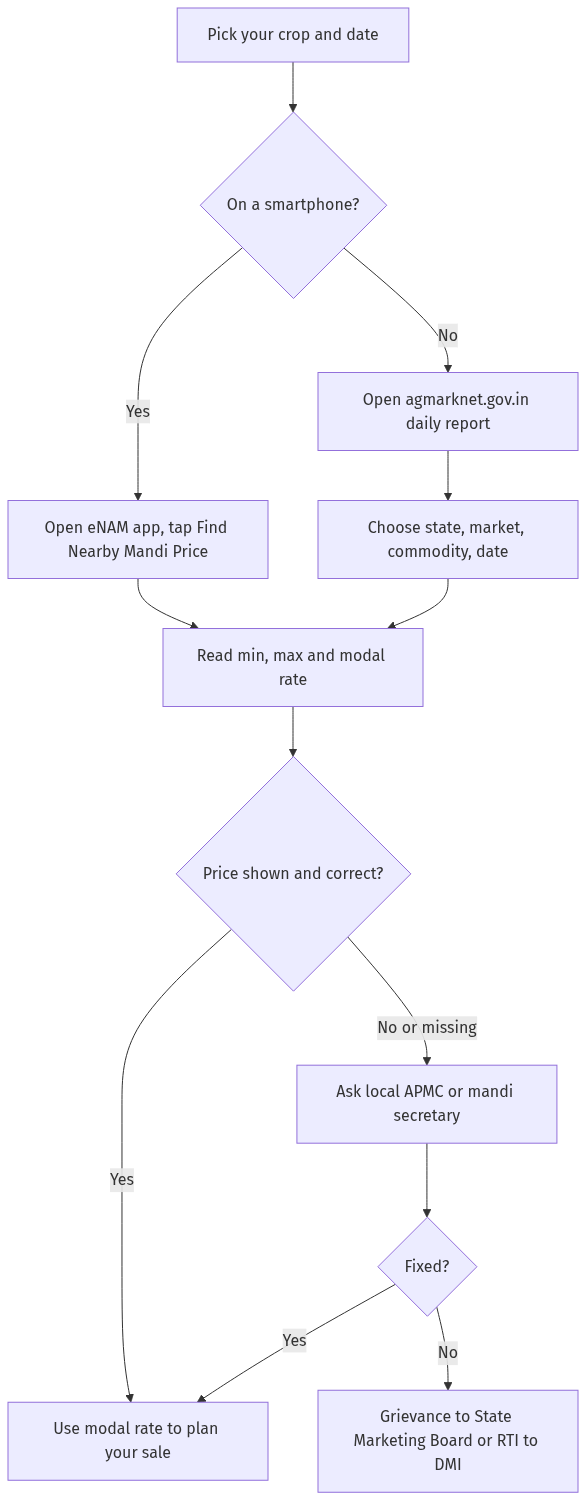
Figure: step-by-step flow. If a step stalls, use the grievance or RTI route shown.
If the price is missing, stale or clearly wrong
Cheat-sheet: who to ask, in order
- Wrong or missing rate for a real trade: ask your local APMC / mandi secretary. The mandi records the day's rate, so corrections start there.
- Whole portal is blank or broken: the Directorate of Marketing and Inspection (DMI) runs Agmarknet; eNAM has a helpdesk listed on enam.gov.in.
- No useful reply: file an RTI with the State Agricultural Marketing Board or DMI public information officer, asking for the recorded arrivals and rates for your crop, market and date.
An RTI is the cleanest way to get the official figure on record when a portal and an officer disagree. Keep your crop name, mandi name and date ready, because the answer is only as good as those three details.
Cheat-sheet: before you load the truck
- Confirm today's modal rate for your crop and your variety in your target mandi.
- Compare it with one nearby mandi to make sure you are not selling low.
- Note the arrival trend: heavy arrivals often soften rates, so an early sale can help.
- Carry your Farmer ID and records so weighment and payment go through cleanly.
- Screenshot the rate with its date, so you have proof if the mandi quotes you less.
Use the price, do not stop at it
A good modal rate is one input. Pair it with a fresh weather and crop advisory so you sell at the right moment, and keep your Farmer ID on Agristack ready so your records line up across schemes. If a sale needs working capital first, check your crop loan and interest subvention options before you commit.
Frequently asked questions
What is the modal price in a mandi rate?
The modal price is the most frequently quoted, prevailing wholesale rate for that crop in that market on that day. It sits between the minimum and maximum and is the figure most farmers use to judge a fair price, because one stray high or low lot will not distort it.
Is Agmarknet free, and do I need to register?
Yes, Agmarknet (agmarknet.gov.in) is a free government portal and you do not need to register or log in just to look up prices. The same applies to viewing prices on the eNAM app. Registration on eNAM is only needed if you want to trade or sell online.
Why does today's price not show yet?
Mandis report rates after the day's trading closes, so the latest data is often from the previous working day. If today is blank, set the date back by a day. Holidays and Sundays may also have no fresh entry for a given market.
Are mandi prices per kilogram or per quintal?
Wholesale mandi rates are usually quoted per quintal, which is 100 kg, unless the screen states a different unit. Always read the unit on the report before you compare, so you do not confuse a per-quintal rate with a per-kg one.
Which app is best for checking prices on a phone?
For quick lookups, the eNAM app with its Find Nearby Mandi Price feature is the most direct, since it sorts mandis around you. Kisan Suvidha is handy if you also want weather and advisory in one place. Both draw on the same official Agmarknet data.
The rate shown is wrong. What can I do?
First ask the local APMC or mandi secretary, since the mandi records the rate. If that does not fix it, raise it with the State Agricultural Marketing Board or DMI, and if you still get no answer, file an RTI asking for the recorded arrivals and rates for your crop, market and date.
Can I see prices for many states at once?
Yes. Agmarknet lets you pick multiple states and markets in its daily report, so you can compare the same crop across regions. The eNAM dashboard also gives a national view. Comparing markets helps you spot where your produce will fetch a better modal rate.