Table of Contents
Farm Pond / Micro-Irrigation Subsidy 2026
Reviewed on 2026-06-20 by Dr. Shrawan Kumar Pathak.
Quick Reply: Under Per Drop More Crop (PMKSY) you get 55% subsidy on drip or sprinkler kit if you are a small or marginal farmer, and 45% if you hold more land, capped at 5 hectare per beneficiary. You apply through your State Agriculture Department and the money comes by DBT.
Most farmers ask one question first: how much will the government actually pay for my drip line, sprinkler or farm pond? The honest answer is that it depends on you, not on the kit. So instead of a wall of rules, answer the short quiz below. Each question moves you toward your exact slab and your next step.
Question 1: are you a small or marginal farmer?
This is the single biggest factor, because it sets your subsidy rate.
- If you cultivate up to 2 hectare, you are a small farmer, and a marginal farmer if it is up to 1 hectare. You fall in the 55% slab for drip and sprinkler systems.
- If you cultivate more than 2 hectare, you are an “other” farmer and fall in the 45% slab.
Either way, the subsidy is paid by the Central and State Governments together, and your own share is the rest of the unit cost. Tip: a soil health card is worth getting first, as it tells you which crops and spacing suit your plot before you size the system.
Question 2: how much land do you want to cover?
The subsidy is generous, but it is not unlimited.
- Subsidy is limited to an overall ceiling of 5 hectare per beneficiary. Cover more land if you wish, but the slab applies only to the first 5 hectare of system.
- In the North Eastern and Himalayan states the approved unit cost is taken 25% higher, and 15% higher in some other states, so the rupee subsidy on the same area is larger there. Your nodal office will quote the exact unit cost for your district.
If you are unsure which crops will repay the investment fastest, plan around water-thrifty, high-value crops first, then expand.
Question 3: is your paperwork DBT-ready?
Per Drop More Crop pays straight into your account, so two things must be in order before you apply.
- The scheme runs through Direct Benefit Transfer (DBT), and Aadhaar is required. If you do not yet have Aadhaar, you can still start on the strength of an Aadhaar enrolment slip and identity proof while your number is issued.
- Your Aadhaar should be linked to the bank account where you want the subsidy. Registering your Farmer ID also smooths verification across the new farmer registries. See our guide to the Farmer ID and Agristack registry.
If you need to fund your own share of the cost, a crop loan can help. Read how the crop loan and interest subvention works before you borrow.
Score yourself
- Small or marginal + Aadhaar-linked account ready: you qualify for the 55% slab. Go straight to Question 4.
- Larger holding + account ready: you qualify for the 45% slab. Go to Question 4.
- Account or Aadhaar not ready: fix that first, then apply. Nothing else can move until DBT details are seeded.
Question 4: how do you actually apply?
There is no single all-India “apply” button, because micro-irrigation is delivered by your state. The route is the same everywhere though.
- Visit or contact your State Agriculture Department (some states route it through the Horticulture Department or a dedicated micro-irrigation agency). This is the nodal department named under the scheme.
- Register on the state micro-irrigation or PMKSY portal and submit land records, Aadhaar, bank details and a photograph.
- An empanelled manufacturer or supplier surveys your field, fixes the design and unit cost, then installs and commissions the system.
- After verification, your subsidy share is released by DBT; the supplier also owes you free after-sales service for a fixed period.
Keep the work order, the bill and the commissioning report. These are your proof if the subsidy is delayed.
What about a farm pond?
A lined or unlined farm pond is funded differently from drip and sprinkler kit, and the numbers are set by your state, not nationally. So treat any single rupee figure you read online with caution.
- Farm ponds are commonly built under state agriculture schemes, the Watershed Development Component of PMKSY, MGNREGS works, or state plan funds. The beneficiary contribution, pond size and per-district targets differ from state to state.
- Find your own rule on your State Agriculture or Horticulture Department portal, or ask the block agriculture officer. Do not assume one state's pond subsidy applies to you. Verify the current unit cost and your share on your state portal before you start digging.
A dedicated Micro Irrigation Fund with NABARD also lets states add a top-up over the central subsidy in some years, which is why two neighbours can see slightly different rates. Verify the current top-up, if any, on pmksy.gov.in or with your nodal office.
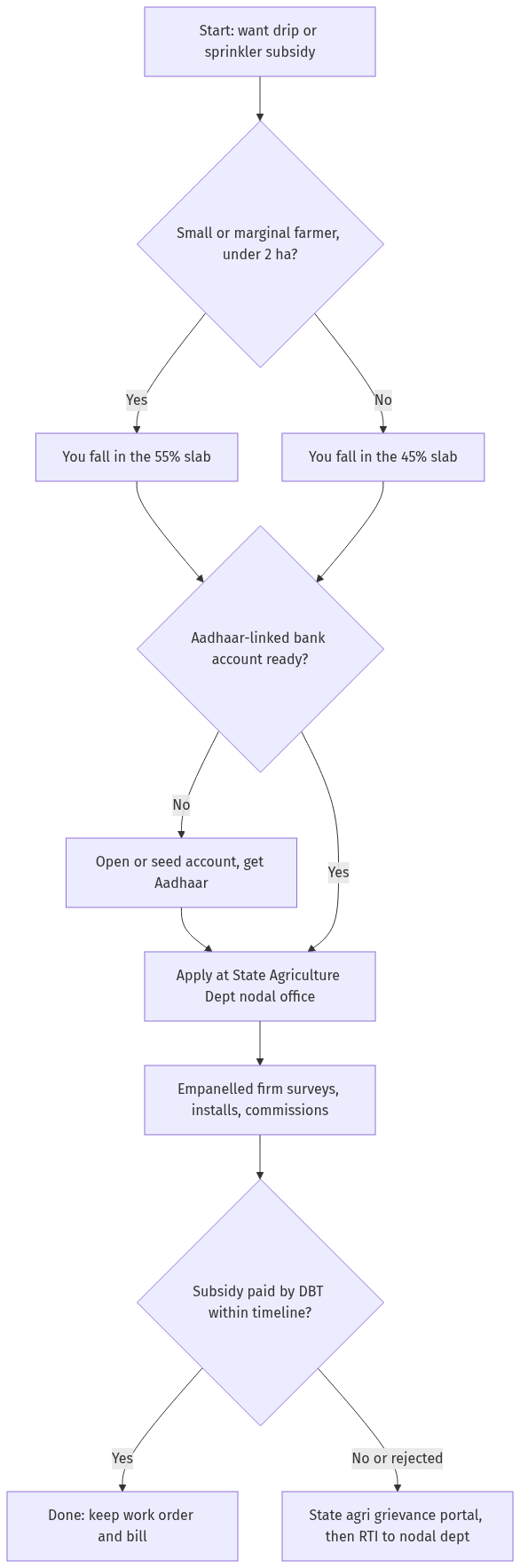
Figure: step-by-step flow. If a step stalls, use the grievance or RTI route shown.
Frequently asked questions
Am I a small farmer or an other farmer?
If you cultivate up to 2 hectare you are a small farmer (up to 1 hectare is marginal), which puts you in the 55% drip and sprinkler slab. Above 2 hectare you are an other farmer in the 45% slab. Your land record decides this, so keep it updated.
Does the 5 hectare ceiling stop me covering my whole farm?
No. You can irrigate as much land as you like, but the subsidy slab applies only up to 5 hectare per beneficiary. Beyond that you pay the full cost yourself for the extra area.
Will I get more subsidy in a hill state?
The rate stays 55% or 45%, but the approved unit cost is taken 25% higher in North Eastern and Himalayan states and 15% higher in some others, so the rupee amount on the same area is larger. Your nodal office quotes the exact figure.
Is Aadhaar compulsory?
Yes. Per Drop More Crop pays by Direct Benefit Transfer, so Aadhaar is required and should be linked to your bank account. If you do not yet have a number, you can begin on an Aadhaar enrolment slip with identity proof while it is issued.
Can I buy the system myself and claim later?
Usually no. Most states route the installation through an empanelled supplier who designs, installs and commissions the system, after which the subsidy is released. Always apply through the nodal department first, before you order any kit.
How do I get a farm pond subsidy?
Farm ponds are funded by state schemes, the Watershed Development Component of PMKSY, MGNREGS or state plan funds, and the share and pond size vary by state. Check your State Agriculture or Horticulture Department portal, or ask your block agriculture officer, for the rule that applies to you.
My subsidy is stuck or rejected. What can I do?
First raise it on your state agriculture grievance portal or the public grievance system, attaching your work order and commissioning report. If there is still no reply, file an RTI with the nodal department asking the status of your file and the reason for any delay. After good yields, you can also sell better on eNAM.
Sources
Irrigation subsidy and water tax: How to check eligibility, apply, and file RTI?
Irrigation subsidies and water tax exemptions are available for farmers. Here is the complete guide:
- Step 1: What is irrigation subsidy? (a) irrigation subsidy is a government benefit that reduces the cost of irrigation for farmers (the government pays part of the irrigation charges — the farmer pays a reduced rate), (b) it applies to: (i) canal irrigation (the farmer uses water from government canals — the government subsidises the water charge), (ii) drip irrigation (the government subsidises the cost of drip irrigation systems — typically 50-90% of the cost), (iii) sprinkler irrigation (similar to drip — the government subsidises the cost), © the subsidy is provided by the state government (each state has its own scheme — the eligibility and amount vary).
- Step 2: Water tax and charges. (a) water tax is levied by the state irrigation department (for canal irrigation — the tax is based on the area irrigated and the crop type), (b) the water tax rates vary by state (typically Rs 100-500 per acre per season — for canal irrigation), © some states waive water tax for: (i) small and marginal farmers (less than 2 hectares), (ii) drought-affected areas (the state government notifies drought-affected districts — water tax is waived), (iii) specific crops (some states waive water tax for food crops — to promote food security).
- Step 3: How to apply for subsidy. (a) visit the state agriculture department website (or the e-District portal — for online application), (b) submit the application with: (i) land records (patta, 7/12 extract, katha), (ii) Aadhaar card, (iii) bank account details (for DBT — the subsidy is transferred directly to the farmer's bank account), (iv) quotation for drip/sprinkler system (if applying for micro-irrigation subsidy), © the agriculture department verifies the application (and inspects the land — for micro-irrigation), (d) the subsidy is sanctioned and transferred to the farmer's bank account (typically 30-90 days).
- Step 4: Common issues. (a) the application is pending for months (the agriculture department delays verification — file RTI for status), (b) the subsidy amount is less than expected (the department may have applied a different rate — check the sanction order), © the subsidy is sanctioned but not received (the bank account details may be incorrect — or the DBT is delayed), (d) the farmer is not aware of the subsidy (many farmers do not know about the subsidy — the department is supposed to publicise it).
- Step 5: File RTI. File RTI with the state Irrigation/Agriculture Department asking for: (a) the status of irrigation subsidy application number [number] (farmer name: [name], village: [name]), (b) the eligibility criteria for irrigation subsidy (and whether the applicant meets them), © the subsidy amount sanctioned (if sanctioned — provide the sanction order number and date), (d) whether the subsidy has been disbursed (if yes: provide the transaction reference number and date), (e) the water tax waiver status for [district] (is the district notified as drought-affected — if yes, from which date).
- Step 6: Drought declaration. (a) the state government declares drought-affected districts (based on the drought assessment — which considers rainfall deficit, crop condition, and moisture index), (b) the drought declaration triggers: (i) water tax waiver, (ii) crop loan restructuring, (iii) additional subsidy for irrigation, © file RTI asking for: (i) the drought assessment report for [district] for [year], (ii) whether [district] has been declared drought-affected, (iii) if not: the reasons for not declaring (the assessment data should support or refute the decision).
- Step 7: Escalation. (a) file a complaint with the District Agriculture Officer (for subsidy delays), (b) file a complaint with the state Agriculture Minister (the minister can direct the department to act), © file a writ petition in the High Court (if the subsidy is unreasonably delayed — the court can order the department to disburse within a timeframe), (d) approach the farmers' grievance committee (each district has a farmers' grievance committee — headed by the District Collector).
See Crop Loan Subvention and Find PIO.