Table of Contents
Crop Loan and Interest Subvention 2026
RBI Ombudsman as of 1 July 2026: Bank, certain NBFC, prepaid-instrument and credit-information complaints go under the Reserve Bank - Integrated Ombudsman Scheme, 2026, which replaced RB-IOS 2021 from 1 July 2026. First complain to the entity. If there is no reply in 30 days (or the longer NPCI/card-network window, if it applies) or you reject the reply, file free at cms.rbi.org.in within 90 days. The Ombudsman can award up to Rs 30 lakh for consequential loss and up to Rs 3 lakh for time, expenses and harassment. Complaints received before 1 July 2026 stay under the 2021 scheme. Source: RBI FAQ, updated 1 July 2026 and the RB-IOS 2026 FAQ PDF dated 1 July 2026.

Reviewed on 2026-06-20 by Dr. Shrawan Kumar Pathak.
Quick Reply: A Kisan Credit Card crop loan up to Rs 3 lakh is priced at 7 percent a year. Under the Modified Interest Subvention Scheme (MISS), if you repay on time you get a 3 percent incentive, so your real rate drops to 4 percent. You apply through your bank, not a separate office.
Treat it like a price tag, not a favour
Most farmers hear “subsidy” and picture a form, an officer and a long wait. The interest subvention is nothing like that. It is a built-in discount on the price of your crop loan. Your job is simply to know the right price and check that your bank is charging it.
So let us do the sum the way you would at a shop counter. You borrow money for the kharif or rabi season on your Kisan Credit Card (KCC). The bank's sticker price for that money, up to Rs 3 lakh, is 7 percent a year. The Government quietly pays part of that price to your bank for you. Pay your dues on time and a second discount lands on top. What you actually carry is 4 percent.
The rate maths in plain rupees
Here is the cost on a one-year crop loan, so you can spot if you are being overcharged.
If you borrow Rs 1,00,000
- At 7 percent the interest for the year is Rs 7,000.
- Repay on time and the 3 percent prompt repayment incentive (PRI) takes Rs 3,000 off.
- Your net interest is Rs 4,000, that is 4 percent.
If you borrow Rs 3,00,000 (the full concessional limit)
- At 7 percent the year's interest is Rs 21,000.
- The 3 percent incentive for timely repayment is Rs 9,000.
- You actually pay Rs 12,000, again 4 percent.
The discount is not loose cash handed to you. The 1.5 percent interest subvention goes from the Government to your bank, and the 3 percent incentive is adjusted in your loan account when you repay on schedule. You never file a separate claim for it.
The Rs 3 lakh to Rs 5 lakh slab works differently
From 1 April 2025 the loan limit under the scheme was raised from Rs 3 lakh to Rs 5 lakh. But the flat 7 percent and the 4 percent net rate apply to the slice up to Rs 3 lakh. On the amount above Rs 3 lakh and up to Rs 5 lakh, your bank charges its own benchmark lending rate, capped at 10 percent. So do not assume the whole Rs 5 lakh is at 4 percent. Ask your branch to show you the rate on each slab in writing and verify the current figure on your bank's KCC sheet.
Who can buy this rate
The concession rides on the Kisan Credit Card, so the eligibility is really KCC eligibility:
- Owner-cultivators, tenant farmers, oral lessees and sharecroppers.
- Self-help groups or joint liability groups of farmers.
- Farmers in allied lines, animal husbandry, dairy and fisheries, get the interest benefit on a loan up to Rs 2 lakh when there is no crop loan.
If you are already a PM-KISAN beneficiary, the simplified one-page KCC form makes the card quicker to get. Your land record, Aadhaar and a passport photo are the usual papers.
How to apply, step by step
Step 1: Pick your lender
KCC is issued by commercial banks, regional rural banks and cooperative banks. Go to the branch where you already hold an account, or apply online through that bank's KCC page.
Step 2: Fill the KCC form
Use the short PM-KISAN linked form if you qualify. Attach proof of land or cultivation, identity and your bank passbook.
Step 3: Get the limit sanctioned
The bank fixes your credit limit on a scale of finance for your crop and acreage. The card lets you draw and repay through the season.
Step 4: Draw and, above all, repay on time
The 3 percent incentive is the part you control. Clear the dues by the due date in your sanction letter. Miss it and you lose the incentive and pay the full 7 percent for that year.
Step 5: Renew every year
A KCC limit is reviewed yearly. Renew it so the concessional rate keeps flowing for the next season.
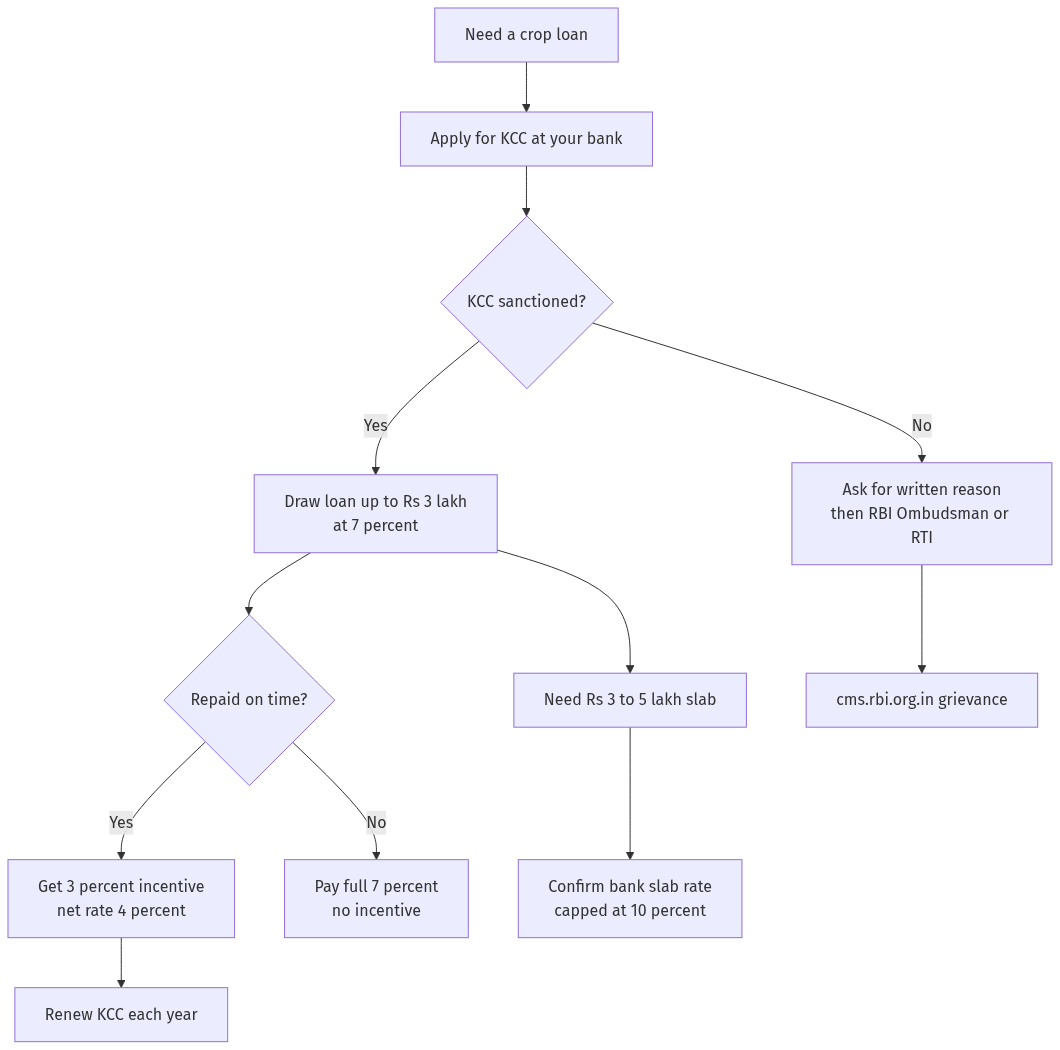
Figure: step-by-step flow. If a step stalls, use the grievance or RTI route shown.
If the rate is wrong or the card is refused
The most common complaint is a bank charging more than 7 percent on the eligible amount, or quietly dropping the 3 percent incentive after on-time repayment. Do not just argue at the counter.
- Ask the branch, in writing, for the rate applied and the reason for any refusal.
- File a complaint with the bank's grievance cell and note the ticket number.
- If there is no fair reply in 30 days, escalate to the RBI Ombudsman at cms.rbi.org.in under the Integrated Ombudsman Scheme.
- For scheme records, a public-sector bank is a public authority, so you can file an RTI to it, or to the Department of Agriculture and Farmers Welfare, for the subvention rules applied to your account.
Keeping your land and farmer records clean makes every step easier. It helps to register on the Farmer ID and Agristack registry and to hold a current Soil Health Card, both of which banks increasingly check at KCC renewal.
Frequently asked questions
Is the crop loan rate really 7 percent or 4 percent?
The bank lends at 7 percent on the amount up to Rs 3 lakh. You only reach the 4 percent net rate by repaying on time, which earns the 3 percent prompt repayment incentive. Default on the date and you stay at 7 percent for that year.
Do I have to apply separately for the subvention?
No. There is no separate subvention form. The 1.5 percent goes from the Government to your bank and the 3 percent incentive is adjusted in your KCC account when you repay on schedule. The concession is built into the card.
Is the whole Rs 5 lakh limit at 4 percent?
No. The 4 percent net rate applies to the slice up to Rs 3 lakh. On the part above Rs 3 lakh up to Rs 5 lakh, your bank uses its own benchmark rate, capped at 10 percent. Verify each slab's rate on your bank's KCC sheet.
What rate applies to animal husbandry or fisheries loans?
If you take a KCC purely for animal husbandry, dairy or fisheries and have no crop loan, the interest benefit applies on the loan up to Rs 2 lakh. See our Animal Husbandry KCC guide for that route.
Can a tenant farmer or sharecropper get this rate?
Yes. Tenant farmers, oral lessees, sharecroppers and members of joint liability or self-help groups can hold a KCC and get the concessional rate, subject to your bank's documentation for cultivation.
My bank charged more than 7 percent. What do I do?
Get the applied rate in writing, raise it with the bank's grievance cell, and if it is not fixed within 30 days, complain to the RBI Ombudsman at cms.rbi.org.in. You can also file an RTI to the bank for the rate records on your account.
Where do I check today's mandi rate before I repay?
Plan your sale and repayment together. Check live rates on our mandi price guide so you sell at a fair rate and clear your KCC dues before the due date.
Sources
Crop loan subvention: Interest subvention scheme eligibility and how to claim?
The Interest Subvention Scheme provides concessional crop loans to farmers. Here is the complete 2026 guide:
- Step 1: What is crop loan subvention? (a) the Government of India provides interest subvention of 1.5% to banks for short-term crop loans up to Rs 3 lakh, (b) the effective interest rate for farmers is 7% (the bank lends at 9% and the government subvents 2%), © for prompt paying farmers: an additional 3% subvention is given (the effective rate is 4%), (d) the scheme is administered by the Department of Agriculture, Cooperation and Farmers Welfare (DAC&FW).
- Step 2: Eligibility. (a) the farmer must be a genuine cultivator (owner-cultivator, tenant farmer, or sharecropper), (b) the loan must be a short-term crop loan (up to 12 months), © the loan amount must be up to Rs 3 lakh (loans above Rs 3 lakh are not eligible), (d) the loan must be from a scheduled commercial bank, RRB, or cooperative bank, (e) the farmer must have a Kisan Credit Card (KCC) or a crop loan account.
- Step 3: How it works. (a) the farmer applies for a crop loan at the bank (with land documents, Aadhaar, and KCC), (b) the bank disburses the loan at 9% interest, © the government subvents 2% to the bank (the bank adjusts the interest rate to 7% for the farmer), (d) if the farmer repays on time (within the due date): the government subvents an additional 3% (the effective rate is 4%), (e) the subvention is credited to the farmer's loan account (the farmer pays only 4%).
- Step 4: KCC application. (a) apply at the bank (with land documents — patta/katha, Aadhaar, and passport photo), (b) the bank verifies the land records and approves the KCC, © the KCC limit is based on the crop pattern and area (typically Rs 30,000-50,000 per acre), (d) the farmer can withdraw from the KCC account as needed (within the limit).
- Step 5: Common issues. (a) the bank does not pass on the subvention (the bank charges 9% instead of 7% — the farmer must complain to the bank's Nodal Officer), (b) the additional 3% is not credited (the bank claims the farmer did not pay on time — the farmer must verify the due date), © the KCC limit is too low (the farmer can request a reassessment based on crop pattern), (d) tenant farmers are denied (the bank asks for land ownership — the farmer can apply with a lease agreement).
- Step 6: How to claim. (a) check your loan account statement (the interest rate should show 7% or 4% — not 9%), (b) if the subvention is not passed on: file a complaint with the bank's Nodal Officer, © if the bank does not resolve: file a complaint with the District Lead Bank Manager, (d) if still not resolved: file a complaint with the DAC&FW (agricoop.nic.in).
- Step 7: File RTI. File RTI with the Department of Agriculture asking for: (a) the subvention amount credited to your loan account, (b) the interest rate applied to your loan, © the status of your KCC application, (d) the reason for denial of subvention (if applicable).
See Crop Loan Subvention and Find PIO.