Table of Contents
Pradhan Mantri Fasal Bima Yojana (PMFBY): a farmer's day, from sowing to claim (2026)
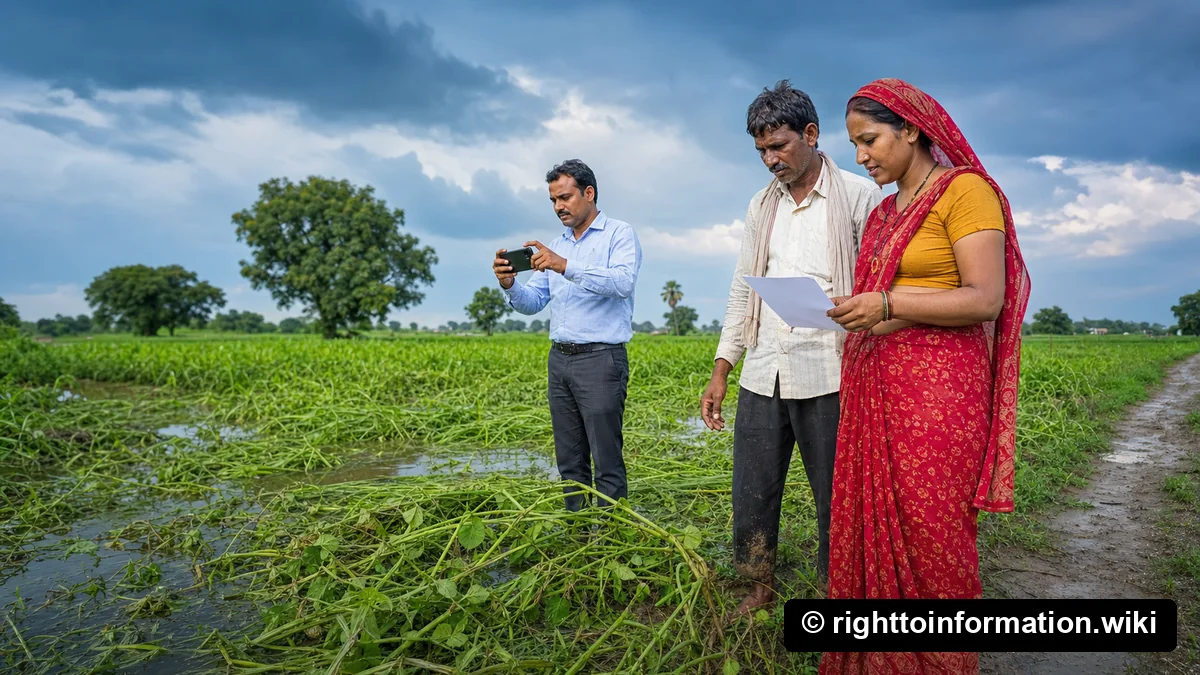
Quick Reply: Complete PMFBY guide 2026: check policy status, file crop loss claims step by step, state-wise coverage table, premium subsidy rates, claim disbursement timelines, RTI escalation for delayed claims, and expanded…
By Dr. Shrawan Kumar Pathak
It is the third week of June. A smallholder farmer in a notified village walks his two acres before the monsoon breaks. He has bought seed and urea on credit against his Kisan Credit Card, and the whole season now rests on rain that may come late or too hard. One bad hailstorm in October and the loan still has to be repaid. This is the risk that Pradhan Mantri Fasal Bima Yojana was built to carry. Follow this farmer through one full season and you will understand the scheme better than any list of rules can teach.
PMFBY pays for crop loss from prevented sowing, mid season adversity, localised calamity and post harvest damage. The farmer pays only 2 percent of the sum insured for kharif crops, 1.5 percent for rabi crops and 5 percent for commercial or horticultural crops. The Union and State governments pay the rest.
Launched: 2016 · Issued by: Ministry of Agriculture and Farmers Welfare · Official portal: pmfby.gov.in · Helpline: 14447
How to check PMFBY status by policy or application number
After enrolment, every farmer receives an application or policy number. This number is the single most important reference for tracking crop insurance status throughout the season. You can check your PMFBY enrolment and policy status in several ways:
- PMFBY portal: Visit pmfby.gov.in and use the “Farmer Information” or “Status Check” feature. Enter your application number, mobile number, or Aadhaar number to retrieve your policy details.
- Crop Insurance mobile app: Download the official Crop Insurance app from the Google Play Store. Log in with your mobile number and view your enrolled policies, sum insured, premium paid and current status.
- Bank branch: If you enrolled through your bank against your Kisan Credit Card crop loan, visit the branch and ask for the policy and application number in writing. The bank is required to provide this.
- Common Service Centre (CSC): The village CSC operator can look up your enrolment using your Aadhaar or mobile number.
Quick tip: If you enrolled through a bank, the premium is debited from your account but the policy may take up to 2 to 3 weeks to appear on the portal. If it does not show after 3 weeks, raise the issue with the bank in writing and keep a copy.
Status meanings you may encounter:
| Status you may see | What it means | What to do |
|---|---|---|
| Enrolled / Active | Your policy is in force for the current season | Keep the application number safe for claims |
| Pending | Application submitted but verification incomplete | Contact your bank or CSC; check if documents are missing |
| Premium Debited | Premium has been deducted but policy not yet generated | Wait 2 to 3 weeks; if still pending, contact the bank |
| Not Found | No enrolment record matches your details | Verify your application number, mobile number or Aadhaar |
| Rejected | Enrolment was refused, often because the crop or area is not notified | Check the notified crop list for your district |
How to check PMFBY claim status and disbursement timeline
Once you have reported a crop loss and the assessment is complete, the claim enters a processing pipeline. Understanding the timeline helps you know when to follow up and when to escalate.
Typical claim disbursement timeline:
| Stage | Expected time from loss report | What happens |
|---|---|---|
| Loss intimation | Day 0 (within 72 hours) | You report the loss and get a docket number |
| Field survey | 7 to 14 days | Insurance company surveyor visits with agriculture dept staff |
| Assessment calculation | 2 to 4 weeks after survey | Yield data compared to threshold; claim amount computed |
| Claim approval | 4 to 8 weeks after survey | Approved by the insurance company and government |
| Disbursement to account | 15 to 30 days after approval | Claim paid via DBT into Aadhaar-linked bank account |
The overall timeline from reporting a loss to receiving money is typically 2 to 3 months for localised calamity claims and can extend to 3 to 6 months for widespread yield-based claims because these depend on final crop cutting experiment results for the entire area.
How to check your claim status:
- Log in to pmfby.gov.in and look up your policy. The claim status will show as Pending, Approved, or Disbursed.
- Call the toll-free helpline at 14447 or 1800-200-3476 with your application number ready.
- Visit your bank branch and ask them to check whether the claim amount has been credited to your account.
- If your bank account is linked to e-Shram, also verify the DBT status on the e-Shram portal.
Important: For the 2024-25 and 2025-26 seasons, the government has emphasised mandatory claim payment within prescribed timelines. For localised calamities and post-harvest losses, the target is payment within 21 days of claim approval. If your approved claim has not been credited within 30 days, you should escalate immediately.
How to file a PMFBY crop loss claim step by step
This section is the most practical part of this guide. Follow every step and keep documentation for each one.
Step 1: Report within 72 hours
For a localised calamity (hailstorm, landslide, inundation, cloudburst, natural fire from lightning) or a post-harvest loss, you must report within 72 hours of the event. Missing this window is the single biggest reason claims are weakened.
- Call 14447 (the national crop insurance helpline)
- Use the Crop Insurance app to file online
- Inform your bank or insurance company in writing
- Record the docket or complaint number immediately — this is your proof of timely reporting
Step 2: Provide loss details
When you report, have this information ready:
- Your application number or policy number
- The survey number of the affected field
- The crop name and variety
- The approximate area damaged (in acres or hectares)
- The date and type of the calamity (hail, flood, drought, etc.)
Step 3: Allow the surveyor to assess
The insurance company dispatches a surveyor to inspect the field, usually accompanied by state agriculture department staff. The surveyor takes photographs, measures the damage and records observations.
- Take your own dated photographs of the damaged crop from multiple angles
- Be present during the survey to point out affected areas
- Ask for a copy of the survey report or at least the surveyor's name and contact
Step 4: Await calculation
For localised calamities, the claim is calculated based on the percentage of damage assessed. For widespread yield loss, the calculation depends on the actual yield of your area versus the threshold yield (the benchmark for normal production). The lower the season's yield falls below the threshold, the higher the payout.
Step 5: Receive payment
An approved claim is paid directly into your Aadhaar-linked bank account through Direct Benefit Transfer (DBT). There is no cash and no middleman. If the payout fails because your account is not seeded with Aadhaar, fix the linking immediately at your bank branch — see our Aadhaar update status guide for help.
PMFBY beneficiary list and enrollment verification
Many farmers want to verify whether their name appears on the official PMFBY beneficiary list, especially if the premium was debited by the bank and no policy document was received. Here is how to confirm your enrollment:
- Search by farmer name: On pmfby.gov.in, navigate to the “Farmer Search” section. Enter your state, district, crop season and farmer name to find your record.
- Search by application number: If you have your application number from the bank or CSC receipt, enter it directly.
- Search by mobile number: The Crop Insurance app lets you log in with your registered mobile number and OTP to see all policies linked to that number.
- State-specific portals: Several states including Andhra Pradesh (Anna Data Sukhibhava) and Karnataka (Anna Bhagya) have their own beneficiary search portals linked to PMFBY.
If your premium was debited but your name does not appear on the beneficiary list: This is the most common dispute. File a written complaint with the bank branch manager with the premium debit receipt and your application number. If unresolved within 15 days, escalate to the insurance company's grievance officer, then to the District Agriculture Officer.
PMFBY vs other crop insurance schemes: which one covers you?
India has multiple crop and farmer insurance schemes. Understanding the differences helps farmers choose the right protection.
| Feature | PMFBY (Fasal Bima Yojana) | Modified NAIS (mNAIS) | Weather Based Crop Insurance (WBCIS) | Restructured Weather-Based Crop Insurance |
|---|---|---|---|---|
| What triggers payout? | Actual yield below threshold; localised calamity | Area-based yield shortfall | Weather parameters (rainfall, temp) breached | Weather parameters at mandal/block level |
| Farmer premium (kharif) | 2% of sum insured | Actuarial, subsidised | Varies by crop | Subsidised actuarial rate |
| Coverage unit | Village/village panchayat | Area (district/block) | Reference weather station | Reference weather station |
| On-account payment? | Yes, for mid-season adversity | No | No | No |
| Individual farm damage? | Yes, for localised perils | No | No | No |
| Technology backbone | YES-TECH + WINDS | Manual CCEs | Automatic weather stations | Automatic weather stations |
Key takeaway: PMFBY is the most comprehensive scheme because it covers both area-based yield loss and individual farm-level damage from localised calamities. If you are a loanee farmer with a Kisan Credit Card, PMFBY is the default recommended cover since 2016, though enrollment is now voluntary.
For broader life and accident insurance, also consider PMSBY and PMJJBY insurance schemes which cover death and disability at very low premiums.
PMFBY state-wise coverage and crop data
PMFBY operates across India, but coverage varies significantly by state. The following table shows approximate enrollment and coverage data for major agricultural states. Figures are indicative based on publicly available government data for recent seasons and may change each crop season.
| State | Approx. farmer applications (per season) | Key crops covered | Notable state feature |
|---|---|---|---|
| Uttar Pradesh | 70+ lakh | Paddy, wheat, sugarcane, mustard | Largest enrollment; mandatory for loanee farmers |
| Maharashtra | 50+ lakh | Soybean, cotton, jowar, tur | High weather-based claims; cyclone-prone coastal districts |
| Madhya Pradesh | 45+ lakh | Soybean, wheat, gram, mustard | Strong CSC enrollment network |
| Rajasthan | 35+ lakh | Bajra, mustard, wheat, gram | Drought-prone; prevented-sowing claims common |
| Karnataka | 30+ lakh | Paddy, maize, groundnut, tur | State co-insurance model; see Anna Bhagya |
| Andhra Pradesh | 25+ lakh | Paddy, groundnut, cotton | Linked to Anna Data Sukhibhava |
| Telangana | 20+ lakh | Paddy, cotton, maize | Integrated with Rythu Bharosa |
| Gujarat | 20+ lakh | Groundnut, cotton, castor, wheat | High horticulture coverage |
| Bihar | 20+ lakh | Paddy, wheat, maize | State Govt pays farmer's share in some schemes |
| Tamil Nadu | 18+ lakh | Paddy, groundnut, sugarcane | Delta crop focus; flood-prone |
Note: These are approximate, indicative figures compiled from Ministry of Agriculture reports and PMFBY portal data. For exact, current-season enrollment for your state, visit pmfby.gov.in and use the State Dashboard. Personal claim status must always be checked on the portal.
Each state notifies its own list of crops and areas for each season. Before sowing, check whether your crop and village are notified. Only a notified crop in a notified area can be insured under PMFBY.
PMFBY premium subsidy and bank loan linkage
One of the most important features of PMFBY is the subsidised premium structure. The farmer pays a fixed, capped share while the Central and State governments pay the much larger balance of the actuarial premium.
Farmer premium rates (uniform across India):
| Crop type | Farmer's share of sum insured |
|---|---|
| Kharif food and oilseed crops | 2% |
| Rabi food and oilseed crops | 1.5% |
| Commercial and horticultural crops | 5% |
For example, if the sum insured for paddy (kharif) is Rs 40,000 per acre, the farmer pays only Rs 800 per acre. If the actuarial premium is Rs 2,500, the remaining Rs 1,700 is split equally between the Central and State governments.
Bank loan linkage explained:
PMFBY is closely tied to the crop loan and interest subvention system. When a farmer takes a crop loan against their Kisan Credit Card, the bank branch is the primary enrollment channel:
- The bank collects the farmer's 2% (or 1.5% / 5%) premium and debits it from the loan account
- The bank enrolls the farmer with the empanelled insurance company for that district
- Since 2020, enrollment is voluntary even for loanee farmers — the bank cannot auto-debit without consent
- If a claim is approved, it is credited directly to the farmer's account, not adjusted against the loan
Important: If your crop loan is restructured or waived under a state loan waiver scheme, your PMFBY policy remains valid for that season — the insurance was already purchased and paid for.
How to file an RTI for a delayed or denied PMFBY claim
When a call to the 14447 helpline or the bank leads nowhere, a written Right to Information (RTI) request is often the most effective way to move a stuck PMFBY file. Insurance companies acting for public authorities, and District Agriculture Officers, are covered under the RTI Act and must respond within 30 days.
When to file an RTI:
- Your claim was approved but not credited to your account for more than 30 days
- Your loss was reported within 72 hours but no survey was conducted
- The claim amount looks far lower than your assessment and the calculation was not shared
- Your enrollment receipt exists but your name is missing from the beneficiary list
- The bank debited premium but no policy was generated
Where to file:
- District Agriculture Officer / District Agriculture Department (for enrollment and notification issues)
- The insurance company's Public Information Officer (for claim assessment and disbursement)
- State Agriculture Department at the Secretariat level for state-wide issues
Draft RTI application for PMFBY claim delay:
To the Public Information Officer,
[Insurance Company Name / District Agriculture Office],
[Address]

Subject: Request for information under Section 6(1) of the RTI Act, 2005
regarding PMFBY Policy No. [your application number]

1. Please provide the current status of my PMFBY enrollment /
   claim bearing application number [number].
2. Please provide the date on which my loss intimation was
   received and the docket number assigned.
3. Please provide the date of field survey, the name of the
   surveyor, and a copy of the survey report.
4. Please provide the threshold yield used for my crop in my
   district and the actual yield assessed.
5. Please provide the detailed calculation of the claim amount
   approved or rejected.
6. If the claim is approved, please provide the expected date
   of disbursement and the reason for delay beyond [number] days.
7. If the claim is rejected, please provide the specific
   grounds for rejection in writing.

I am enclosing Rs. 10 as the application fee. Kindly provide
the information within 30 days as per Section 7(1) of the
RTI Act, 2005.

[Your name, address, and contact number]
Draft it instantly: Use our AI RTI Drafter or read the step-by-step RTI filing guide to submit online.
If the PIO does not respond within 30 days or the reply is unsatisfactory, file a First Appeal under Section 19(1) within 30 days of the expiry. See our RTI First Appeal guide for the full process and templates. State-level RTI fees vary — check our RTI fees by state guide for your state.
The bad night: reporting a loss within 72 hours
In the second week of October, a sudden hailstorm hits at night and beats down half his paddy days before harvest. This is the moment the whole scheme turns on, and speed decides everything.
- Report within 72 hours. For a localised calamity or a post harvest loss he must intimate the loss within 72 hours of the event. He can call the national helpline on 14447, use the Crop Insurance app, or inform his bank or the insurance company. He notes the docket or complaint number the moment he gets it.
- Say what, where and how much. He gives his application number, the survey number of the field, the crop and the rough area damaged.
- Let the surveyor assess. The insurance company sends a surveyor to inspect the field along with the agriculture department. Photographs of the damaged crop, taken by him with a date, help the assessment.
- Wait for the calculation. The loss is assessed and the claim is calculated against the rules for that trigger.
- Receive the money in his own account. An approved claim is paid directly into his Aadhaar linked bank account. There is no cash and no middleman.
Because he reported inside 72 hours and kept his docket number, his file cannot be brushed aside for a missed deadline. The farmers who lose out are almost always the ones who waited a week and then had no record of when they first complained.
Common problems when reporting a loss:
| Problem | Likely cause | What to do |
|---|---|---|
| Helpline unreachable | High call volume after a widespread event | Try the Crop Insurance app instead; keep screenshots |
| No docket number given | Call not logged properly | Call back, ask for the complaint reference number explicitly |
| Surveyor did not come within 14 days | Staff shortage or delayed deployment | File written complaint with the insurance company; preserve loss report |
| Surveyor came but did not inspect my plot | Cluster-based survey missed your field | File a written objection within 7 days; take your own photos |
Morning of enrolment: the farmer signs up
Our farmer grows paddy, a kharif food crop. Before he sows, he has to insure it, because cover has to be in place at the start of the season, not after the damage. He has three honest routes and he picks whichever is nearest.
- Through his bank. Since 2020 the scheme is voluntary even for loanee farmers who have a crop loan. He is no longer signed up automatically. If he wants cover he tells the bank branch that holds his Kisan Credit Card to debit the premium and enrol his paddy. See our step-by-step PMFBY application guide for the full process.
- Through a Common Service Centre. The village CSC operator enters his land record, crop and area, and enrols him for a small service fee that the government reimburses.
- Through the portal or app himself. He can enrol at the national crop insurance portal at pmfby.gov.in or on the Crop Insurance app, using an Aadhaar based login. See our Aadhaar update status guide if your Aadhaar is not linked to your bank.
He chooses his crop from the list the State government has notified for his district and season. Only a notified crop in a notified area can be insured, so he checks that paddy is on the list for his block before he pays. The premium for his paddy is 2 percent of the sum insured. On a sum insured of around Rs 40,000 an acre, that is roughly Rs 800 an acre from his pocket. The remaining actuarial premium, which is far larger, is shared by the Central and State governments. He keeps the enrolment receipt and the application number, because that number is what he will quote if he ever has to chase a claim.
The cut off date matters more than farmers expect. For kharif the enrolment window usually closes around the end of July and for rabi around the end of December, but the exact date changes every season and every State. He confirms the live cut off on the portal rather than trusting last year's date. If he misses it, there is no cover, whatever happens to the crop.
Mid season: what the cover protects
The rain comes, the crop stands, and now the farmer knows what he is protected against. PMFBY is not only for a total wipe out at harvest. It covers four different situations across the season.
- Prevented or failed sowing. If bad weather stops him from sowing at all despite being ready, he can claim a part of the sum insured for that notified area.
- Standing crop loss from mid season adversity. During the season, a long dry spell, a flood or a pest and disease attack that pushes expected yield well below normal can trigger an on account part payment, often calculated at around 25 percent of the likely claim, released before final harvest data is ready.
- Localised calamity at the individual farm. Hailstorm, landslide, inundation, cloudburst and natural fire from lightning are assessed on his own field, not on a village average. If hail flattens only his plot, he is still covered.
- Post harvest loss. For crops that are cut and left to dry in the field, damage from cyclone, unseasonal rain or hailstorm within about 14 days of harvesting is covered too.
For the widespread yield loss at the end of the season, the payout is worked out by comparing the actual yield of his area against a threshold yield. The lower the season's yield falls below that threshold, the larger the share of the sum insured that is paid. This is why the scheme depends so heavily on measuring yield accurately, which brings in the technology the farmer never sees but that decides his money.
The technology behind the payout
Two systems now sit under PMFBY to make yield and weather data faster and harder to dispute. The farmer benefits from both even though he only ever meets an app or a phone call.
- YES-TECH. The Yield Estimation System using Technology uses satellite remote sensing to estimate yield, with a minimum weight of 30 percent given to the technology based figure. This reduces the wait for manual crop cutting experiments and the arguments that used to follow them.
- WINDS. The Weather Information and Network Data Systems sets up automatic weather stations at block level and automatic rain gauges at panchayat level, so that hyper local weather data, not a distant district reading, backs a weather based claim.
To fund this, the Union Cabinet approved a Fund for Innovation and Technology of Rs 824.77 crore when it cleared the scheme's continuation. The point of this section for the farmer is simple. Accurate data means his genuine loss is more likely to be caught and paid, and a false claim is harder to push through.
A season with insurance and a season without
Think of two neighbours with the same flattened paddy. The first never enrolled. He absorbs the full loss, still owes the crop loan, and borrows again for the next sowing, sliding a little deeper each bad year. The second paid his 2 percent premium in June, reported the hail within 72 hours in October, and a few weeks after assessment a claim lands in his bank account. It may not cover every rupee he hoped to earn, but it keeps the loan serviceable and the next season fundable. Over nine years the scheme has insured more than 78 crore farmer applications and paid claims of well over Rs 1.7 lakh crore, which is the difference between these two neighbours repeated across the country.
Documents the farmer keeps ready
| Document | Why it matters |
|---|---|
| Aadhaar | Identity and the account the claim is paid into |
| Bank account passbook | Must be Aadhaar linked so the payout does not bounce |
| Land record such as the 7 or 12 extract or Khasra Khatauni | Proves the insured land is his |
| Sowing certificate or self declaration | Some States ask for proof of the crop sown |
| Enrolment receipt and application number | The single most useful paper when a claim is delayed |
Common problems and how to fix them
- Premium debited but no policy visible. Ask the bank or CSC for the policy and application number in writing, and confirm the enrolment on the portal. Money taken without a policy on record is the commonest dispute.
- Crop or village not notified. Only notified crops in notified areas qualify. Check the notification for the season before sowing, because this cannot be fixed after a loss.
- Aadhaar not linked to the bank account. A direct benefit transfer fails silently if the account is not seeded. Get it linked at the branch before the season, not after a claim is approved.
- Loss reported late. Missing the 72 hour window is the easiest way to weaken a localised or post harvest claim. Report first, gather photographs after.
- Claim amount looks too low or is rejected. Ask in writing for the yield data, the threshold yield used and the calculation. This is exactly where the right to information helps.
Benefit delayed or claim denied? File an RTI
When a call to the helpline or the bank leads nowhere, a written Right to Information request to the District Agriculture Officer or the insurance company acting for a public authority often moves a stuck file. Ask narrow, factual questions about the status of your application number, the officer handling it, the yield data and threshold used, and the reason for any delay or rejection. Most stuck cases get a clear written answer within the statutory 30 days.
- Draft it in minutes: AI RTI Drafter
- Full filing and appeal process: How to file RTI online in India
- First Appeal process: RTI First Appeal guide
- RTI fees by state: RTI fees by state
Where this scheme came from
Pradhan Mantri Fasal Bima Yojana was launched in 2016 by the Union government led by Prime Minister Narendra Modi as the country's flagship crop insurance scheme, run by the Ministry of Agriculture and Farmers Welfare. Its continuation was cleared up to the year 2025 to 2026 with an overall outlay of Rs 69,515.71 crore, alongside the technology upgrades described above. You can see it beside every other central and State welfare scheme on the All Modi-era Sarkari Yojana index 2014 to 2026.
Frequently asked questions
How much premium does a farmer pay?
The farmer pays a fixed share of the sum insured. That is 2 percent for kharif food and oilseed crops, 1.5 percent for rabi food and oilseed crops, and 5 percent for commercial and horticultural crops. The Central and State governments pay the much larger balance of the actuarial premium.
Is the scheme compulsory if I have a crop loan?
No. Since 2020 it is voluntary for everyone, including loanee farmers with a Kisan Credit Card. You are not enrolled automatically any more. If you want cover you have to opt in before the cut off date.
What losses are covered?
Prevented or failed sowing, standing crop loss from mid season adversity such as drought or flood, localised calamities like hailstorm, landslide, inundation, cloudburst and natural fire, and post harvest losses for cut and spread crops within about 14 days of harvest.
How fast must I report crop damage?
For a localised calamity or a post harvest loss, report within 72 hours of the event. Call the helpline on 14447, use the Crop Insurance app, or inform your bank or insurer, and keep the docket number.
Where does the claim money go?
An approved claim is paid directly into your Aadhaar linked bank account through direct benefit transfer. Keep the account seeded with Aadhaar so the payout does not fail.
Is PMFBY still running in 2026?
Yes. The Cabinet approved its continuation up to the year 2025 to 2026. Always confirm the current season's enrolment window and rules on the official portal pmfby.gov.in before you pay.
How can I check my PMFBY policy status online?
Visit pmfby.gov.in, use the Farmer Information or Status Check section, and enter your application number, mobile number, or Aadhaar number. You can also use the Crop Insurance mobile app or visit your bank branch.
How long does a PMFBY claim take to get paid?
For localised calamity and post-harvest claims, expect payment within 2 to 3 months of reporting. For widespread yield-based claims, it can take 3 to 6 months because these depend on final crop cutting experiment results. If an approved claim is not credited within 30 days, escalate with the helpline or file an RTI.
What if my name is not on the PMFBY beneficiary list but premium was debited?
File a written complaint with your bank branch manager with the premium debit receipt and application number. If unresolved within 15 days, escalate to the insurance company's grievance officer, then to the District Agriculture Officer. You can also file an RTI asking for the status of your enrollment application.
Can I claim PMFBY for individual farm-level damage?
Yes, for localised perils such as hailstorm, landslide, inundation, cloudburst, and natural fire from lightning. These are assessed at your individual farm, not on a village average. You must report within 72 hours and allow the surveyor to inspect your plot specifically.
What is the difference between PMFBY and Weather-Based Crop Insurance?
PMFBY pays based on actual yield shortfall compared to a threshold yield and also covers individual farm-level damage from localised perils. Weather-Based Crop Insurance (WBCIS) pays when weather parameters (rainfall, temperature, humidity) at a reference weather station breach predefined triggers — regardless of your individual farm's actual outcome. PMFBY is more comprehensive because it covers both area-level and individual-level losses.
What should I do if my PMFBY claim is rejected or the amount is too low?
Ask the insurance company in writing for: (1) the yield data for your area, (2) the threshold yield used, (3) the claim calculation sheet, and (4) the specific grounds for rejection. If the written response is not satisfactory, file an RTI with the District Agriculture Officer or the insurance company's PIO. Preserve your application number, loss report docket number and all correspondence.
Can I enroll in PMFBY without a Kisan Credit Card?
Yes. You can enroll through a Common Service Centre (CSC) or directly on the pmfby.gov.in portal using an Aadhaar-based login. A KCC or bank loan is not mandatory — it is only one of three enrollment channels.
Summary and next step
Bottom line: PMFBY protects a notified crop against prevented sowing, mid season adversity, localised calamity and post harvest loss. You pay only 2 percent for kharif, 1.5 percent for rabi or 5 percent for commercial crops, and the government pays the rest. Enrol before the cut off, report any loss within 72 hours, and if a genuine claim is delayed, an RTI usually clears it.
- Enrol or check premium: pmfby.gov.in
- Step-by-step application guide: How to apply for PMFBY
- If a claim is delayed, draft an RTI: AI RTI Drafter
- All government schemes: Sarkari Yojana index
About this guide — editorial standards and expertise
This PMFBY guide is written and maintained by the RTI Wiki editorial team, which includes practitioners with hands-on experience in Right to Information applications for agricultural scheme grievances. The content has been compiled from official government sources including the PMFBY portal, Ministry of Agriculture and Farmers Welfare, and Press Information Bureau (PIB) releases, and cross-checked against the scheme's operational guidelines and Cabinet approval notifications.
The guide is reviewed quarterly to reflect scheme amendments, revised premium rates, technology upgrades (YES-TECH, WINDS), and updated claim disbursement timelines.
Last reviewed: 10 July 2026
Next review due: 10 October 2026
Author: RTI Wiki editorial team — see our team page
Sources cross-checked against: pmfby.gov.in, agricoop.gov.in, pib.gov.in, india.gov.in
Related schemes
Sources
- Official portal: pmfby.gov.in
- Ministry of Agriculture and Farmers Welfare: agricoop.gov.in — PMFBY operational guidelines and scheme documents
- Press Information Bureau: pib.gov.in — Cabinet continuation of PMFBY to 2025-26 with outlay Rs 69,515.71 crore and FIAT of Rs 824.77 crore
- PIB: pib.gov.in — PMFBY nine-year performance: farmer applications insured and claims paid
- National Portal of India: india.gov.in — PMFBY scheme overview and beneficiary information
- Department of Financial Services: financialservices.gov.in — KCC and crop loan interest subvention guidelines linked to PMFBY enrollment
- PMFBY operational guidelines (revised 2024): pmfby.gov.in/static/pdf/operational-guidelines.pdf|PMFBY Operational Guidelines
- Helpline: 14447 / 1800-200-3476
Last reviewed: 10 July 2026.