Table of Contents
Which Money Game is Legal in India? (2026, After the Online Gaming Act)
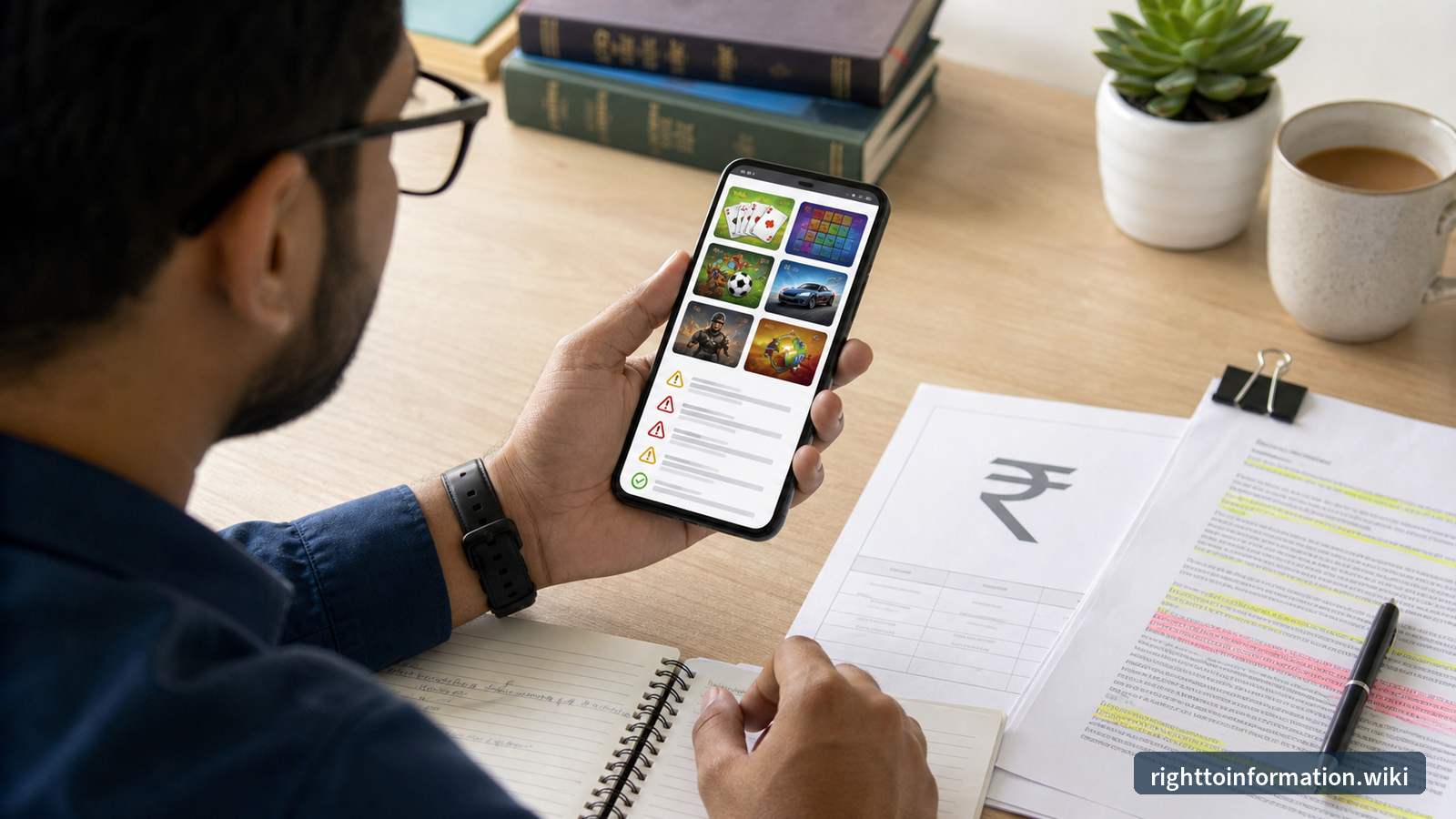
Quick Reply: Since 1 May 2026 the Online Gaming Act 2025 bans every online real-money game in India, skill or chance. Free social games, recognised e-sports, licensed offline casinos in Goa, Daman and Sikkim, and state lotteries remain legal.
One-line answer. As of 1 May 2026, almost no online real-money game is legal in India. The Promotion and Regulation of Online Gaming Act, 2025 bans all online money games, whether based on skill or chance. Only free-to-play social games, recognised e-sports without betting, licensed offline casinos in Goa, Daman and Sikkim, and authorised state-government lotteries remain legal.
The law changed in 2026. Read this before you deposit any money.
- The Online Gaming Act 2025 came into force on 1 May 2026.
- It prohibits every online money game, including real-money rummy, poker and fantasy sports, because Section 5 bans online money games whether they are skill or chance.
- Apps that still take your deposit for a real-money game are now operating illegally. Your money is at high risk and there is no licensed grievance route.
- If you have already lost money to such an app, see how to recover money and complain below.
On this page
What the 2025 Online Gaming Act changed
For years, Indian courts separated games of skill (generally allowed) from games of chance (gambling, generally banned), and real-money skill apps like fantasy sports and online rummy operated under state laws. That position has now changed for online play.
The Promotion and Regulation of Online Gaming Act, 2025 received Presidential assent on 22 August 2025, and the Act with its Rules came into force on 1 May 2026. Its Section 5 prohibits all online money games, and Section 2(1)(g) defines an online money game as one where users pay a fee or stake with an expectation of winnings, “irrespective of whether such game is based on skill, chance, or both.”
In plain words: if you pay money online hoping to win money, the format is banned, even if it is mostly skill. A new regulator, the Online Gaming Authority of India — established under Section 8 of the Act by the Promotion and Regulation of Online Gaming Rules, 2026 (G.S.R. 303(E), notified 22 April 2026) and chaired by the Additional Secretary, MeitY — oversees the law. The Authority decides whether a game is a banned “online money game” or a permissible “online social game” or e-sport, and runs a staged grievance route: first with the registered provider, then an appeal to the Authority within 30 days, and a further appeal to the Secretary, MeitY. This grievance route is for legal, registered games only — a banned money-game app has no licensed grievance path. A constitutional challenge to the Act is pending in the Supreme Court, but no stay has been granted, so it is in force today.
Money games that are now illegal online
Under the 2025 Act, these online real-money formats are prohibited:
- Online rummy for money and online poker for money, which earlier ran as skill games in many states. Read Rummy, poker, fantasy: state laws.
- Fantasy sports for money (Dream11-style paid contests).
- Online casino games such as slots, roulette, dice, teen patti for money, and crash or colour-prediction games. Read Illegal casino app guide.
- Satta King and matka, which were always illegal. Read Is Satta King legal in India?
- Cricket and IPL match betting, toss betting, and player-outcome betting. Read IPL betting apps legal guide.
- Offshore betting apps that take Indian UPI deposits. Read Gambling laws state by state in India
A label does not save an app. Calling something “prediction”, “fantasy”, “VIP tips”, “colour trading”, or “investment game” does not make it legal if you pay online to win money.
What is still legal
- Free-to-play social games offered purely for entertainment or skill-development, where you do not wager money for a monetary return. A subscription or one-time access fee is allowed; betting is not.
- Recognised e-sports organised as competitive events under the sports framework and registered with the Authority. Entry fees and prize money are allowed for genuine e-sports.
- Licensed offline casinos in the authorised venues of Goa, Daman and Sikkim, which are governed by separate state laws, not by this online Act.
- Authorised state-government lotteries, only in states that permit and run them, again under separate state law.
Even here, only the government-run or properly licensed version is legal. A private “lottery” or an offshore “casino app” is not.
State rules and offline games
Betting and physical gambling remain state subjects, so offline rules still vary by state. Goa, Daman and Sikkim license offline casino activity in named venues. Most other states permit only government lotteries, if any. The 2025 Act sits on top of this for anything played online: online real-money play is now banned nationwide regardless of your state. For the offline, state-by-state picture, see Gambling laws state by state in India.
Penalties under the 2025 Act
The Act carries criminal penalties, aimed mainly at operators, advertisers and payment enablers:
| Activity | Penalty |
| Offering or enabling an online money game | Up to 3 years imprisonment or a fine up to ₹1 crore, or both (higher for repeat offences). |
| Advertising or promoting an online money game | Up to 2 years imprisonment or a fine up to ₹50 lakh, or both. |
| Facilitating payments for an online money game (banks, payment apps) | Enforcement action; up to 3 years imprisonment or a fine up to ₹1 crore. |
| Non-compliant websites and apps | Blocked under Section 14 of the 2025 Act, using the blocking machinery of the Information Technology Act, 2000. |
| Repeat offence — offering or facilitating an online money game | Not less than 3 years and up to 5 years, with fine from ₹1 crore to ₹2 crore (Section 9). |
The enforcement weight is on the businesses. Even so, as a player you carry the financial risk: a banned app can disappear with your balance and you have no licensed grievance forum.
What to do if you have lost money to a betting or gaming app
- Stop depositing immediately and take screenshots of your balance, transaction IDs and the app or website.
- Report the financial fraud on the National Cyber Crime Reporting Portal at cybercrime.gov.in or call 1930 (the cyber-fraud helpline) as soon as possible, ideally within the golden hour, to try to freeze the transfer.
- Raise a complaint with your bank or UPI app for an unauthorised or disputed transaction, and ask them in writing to flag the beneficiary account.
- Use RTI to follow up on enforcement: you can ask a state cyber cell what action was taken on your complaint. Use the AI RTI Drafter to draft it.
- See the detailed complaint guide and the UPI fraud recovery guide.
Tools and next steps
- AI RTI Drafter — ask a state cyber cell or regulator for enforcement records.
- Timeline Calculator — track complaint, RTI and appeal deadlines.
- Complaint guide — if money is stuck or an app blocked withdrawals.
Related guides
Frequently asked questions
Is online rummy legal in India in 2026?
No, not for money. Real-money online rummy is banned under Section 5 of the Promotion and Regulation of Online Gaming Act, 2025, which covers online money games “irrespective of whether such game is based on skill, chance, or both”. A free rummy game with no money wagered is a social game and is allowed.
Is Dream11 or paid fantasy sport legal now?
Paid online fantasy sport is an online money game and is prohibited from 1 May 2026, even though courts earlier treated fantasy sport as a skill game. Only free contests with no monetary stake fall outside the ban.
Is online poker for money legal?
No. Online poker played for money is banned under the 2025 Act, regardless of the old skill-versus-chance argument.
Is colour prediction or a "trading game" legal?
No. These are online money games and are illegal. A name like “prediction”, “colour trading” or “investment game” does not change the law if you pay to win money.
Is a game legal if the app is on the Play Store or has a foreign licence?
No. App-store availability is not legal approval, and a foreign gambling licence does not override Indian law. Such apps are operating illegally in India.
What is the punishment under the Online Gaming Act 2025?
Offering an online money game can attract up to 3 years imprisonment or a fine up to ₹1 crore. Advertising one can attract up to 2 years or a fine up to ₹50 lakh. Facilitating payments for one also carries up to 3 years or ₹1 crore. The penalties target operators, advertisers and payment enablers.
Are casinos in Goa or state lotteries also banned?
No. Licensed offline casinos in Goa, Daman and Sikkim, and authorised state-government lotteries, are governed by separate state laws and are not the subject of this online-gaming Act. Only the government-run or properly licensed version is legal.
What should I do if I already lost money to a betting app?
Report it at cybercrime.gov.in or call 1930 quickly, dispute the transaction with your bank, save all evidence, and follow the complaint guide. You can use RTI to ask the cyber cell what action was taken.
Conclusion
The simple 2026 rule is this: if you pay money online hoping to win money, it is banned in India, skill or chance. What remains legal is free social play, recognised e-sports without betting, licensed offline casinos in Goa, Daman and Sikkim, and authorised state lotteries. If an app still takes your real-money deposit online, treat it as illegal and unsafe, and do not deposit.