Table of Contents
Swadesh Darshan 2026: SD 2.0, PRASHAD and SASCI guide

Quick Reply: Swadesh Darshan India 2026 — SD 1.0, SD 2.0, CBDD, PM-JUGA tribal homestays, PRASHAD pilgrimage, SASCI iconic centres. Citizen guide.
Quick answer. “Swadesh Darshan” is the Government of India's flagship tourism-infrastructure scheme, run by the Ministry of Tourism (MoT), that funds states to build and upgrade tourism destinations. It runs in two generations — Swadesh Darshan 1.0 (launched 2014–15) which sanctioned thematic-circuit projects worth [financial detail removed] with [financial detail removed] released and the bulk physically complete; and Swadesh Darshan 2.0 (launched 2022) which has so far sanctioned a multi-project portfolio with a sharper focus on sustainable, responsible, destination-led development. SD 2.0 carries three operational sub-schemes — Challenge-Based Destination Development (CBDD), Development of Homestays in Tribal Areas under Pradhan Mantri Janjatiya Unnat Gram Abhiyan (PM-JUGA), and the State Perspective Plan (SPP) through which states submit their Top-10 destinations. PRASHAD (Pilgrimage Rejuvenation and Spiritual Heritage Augmentation Drive) is a parallel pilgrimage-circuit scheme — projects across 28 States/UTs. SASCI (Special Assistance to States for Capital Investment, Part III) issued by the Department of Expenditure, Ministry of Finance in August 2024, gives 50-year interest-free loans to states for Iconic Tourist Centres of global scale — destinations shortlisted so far. Together these schemes are the load-bearing rails of every state's tourism budget. The MoT's EFC note for continuation 2026-27 to 2031-32 has been formulated and submitted for approval — once cleared, fresh proposals open.
This pillar guide gives you the full citizen-readable map of all six schemes — what each one funds, who decides, what's been sanctioned, who is left out, what RTI questions to ask, and how to verify projects in your own state. Every section links to a deep-dive article in the cluster.
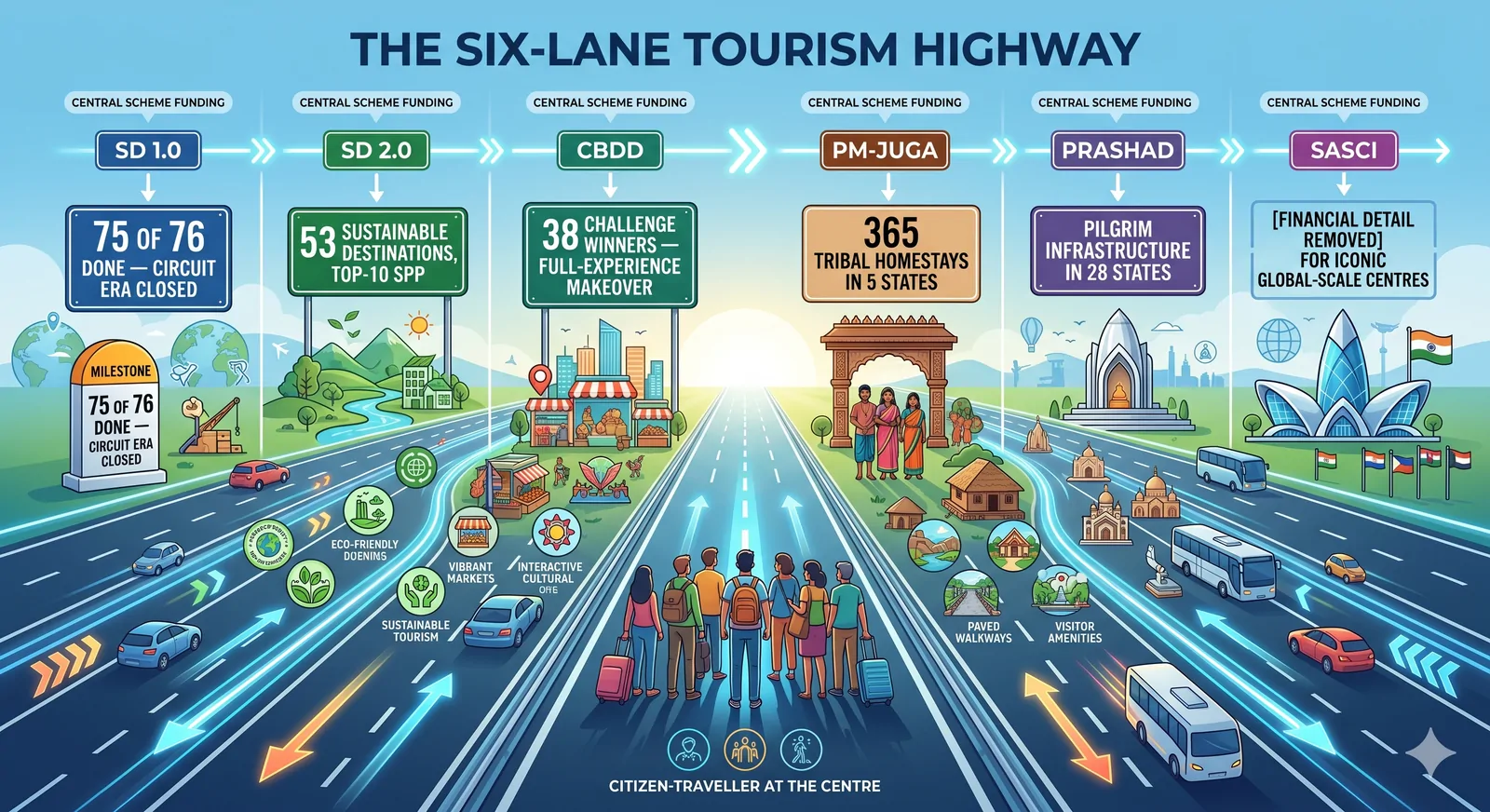
The six schemes — at a glance
| # | Scheme | Owner | Period | Sanctioned (Rs Cr) | Projects | Status |
|---|---|---|---|---|---|---|
| 1 | Swadesh Darshan 1.0 | MoT | 2014–15 to 2018–19 | 5,295.24 | 76 | 75 of 76 complete |
| 2 | Swadesh Darshan 2.0 | MoT | 2022–present | 2,208.31 | 53 | Ongoing |
| 3 | CBDD (sub-scheme of SD 2.0) | MoT | 2023–24 onwards | 697.94 | 38 | Ongoing |
| 4 | PM-JUGA Tribal Homestays (sub-scheme of SD 2.0) | MoT | 2025–26 | 17.52 | 365 homestays in 9 clusters | Ongoing |
| 5 | PRASHAD (parallel) | MoT | 2015–present | 1,726.74 | 54 (in 28 States/UTs) | Ongoing |
| 6 | SASCI Part III — Iconic Tourist Centres | DoE/MoF | August 2024 | 3,295.76 | 40 | Shortlisted; tendering / commencement |
Combined central allocation: roughly [financial detail removed] across the six schemes, before SASCI's full pipeline disbursement and the SD 1.0 final reconciliation. None of this counts state matching contributions — most state schemes (Uttarakhand, Himachal, Sikkim, Odisha, Meghalaya) layer their own subsidies on top, often quintupling the on-the-ground spend.
Swadesh Darshan 1.0 (2014–19) — the founding circuit scheme
- Vision: develop tourism infrastructure by funding identified thematic circuits — Buddhist, Coastal, Desert, Eco, Heritage, Himalayan, Krishna, North-East, Ramayana, Rural, Spiritual, Sufi, Tirthankar, Tribal, Wildlife.
- Funding model: 100% central financial assistance to State Governments / UT Administrations / Central Agencies (CAs).
- Numbers: a substantial portfolio of projects, the bulk of which are physically complete.
Swadesh Darshan 2.0 (2022–) — sustainable, destination-led
- Mission shift: from projects to tourism experiences. Move from 15 thematic circuits to destination-management approach at the level of one town / valley / coast.
- Pillars: tourism + allied infrastructure, services, human capital, destination management and promotion, policy & institutional reforms.
- Numbers: a multi-project portfolio sanctioned.
- SD 2.0 sanctioned highlights (Western-Ghat region):
- Goa: Porvorim Creek ([financial detail removed]), Colva Beach ([financial detail removed]) — both 2024-25
- Kerala: Alappuzha Global Water Wonderland ([financial detail removed]), Malampuzha ([financial detail removed]), Kumarakom Bird Sanctuary ([financial detail removed])
- Maharashtra: Pune Shivshrusthi Theme Park ([financial detail removed])
- Tamil Nadu: Mamallapuram Shore Temple ([financial detail removed])
- Sustainability mandates: standardised carrying-capacity assessment template circulated to states; O&M plan required beyond project completion; emphasis on local aesthetics, low-impact construction, water conservation, energy efficiency, renewable energy, solid-waste management.
CBDD — Challenge Based Destination Development (sub-scheme of SD 2.0)
- Origin: announced in Union Budget 2023–24; objective is competitive, end-to-end transformation of destinations through challenge-based shortlisting.
- Numbers: shortlisted destinations under the challenge framework.
- Sanctioned (Western-Ghat region):
- Goa: Mayem Village ([financial detail removed]) — Beautification & Development of Harvalem Waterfall
- Gujarat: Vadnagar ([financial detail removed]), Thol Village ([financial detail removed]), Porbandar ([financial detail removed]) — Sacred Ocean Retreat at Harsiddhi Shore
- Kerala: Varkala-Dakshin Kashi ([financial detail removed]), Thalassery: The Spiritual Nexus ([financial detail removed])
- Maharashtra: Ahmednagar Fort ([financial detail removed])
- Tamil Nadu: Rameswaram Island ([financial detail removed]) — Iconic transformation
- What CBDD funds differently from SD 2.0 base: a single end-to-end experience at a destination — not just one component but the full visitor journey. Themes: Culture & Heritage, Spiritual Tourism, Ecotourism & Amrit Dharohar Sites.
PM-JUGA Tribal Homestays (sub-scheme of SD 2.0)
- Full name: Development of Homestays in Tribal Areas under Pradhan Mantri Janjatiya Unnat Gram Abhiyan.
- Operationalisation: Draft Schematic Guideline issued vide OM No. SD-7/34/2024-SD dated 20.01.2025.
- Mission: promote responsible tourism + livelihood opportunities in tribal villages; convergence with the broader DAJUGA / PM-JUGA tribal-development framework.
- Numbers: Multiple states with village clusters spanning numerous villages.
- State-wise allocation:
- Andhra Pradesh — 1 cluster, 5 villages, 33 homestays (all renovation), [financial detail removed]
- Ladakh — 3 clusters, 19 villages, 111 homestays (18 new + 93 renovation), [financial detail removed]
- Madhya Pradesh — 2 clusters, 14 villages, 86 homestays (all new), [financial detail removed]
- Mizoram — 2 clusters, 12 villages, 89 homestays (all new), [financial detail removed]
- Uttarakhand — 1 cluster, 5 villages, 46 homestays (16 new + 30 renovation), [financial detail removed]
- Why this matters: this is the first formally MoT-funded homestay programme under SD 2.0 and is a model that other state homestay subsidies can converge with. See our government-schemes article on how non-tribal homestay owners can stack other subsidies (Mudra, PMEGP, state-tourism subsidy) to similar effect.
PRASHAD — pilgrimage rejuvenation (parallel scheme)
- Full name: National Mission on Pilgrimage Rejuvenation and Spiritual Heritage Augmentation Drive.
- Launch: January 2015.
- Numbers: 54 projects in 28 States/UTs, sanctioned Rs 1,726.74 crore, released Rs 1,213.56 crore as on 6 March 2026.
- Western-Ghat region examples:
- Goa: Bom Jesus Basilica ([financial detail removed]) — sanctioned 2024–25
- Gujarat: Dwarka, Somnath (initial + Promenade), Ambaji Banaskantha — [financial detail removed] cumulative
- Kerala: Guruvayur ([financial detail removed], 2016-17)
- Maharashtra: Trimbakeshwar Nashik ([financial detail removed], 2017-18)
- Tamil Nadu: Kanchipuram ([financial detail removed]), Velankanni ([financial detail removed]), 8 Navagraha Temples ([financial detail removed], 2024-25)
- What PRASHAD typically funds: queue-management mandapams, public conveniences, ghat / kalyani upgradation, drinking water, illumination, parking, signage, IT systems (CCTV, public-address, digital signage), pilgrim arrival centres, sewage-treatment plants. The Sri Chamundeshwari (Mysuru) [financial detail removed] project alone funds 19 distinct components plus a Mahishasura Plaza pilgrimage facility complex.
SASCI Part III — Iconic Tourist Centres of global scale
- Owner: Department of Expenditure (DoE), Ministry of Finance — not MoT directly. Operational guidelines issued 9 August 2024.
- Funding model: 50-year interest-free loans from the Centre to States for iconic tourist centres, with a strong branding + global-scale marketing mandate.
- Numbers: destinations shortlisted in consultation with State Governments.
- Western-Ghat region projects:
- Goa: Chhatrapati Shivaji Maharaj Museum, Ponda ([financial detail removed]); Townsquare in Porvorim ([financial detail removed])
- Gujarat: Ecotourism at Kerly/Mokarsagar Porbandar ([financial detail removed]); Tented City + Convention Centre at Dhordo ([financial detail removed])
- Kerala: Ashtamudi Biodiversity / Eco-recreational Hub Kollam ([financial detail removed]); Sargaalayaa “Global Gateway to Malabar's Cultural Crucible” ([financial detail removed])
- Maharashtra: INS-Guldar Underwater Museum + Submarine Tourism Sindhudurg ([financial detail removed]); RAM-KAL PATH Nashik ([financial detail removed])
- Tamil Nadu: Nandavanam Heritage Park Mammallapuram ([financial detail removed]); Eco Park at Race Course Ooty ([financial detail removed])
ACA — Assistance to Central Agency (separate, smaller envelope)
The Ministry's Assistance to Central Agencies scheme funds ITDC, WAPCOS, BECIL, ASI, Port Trust of India, Ministry of Railways, etc. for tourism-infrastructure projects at the central-agency level. Indicative project — Hospet Railway Station upgrade (March 2017, [financial detail removed], complete) supports Hampi tourism. Components: waiting/retiring rooms, modern toilets, executive lounges, cloak-room, passenger guidance, circulating-area improvement, accessibility for persons with disabilities, booking-office upgrade.
Continuation beyond 2025–26 — the EFC pipeline
- EFC note for scheme continuation from FY 2026-27 to FY 2031-32 has been formulated and submitted for approval.
- Once approved, MoT will issue revised guidelines and States/UTs may submit fresh proposals.
- Conveyed via OM No. SD-8/15/2020-SD-Part(6) dated 22 December 2025.
- What citizens can do now: file RTIs to your State Tourism Department asking what proposals it intends to submit in the next cycle, and which districts are prioritised. See how to use RTI to track these schemes.
Why these schemes matter to citizens
- Public money on visible ground. Together these schemes will spend in excess of [financial detail removed] on visible infrastructure — visitor centres, mandapams, signage, parking, sewage, ropes, eco-bridges. Quality and pace are improved by citizen oversight.
- Local-economy multiplier. Every sanctioned project triggers downstream spend on hospitality, transport, food, guides. An accurate registry of sanctions in your district lets you push for the catalytic services around it.
- Tribal + rural inclusion. PM-JUGA puts homestays in tribal villages on a national footing. Citizens can verify whether the 365 sanctioned homestays exist on the ground and whether disbursement reached the village SHG / cluster lead.
- Pilgrimage modernisation. PRASHAD upgrades civic infrastructure at temple towns. The component-wise sanctions are public; deviations are detectable on the ground.
Infographic idea
“The Six-Lane Tourism Highway” — a horizontal multi-lane diagram with the citizen-traveller at the centre and six lanes of central scheme funding flowing in:
- SD 1.0 → “75 of 76 done — circuit era closed”
- SD 2.0 → “53 sustainable destinations, Top-10 SPP”
- CBDD → “38 challenge winners — full-experience makeover”
- PM-JUGA → “365 tribal homestays in 5 states”
- PRASHAD → “Pilgrim infrastructure in 28 states”
- SASCI → “[financial detail removed] for iconic global-scale centres”
Image suggestions
- Mid-article — split-frame: a before photo of a temple-town queue-management gap vs an after of the same town's PRASHAD-funded mandapam.
- Pre-FAQ — a flow diagram: “How a project becomes a sanctioned scheme” — district-level proposal → state tourism dept → MoT → CSMC review → DPR → sanction → tender → execution → O&M.
Frequently asked questions
Is "Swadesh Darshan" the same as "PRASHAD"?
No. Swadesh Darshan funds tourism circuits and destinations; PRASHAD specifically funds pilgrimage and spiritual-heritage sites. Both are MoT schemes but they have different guidelines and project pipelines. PRASHAD is older (2015) and runs in parallel.
Can a private homestay owner apply directly to MoT for funding?
Generally no. SD 2.0 funds States; PM-JUGA funds village clusters via the State Tribal Welfare / Tourism Department. Individual homestay owners get to register state-wise homestay registration + apply for state subsidies; central capital flows through the state. See homestay government schemes article.
How do I know if my district has a sanctioned project?
When will fresh proposals be invited?
The MoT has formulated an EFC note for FY 2026-27 to FY 2031-32; once approved, States will be invited to submit fresh proposals via the State Perspective Plan (SPP) framework. This is expected to be early FY 2026-27.
What is "carrying capacity" and why does it matter under SD 2.0?
Is the SASCI loan really interest-free?
Yes. Department of Expenditure / Ministry of Finance issues SASCI Part III as a 50-year interest-free loan to states. The principal is repayable; no interest. This is meant to capitalise long-tail tourism infrastructure that would not justify commercial debt. The state services the principal; the centre absorbs the interest cost.
Citizen-action checklist
- [ ] Identify your district's sanctioned projects under each of the six schemes (use the RTI guide)
- [ ] Track physical progress on the State Tourism Department portal (each state publishes monthly progress)
- [ ] If your district is missing from SPP, file an RTI to the State Tourism Department asking why and what evidence is needed for inclusion
- [ ] For PRASHAD-funded temples, verify component-wise execution against the sanctioned DPR
- [ ] For tribal-homestay clusters, verify physical homestay numbers against the schematic guideline release
- [ ] Track the EFC continuation notification — once approved, fresh-proposal window opens
- [ ] Compare your state's central receipts with peer states — surface gaps to your State Tourism Minister + MP
- [ ] Register on the MoT's Incredible India portal if you operate a homestay — visibility is bundled into many SD 2.0 sub-projects
- [ ] Cross-link any PRASHAD / SASCI temple-town infrastructure with carrying-capacity data — push your municipal corporation to publish it
Related on RTI Wiki
Sources
- Ministry of Tourism — Swadesh Darshan Scheme Operational Guidelines (2014–15) and revised guidelines (2017).
- Ministry of Tourism — Swadesh Darshan 2.0 Operational Guidelines (2022).
- Ministry of Tourism — CBDD (Challenge Based Destination Development) Guidelines, sub-scheme of SD 2.0.
- Ministry of Tourism — Draft Schematic Guideline for Development of Tribal Homestays, OM No. SD-7/34/2024-SD dated 20.01.2025.
- Ministry of Tourism — PRASHAD Scheme guidelines (January 2015).
- Ministry of Finance, Department of Expenditure — Special Assistance to States for Capital Investment (SASCI) Part III guidelines, 9 August 2024.
- Ministry of Tourism — OM No. SD-8/15/2020-SD-Part(6) dated 22 December 2025 on EFC continuation FY 2026-27 to FY 2031-32.
- India Tourism Data Compendium 2025 — MoT, GoI.