Table of Contents
Trade Licence Renewal and Penalty 2026

Reviewed on 2026-06-20 by Dr. Shrawan Kumar Pathak.
Quick Reply: A trade licence runs for one financial year, April to March in most cities, so it is a yearly deadline. Renew it on your city Municipal Corporation portal before your due date. Miss it and you pay a late penalty that grows the longer you wait, and a long lapse can force a fresh application.
A trade licence is not a one-time document. It is a clock. The day it is issued, the countdown to its next renewal starts, and your municipal corporation expects you to act before the year runs out. This guide walks you through that clock, the day-by-day cost of missing it, and exactly what to do if your renewal gets stuck.
Renewal is a yearly deadline, not a chore
In most urban local bodies (ULBs) a trade licence, called a Certificate of Enlistment in some states, is valid for a single financial year, 1 April to 31 March. Some cities run it on the calendar year instead. So your very first job is to read the validity dates printed on your own licence and mark the expiry, because that single date drives everything below.
The reason this matters: an expired licence means your shop or business is operating without authorisation. That exposes you to a late penalty, and in some cities to sealing of the premises. Renewal is cheaper and quieter than getting caught lapsed, so treat the deadline as fixed.
The renewal clock, step by step
Think of the year in four windows. Knowing which window you are in tells you what you will pay.
Window 1: The renewal window opens (around January)
Most ULBs open online renewal a few months before the financial year ends, commonly from January. Several states now send an automatic SMS or email reminder about 30 days before expiry. West Bengal, for example, runs an auto-renewal model where the system notifies you 30 days ahead, you log in to the e-district portal, and the renewed certificate downloads in real time once you pay. Do not wait for the reminder. Open your portal in January and renew early, while the fee is plain and the queue is short.
Window 2: On or before the due date
If you renew on or before your due date, in most cities 31 March, you pay only the normal renewal fee. The fee is usually auto-calculated by the portal from your trade type, category and area, so there is nothing to negotiate. This is the cheapest and safest window. Aim to finish here.
Window 3: The grace window (late, with penalty)
Miss the due date and you enter the late zone. Many ULBs allow a short grace period after expiry, but you now pay the fee plus a late penalty. That penalty is set by each municipal corporation, so it varies a lot. Some cities charge a percentage of the fee per month of delay, others charge a flat amount per day. There is no single national figure, so verify the exact penalty on your municipal portal before you assume an amount. The rule of thumb is simple: every month you wait, the bill grows.
Window 4: A long lapse (fresh application)
If your licence stays lapsed for many months, several ULBs stop treating it as a renewal at all. They make you file a fresh trade licence application, which can mean a new inspection, fresh documents and a longer wait, on top of accumulated penalty. The exact threshold differs by city, so check your ULB portal, but the lesson holds: the longer you ignore it, the more it costs and the more paperwork it takes to recover. If you are renewing this late, our trade licence application guide explains the full first-time process you may now have to repeat.
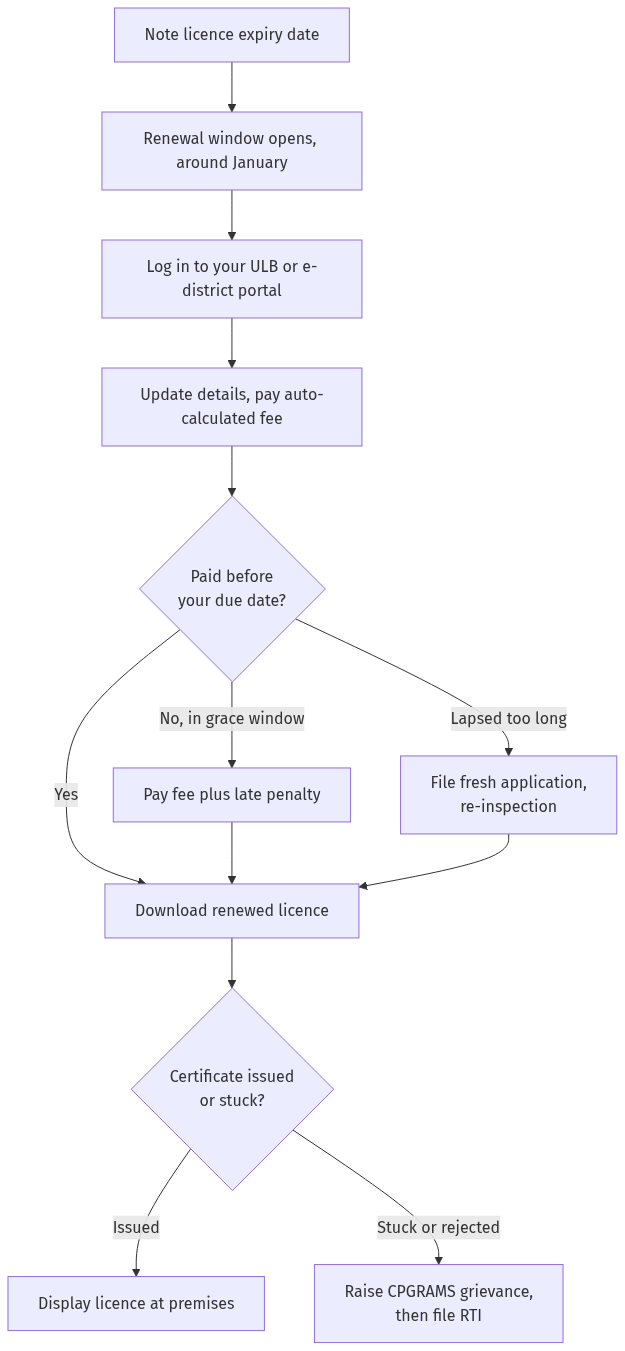
Figure: step-by-step flow. If a step stalls, use the grievance or RTI route shown.
How to renew online
The exact screens differ by city, but the flow is consistent across portals like Delhi's mcdonline.nic.in and state e-district sites.
- Open your city Municipal Corporation or state e-district portal and log in, or register with your existing licence number.
- Find Trade Licence and choose Renewal, then enter your licence or enlistment number to pull up your record.
- Check that your name, trade type, address and area are correct, and update your phone and email if they have changed.
- The portal auto-calculates the renewal fee, plus any late penalty if you are past the due date.
- Pay online and download the renewed licence or payment receipt. Keep both.
- Display the renewed licence at your premises, since many cities penalise non-display separately.
Documents you should keep ready
Renewal is lighter than a first application, but ULBs commonly ask for the previous year's licence and payment receipt, recent photographs of the establishment, and proof of lawful occupancy such as a rent agreement, lease deed, electricity bill or water bill. If you also pay municipal property dues, keeping your holding or property tax receipts current helps, because some ULBs check for pending dues before they renew.
The penalty ladder, in plain terms
Because penalties are set city by city, treat the figures on any private website with caution and confirm yours on the official portal. What is consistent nationally is the shape of the cost:
- On time: normal fee only.
- Within the grace window: fee plus a modest late penalty.
- Months late: fee plus a penalty that keeps growing with each month, often calculated per month or per day of delay.
- Operating without renewing: risk of a separate fine for running without a valid licence, and in some cities sealing of the premises.
The single most useful habit is to renew in the first window. Everything after that only adds cost.
If your renewal is stuck or rejected
Sometimes you pay but the certificate does not generate, the portal shows a wrong category, or staff sit on a manual approval. Do not keep re-paying or arguing at the counter. Escalate in order.
Step 1: Use the municipal grievance channel
Raise a complaint with your licence number, payment reference and a clear description on your city's grievance system, or on the central CPGRAMS portal at pgportal.gov.in. Our municipal grievance guide shows how to file one that actually gets actioned and tracked.
Step 2: File an RTI
If the grievance stalls, file a Right to Information application with the Public Information Officer of your municipal corporation. Ask for the current status of your renewal, the name and designation of the officer holding it, the reason for delay, and the date by which it will be decided. An RTI puts a named officer on record and usually unblocks a file faster than another reminder. The same approach works for any stuck civic file, as our guide to a building plan approval delayed after fees are paid explains.
Frequently asked questions
When is the trade licence renewal due date?
In most cities the licence runs for the financial year and must be renewed by 31 March. Some ULBs follow the calendar year. Read the validity dates on your own licence and confirm the deadline on your municipal portal, since this is set locally.
What is the penalty for late trade licence renewal?
There is no single national penalty. Each municipal corporation sets its own late fee, often a percentage of the licence fee per month of delay or a flat amount per day. Verify the exact figure on your city portal before assuming an amount, because it grows the longer you wait.
Can I renew my trade licence online?
Yes, in most cities. Log in to your Municipal Corporation or state e-district portal, choose renewal, enter your licence number, verify your details, pay the auto-calculated fee and download the renewed licence. Some states even auto-renew with a real-time certificate after payment.
What happens if I do not renew at all?
Your business is then operating without a valid licence. You risk a fine for running unlicensed, and in some cities sealing of the premises. A long lapse can also force you to file a fresh application with a new inspection, so renewing late is always cheaper than not renewing.
Is there a grace period after the due date?
Many ULBs allow a short grace window after expiry, during which you can still renew by paying the fee plus a late penalty. The length of this grace period and the penalty both vary by city, so check your municipal portal rather than assuming a standard window.
Which documents do I need for renewal?
Usually the previous year's licence and payment receipt, recent photos of the establishment, and proof of lawful occupancy such as a rent agreement, lease deed, electricity bill or water bill. Some cities also check that your municipal property dues are clear before renewing.
My payment went through but the licence did not generate. What now?
Keep the payment reference, then raise a grievance on your city portal or CPGRAMS at pgportal.gov.in with your licence number. If it stays stuck, file an RTI with your municipal corporation asking for the status, the officer responsible and the reason for delay.