Table of Contents
Pet / Dog Licence 2026

Reviewed on 2026-06-20 by Dr. Shrawan Kumar Pathak.
Quick Reply: A pet or dog licence is issued by your municipal corporation under its own city Act and dog byelaws. You vaccinate your dog against rabies, fill the prescribed form, attach proof of address and a photo, pay the fee and collect a licence plus a metal tag. Renew it every year.
A Tuesday morning, step by step
Picture a notice slipped under your door. Your housing society wants every dog owner to show a valid municipal licence by month-end. You have had your dog for over a year and never registered it. By the time your tea is cold you need a plan. Here is how that one day goes, hour by hour, so you can copy it in your own city.
A pet licence is not a national document. There is no single all-India portal. Your city corporation issues it under its own law, so the form, the fee and the penalty differ from one municipality to the next. So your first move is to find the right office, not to search for a generic form.
9 a.m.: find your own city portal
You open your municipal corporation website and search for “dog licence” or “pet registration”. Almost every urban local body has a page for it, sometimes under the veterinary or public-health department. If your corporation has no online form, the same department accepts the application at the counter. Do not use a private “pet licence” website that asks for money. Start only from your own city or state portal, or from the national services list at india.gov.in services which points to each state's own service.
While you are there, bookmark two related pages you may need later: how to apply for a municipal trade licence if you run a small home business, and how to pay holding or property tax locally. Same corporation, same login in many cities.
10 a.m.: the vet, then the paperwork
If your dog's rabies shot has lapsed, go to the vet first. A valid anti-rabies vaccination certificate is the one document almost every corporation insists on, and many will not even accept your form without it. Have the vet update the card and sign a health note before you start the application.
What you keep ready
Lay everything out on the table. Across most Indian cities the list looks the same:
- A current anti-rabies vaccination certificate.
- Proof of your identity and address.
- A recent photograph. Several cities, such as Guwahati, ask for a photo of you with your dog.
- Your dog's details: breed, age, colour and sex.
- In some cities, a no-objection note from your society or neighbours.
Exact documents vary, so read your own corporation's checklist before you pay. If a figure or form number on a blog does not match your city page, trust the city page.
2 p.m.: fill the form and pay
Fill the prescribed application, often called Form A and Form B, upload your scans and the photo, and pay the fee. Fees are modest, usually a few hundred rupees a year, but they genuinely differ by city. As a real example, Guwahati Municipal Corporation charges Rs 110 per dog, made up of a Rs 100 registration fee and a Rs 10 application fee, with a metal tag costing extra. Your city may charge more or less, so verify the current figure on your municipal portal before you assume any amount.
Many corporations only register a dog that is older than three months, the age by which the first rabies shot is due, so confirm your dog meets the minimum age.
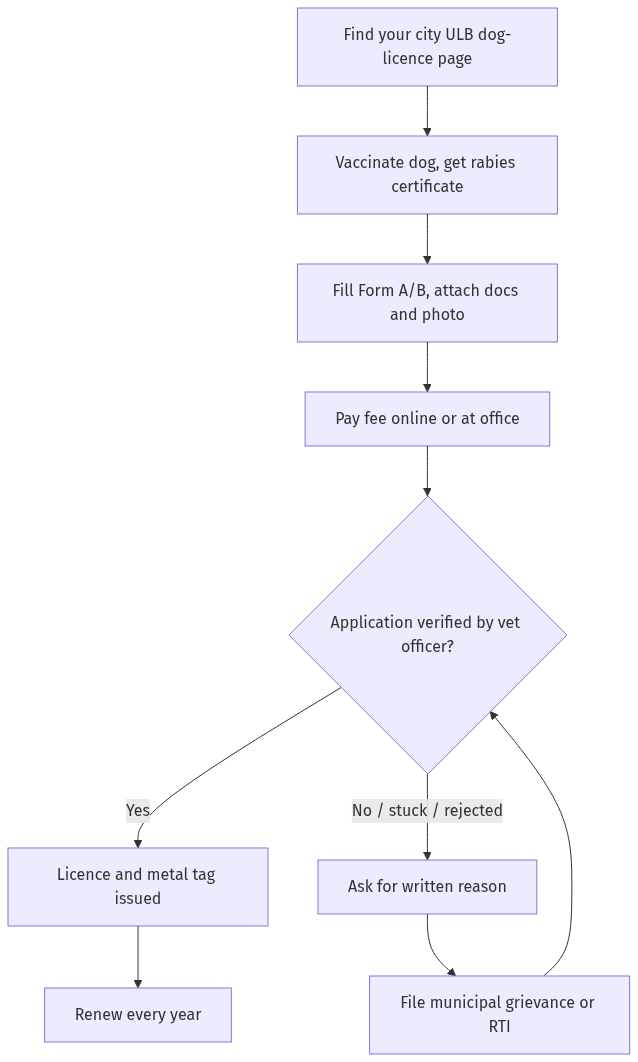
Figure: step-by-step flow. If a step stalls, use the grievance or RTI route shown.
4 p.m.: licence, tag and a calendar reminder
A veterinary officer verifies your application and signs the certificate. The corporation issues the licence and, in many cities, a numbered metal tag that goes on your dog's collar. That tag is proof on the street that your dog is registered.
The last thing to do is set a phone reminder for the same week next year. A dog licence is almost always valid for one year and must be renewed annually, the same way you renew a utility connection or a trade licence. Skip the renewal and you are back to being unregistered.
Why bother at all
Registration is not just a society rule. Most municipal Acts make a dog licence compulsory, and some cities levy steep fines on owners of unregistered dogs and can even impound the animal in a dispute. The exact penalty differs by city, so check your local byelaw rather than a number you read online. A licence also helps if your dog is ever lost, complained against, or caught up in a neighbour dispute.
A quick note on stray dogs. The Animal Birth Control Rules, 2023, made under the Prevention of Cruelty to Animals Act, 1960, deal with sterilising and vaccinating community or stray dogs through your local body. They are a separate subject from registering your own pet, so do not confuse the two.
If your application is stuck or rejected
Not every day ends this smoothly. If your form sits unverified for weeks, or the office rejects it without telling you why, do not give up.
First, ask for the reason in writing. A clear written ground tells you whether the problem is a missing vaccination date, an unpaid fee or a clerical error you can fix in a day. If the corporation still does not act, escalate. You can raise a municipal grievance on your city or state grievance portal, and you can file an RTI asking for the status of your application, the official who is handling it and the timeline the corporation follows. A dated grievance or RTI usually moves a stalled file faster than another phone call.
Frequently asked questions
Is a dog licence legally compulsory in India?
In most cities, yes. Pet licensing comes from your municipal corporation's own Act and byelaws, and many of them make registration mandatory. Because the rule is local, check your own corporation's page to confirm whether and how it applies to you.
How much does a pet or dog licence cost?
It is usually a few hundred rupees a year, but the amount varies widely by city. For example, Guwahati Municipal Corporation charges Rs 110 per dog. Always confirm the current fee on your own municipal portal, because no single fee applies across India.
What documents do I need?
Almost everywhere you need a valid anti-rabies vaccination certificate, proof of your identity and address, a recent photo and your dog's basic details. Some cities want a photo of you with the dog or a no-objection note from neighbours. Read your city's checklist before applying.
Can I apply online?
Many corporations have an online dog-licence or pet-registration form on their website. If yours does not, the veterinary or public-health department accepts the application at the counter. Avoid private websites that charge a fee to “register” your pet.
How often do I renew it?
A dog licence is almost always valid for one year and must be renewed annually, usually with an updated rabies vaccination certificate. Set a reminder so you do not lapse and risk a penalty.
Do the Animal Birth Control Rules, 2023 mean I must register my pet?
No. Those rules govern sterilising and vaccinating stray or community dogs through your local body. Registering your own pet is a separate municipal process under your city's dog byelaws.
What if the office rejects my application or does not respond?
Ask for the reason in writing, fix any genuine gap, then escalate through your city's municipal grievance portal. If there is still no action, file an RTI asking for the status, the responsible officer and the timeline.