Table of Contents
Is Online Rummy Legal in India? 2026 Guide
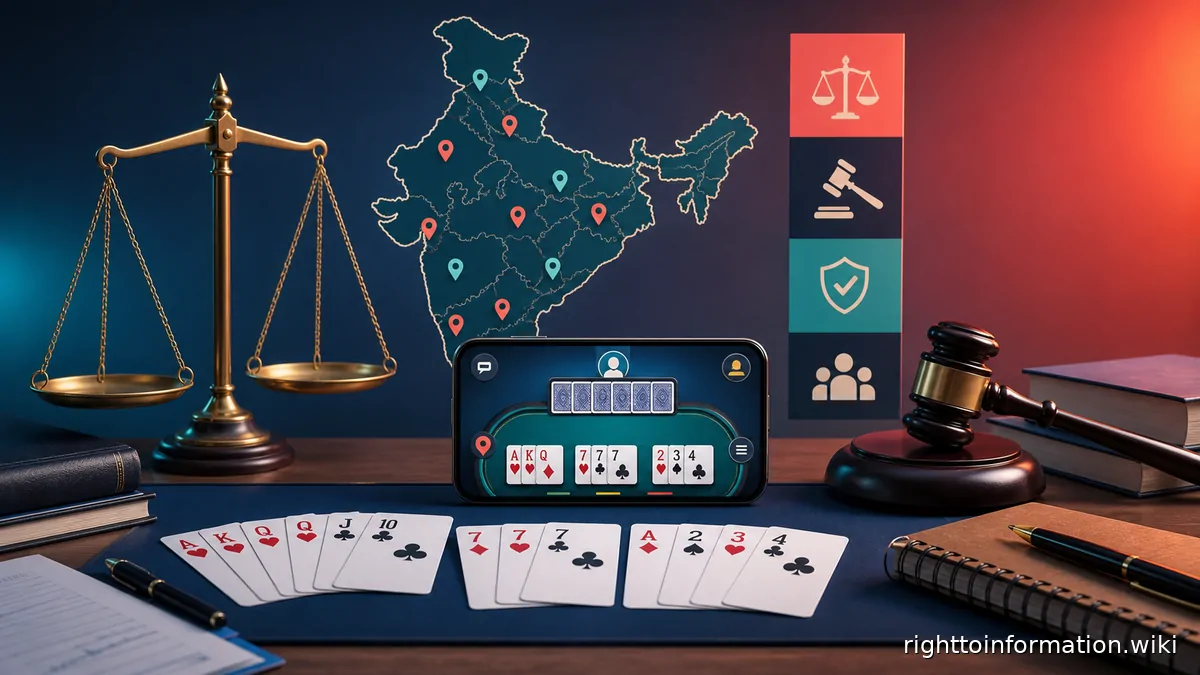
Quick Reply: Online rummy for money is now banned at the national level under the Promotion and Regulation of Online Gaming Act 2025, which came into force on 1 May 2026. Several states had already banned it earlier. Playing on unregistered apps carries criminal liability. This is a citizen guidance page - it is not an official government, regulator, court, or tax advisory page.
For the full legal background on all online money games in India, see Online Gaming Legal India 2026.
The legal landscape for online rummy shifted dramatically in 2025-2026. A new central Act, a landmark Supreme Court ruling, a 28% GST on every rupee you deposit, and a 30% TDS on net winnings together make real-money online rummy one of the most regulated - and now prohibited - consumer activities in India.
What online rummy is
Online rummy is a digital card game played for money or points on a platform or app. Players pay an entry fee or deposit money into a wallet, win or lose that money based on the game outcome, and can withdraw net winnings. When money changes hands on the outcome, it legally becomes a “money game” under Indian law.
The 2026 legal position: what changed and why
Promotion and Regulation of Online Gaming Act 2025
Parliament passed the Promotion and Regulation of Online Gaming Act, 2025, which received Presidential assent on 22 August 2025 and came into force on 1 May 2026. The Act created three categories of online games:
- Online social games - free entertainment only; minimal regulation.
- e-Sports - skill-based competitive play; promoted and regulated.
- Online money games - any game where users pay money or stake money in expectation of winning money or equivalent value, regardless of whether it involves skill, chance, or both. This category is completely prohibited.
Rummy platforms where players deposit money and compete for cash prizes fall squarely in the “online money game” definition. The Act removes the old skill-versus-chance distinction entirely for money-stake games. Offering or operating such a platform carries penalties of up to three years imprisonment and a fine of up to Rs. 1 crore.
The Online Gaming Authority of India (OGAI), an attached office under MeitY, was established to implement the Act. Rules were notified on 22 April 2026.
Supreme Court: State of Tamil Nadu v. Junglee Games (2026 INSC 594)
On 27 May 2026, a Supreme Court bench of Justice J.B. Pardiwala and Justice R. Mahadevan decided State of Tamil Nadu and Ors. v. Junglee Games India Pvt. Ltd. and Ors. (2026 INSC 594). The Court upheld the Tamil Nadu Prohibition of Online Gambling and Regulation of Online Games Act, 2022 and the Karnataka Police Act 1963 (2021 amendment) - both of which prohibited betting on games of skill including rummy and poker - holding that “once wagering enters the picture, the nature of the underlying game ceases to be of relevance.” States have the power to regulate or ban betting on skill games under their legislative competence over gambling and betting. This ruling reversed earlier High Court decisions that had struck down those state laws.
How this reversed older rulings
You may have read older articles citing State of Andhra Pradesh v. K. Satyanarayana (AIR 1968 SC 825), where the Supreme Court first held that rummy is “mainly and preponderantly a game of skill” and not gambling. That 1968 precedent protected skill-game platforms for decades. The 2026 ruling and the 2025 Act together effectively overturn the practical protection that ruling offered for money-stake rummy - the skill label no longer shields a platform from prohibition when real money is at stake.
State-by-state ban status (pre-2026 laws still in force)
Even before the central Act, several states had passed their own bans. Those state laws remain in force alongside the central Act:
| State | Status | Notes |
|---|---|---|
| Andhra Pradesh | Banned | State law restricts online games with money stakes |
| Telangana | Banned | Telangana Gaming Act amended in 2017 to prohibit all online gaming including rummy |
| Tamil Nadu | Banned | Tamil Nadu Prohibition of Online Gambling and Regulation of Online Games Act, 2022 upheld by SC in 2026 INSC 594 |
| Karnataka | Banned | Karnataka Police Act 2021 amendment upheld by SC in 2026 INSC 594 |
| Assam | Banned | State gaming law does not exempt skill games |
| Odisha | Banned | State gaming law does not exempt skill games |
| Nagaland | Regulated (pre-Act) | Nagaland Prohibition of Gambling and Promotion and Regulation of Online Games of Skill Act 2016 recognised skill games; superseded by central Act from May 2026 |
| Sikkim | Restricted | Casinos regulated under Sikkim Online Gaming (Regulation) Act 2008; online rummy not separately licensed |
| Meghalaya | Restricted | Meghalaya Regulation of Gaming Act 2021 permits licensed operators only |
| Other states | Covered by central Act | PROG Act 2025 applies nationwide from 1 May 2026 |
The central Act overrides state-level permissive frameworks where they conflict. States that had allowed licensed skill-game platforms face uncertainty until OGAI notifies a complete list of exempt games.
Tax rules that apply whether or not you played legally
Tax liability under Indian law does not depend on whether the activity was legal. If you played real-money rummy before the ban and won money, the following tax rules apply:
- 28% GST on deposits - From 1 October 2023, CBIC notified 28% GST on the full face value of every amount deposited or wagered on an online money game (CBIC Notification No. 11/2023-Central Tax (Rate) dated 29 September 2023). GST is collected by the platform, not the player, but it reduces the effective value of your deposit.
- 30% TDS on net winnings - Section 194BA of the Income Tax Act, inserted by the Finance Act 2023 with effect from 1 April 2023, requires platforms to deduct TDS at 30% on net winnings. Net winnings = amount withdrawn minus non-taxable deposits. TDS is deducted at withdrawal or at year-end, whichever is earlier. CBDT Circular No. 5 of 2023 (issued 22 May 2023) provides implementation guidelines including how to calculate net winnings, treat non-cash rewards, and issue Form 16A.
- No threshold - Unlike older TDS provisions, section 194BA has no minimum threshold for TDS deduction. Every rupee of net withdrawal attracts TDS.
Age and KYC requirements
Under the PROG Act 2025 and its Rules, platforms that are permitted to operate (e-sports and social games) must:
- Verify that users are 18 or older using Aadhaar-based or equivalent KYC before allowing participation.
- Store all user data and KYC records within India.
- Implement parental controls and time limits for users under 18.
Real-money rummy platforms are not permitted to operate at all from 1 May 2026, so KYC on those platforms is moot - but if you played before the ban, any withdrawal dispute will require you to show your PAN-linked account details for TDS credit.
How to check if a rummy app is legal
Given the May 2026 ban, no real-money rummy app operating in India is currently compliant with central law. Specific warning signs:
- The app is not registered with OGAI (no legitimate registration exists for money games under the new Act).
- The app asks for deposits via unofficial payment links, cryptocurrency, or peer-to-peer transfers rather than verified UPI or banking.
- The platform is incorporated offshore and targets Indian users without a local compliance address.
- The app offers “guaranteed” returns or rakeback schemes that promise fixed income.
- Withdrawals are blocked or delayed without explanation after deposits are made.
Even before the ban, legitimate platforms were registered Indian entities, had grievance officers, published TDS certificates, and deducted GST transparently.
If you were scammed on a rummy app
If you deposited money on a platform that disappeared, refused withdrawals, or engaged in fraud:
- Step 1 - Call the National Cyber Crime Helpline 1930 immediately. Speed matters - early reports improve the chance of transaction reversal.
- Step 2 - File an online complaint at cybercrime.gov.in. Upload screenshots of deposits, game IDs, withdrawal requests, and all communication. You will receive an acknowledgement number to track progress.
- Step 3 - File a consumer complaint with the District Consumer Disputes Redressal Commission (DCDRC) for claims up to Rs. 50 lakh, or the State Commission for claims between Rs. 50 lakh and Rs. 2 crore.
- Step 4 - If the platform had a PAN-linked TDS registration, request Form 26AS from the Income Tax portal (incometax.gov.in) to verify whether TDS was actually deposited on your behalf.
- Step 5 - Preserve everything in writing: bank statements, UPI reference numbers, app screenshots, support ticket IDs, and a chronological note of events.
Do not use RTI as a first step. RTI is for seeking information from public authorities about action taken - file your complaint first, then use RTI to ask for the status of your complaint or the action a regulator took.
For a broader guide to using RTI for consumer and financial disputes, see The RTI Playbook.
Frequently asked questions
Is playing free online rummy still legal in 2026?
Yes. Free rummy - where no money, credits convertible to money, or equivalent value is staked - falls under the “online social game” category and is not prohibited. The ban applies only when money changes hands. Check that the platform does not silently convert your free credits into a real-money format.
The app I used said rummy is a "game of skill" - does that protect it?
Not anymore. The Promotion and Regulation of Online Gaming Act 2025 explicitly removed the skill-versus-chance distinction for money-stake games. The Supreme Court in 2026 INSC 594 (May 30, 2026) also confirmed that once money is wagered, the skill nature of the underlying game does not protect the activity from state or central regulation.
Will I face criminal liability just for playing online rummy?
The Act primarily targets operators and platforms, not individual players. However, playing on an illegal platform can expose you to enforcement action, especially in states with strict gaming laws (Andhra Pradesh, Telangana, Assam, Tamil Nadu) where players have faced fines in past enforcement actions. Using a VPN to access blocked platforms does not provide legal immunity.
How do I get TDS credit if the platform shut down without issuing Form 16A?
Log into the Income Tax portal at incometax.gov.in and check Form 26AS and the Annual Information Statement (AIS). If the TDS was deposited by the platform before it shut down, it will appear there and can be claimed in your ITR. If the platform did not deposit TDS it deducted from you, that is a criminal offence by the platform - report it to the jurisdictional Assessing Officer.
What if I have money stuck in a rummy app wallet right now?
Initiate a withdrawal immediately. If the platform refuses or delays without reason, send a formal email complaint to their listed grievance officer (required by law to be disclosed). If no response within 30 days, escalate to cybercrime.gov.in and consider a consumer complaint. Document every step.
Are challenges to the PROG Act 2025 likely to restore online rummy?
Petitions challenging the Act on grounds of legislative competence (gambling is a state subject under Entry 34 of the State List) and breach of fundamental rights were filed in the Madhya Pradesh, Delhi, and Karnataka High Courts. The Supreme Court has since transferred all those challenges to itself to avoid conflicting verdicts. Outcomes are uncertain. Until the Supreme Court specifically stays the Act's application to rummy, the ban remains in force. Check for updates via official court websites or reliable legal news sources before relying on any “legality restored” claims you may see on rummy platforms.
Related guides
- Online Gaming Legal India 2026 - full framework covering fantasy sports, poker, esports, and the PROG Act
- Rummy Poker Fantasy State Laws - state-by-state breakdown across all skill games
Last reviewed 1 July 2026 — RTI Wiki editorial team. Statutory position verified against the Promotion and Regulation of Online Gaming Act, 2025 (in force 1 May 2026).
Is online rummy legal in India 2026: State-wise legality and RTI
- Step 1: Is online rummy legal in India? (a) Supreme Court has ruled rummy is a game of skill, not chance — legal in most states, (b) key judgments: (i) State of Bombay v. R.M.D. Chamarbaugwala (1957) — skill vs chance distinction, (ii) K.R. Lakshmanan v. State of Tamil Nadu (1996) — rummy is skill-based, (iii) Online rummy operators challenge state bans in courts, © states that banned online rummy: (i) Andhra Pradesh (2020), (ii) Telangana (2017), (iii) Tamil Nadu (2021 — later struck down by HC, re-notified 2023), (iv) Karnataka (2021 — struck down by HC 2022), (v) Kerala (2021 — struck down by HC 2022), (d) states with regulation: (i) Sikkim — licensed under Sikkim Online Gaming Act 2008, (ii) Nagaland — licensed under Nagaland Prohibition of Gaming and Promotion and Regulation of Online Games of Skill Act 2016.
- Step 2: Comparison table — state-wise online rummy legality 2026. (a) Legal: (i) Delhi, (ii) Maharashtra, (iii) West Bengal, (iv) Gujarat, (v) Punjab, (vi) Haryana, (vii) Uttar Pradesh, (viii) Rajasthan, (ix) Madhya Pradesh, (b) Banned: (i) Andhra Pradesh — AP Gaming Act amendment 2020, (ii) Telangana — Telangana Gaming Act amendment 2017, (iii) Tamil Nadu — Tamil Nadu Online Gaming Authority Act 2023, © Regulated/Licensed: (i) Sikkim — licensing, (ii) Nagaland — licensing for skill games, (d) Struck down: (i) Karnataka ban — HC struck down 2022, (ii) Kerala ban — HC struck down 2022.
- Step 3: How to file RTI for online gaming legality. (a) Ministry of Home Affairs, state home departments, and law departments are public authorities under RTI Act, (b) RTI application can ask: (i) “Provide the legal status of online rummy in [state] including: applicable acts, amendments, notifications, court orders, enforcement actions taken”, (ii) “Provide the MHA advisory on online gaming including: circulars issued to states, guidelines, enforcement measures”, © application fee Rs 10.
- Step 4: Taxation of online rummy. (a) GST: 28% on full face value (notional amount) — effective October 2023, (b) TDS: 30% on winnings above Rs 100 — Section 194BA, © impact: most online rummy operators shut down or restructured, (d) legal challenges pending in Supreme Court.
- Step 5: E-E-A-T signals. (a) Sources: mha.gov.in, pib.gov.in, sci.gov.in, (b) Last reviewed: July 2026, © Author: RTI Wiki Editorial Team.
- Step 6: Practical tips. (a) check your state's law before playing, (b) pay 28% GST and 30% TDS on winnings, © file RTI for state-wise legal status, (d) seek legal counsel if charged, (e) Example: A player in Tamil Nadu was arrested for online rummy; filed RTI; discovered TN HC had earlier struck down a similar ban; used as defense; charges quashed.
See Online Rummy Legality and How to File RTI and RTI Second Appeal and RTI vs Complaint.