Table of Contents
Name/DOB Correction on Marksheet 2026

Reviewed on 2026-06-20 by Dr. Shrawan Kumar Pathak.
Quick Reply: Apply to the board or university that issued the marksheet, not to any general office. First decide your route: a printing or spelling error is fixed with proof and the correction form; an actual change of name needs a gazette notification and affidavit first. Boards allow only a limited window after your result, so act early.
A wrong letter in your name or a slipped date on a marksheet looks small until a bank, a passport officer or an employer flags the mismatch and freezes your file. This guide cuts through the confusion that traps most applicants: people send the wrong kind of request to the wrong office, miss a quiet time limit, and only learn the rules after a rejection. We will name each trap before you fall into it.
First, work out which correction you actually need
Most failed applications fail here. There are two very different things people lump together as “marksheet correction”, and they take different routes.
Route A: a clerical or spelling error
This is when your school records are correct but the board printed something wrong, a transposed letter, a wrong initial, a date typed as 03 instead of 30. You are not changing anything, you are asking the board to match its certificate to its own admission record. You apply to the issuing board or university with documentary proof. This is the faster route.
Route B: an actual change of name
This is when the marksheet correctly records the name you were enrolled under, but you now want a different legal name, after marriage, a religious change, or simply a new spelling you prefer. Here the board will not act on your word alone. You must first change your name through the official process: publish a gazette notification, place a newspaper advertisement, and swear a notarised affidavit. Only then does the board update the record on the strength of that gazette. Sending Route B as if it were Route A is the single most common reason for a flat rejection.
If you are unsure which applies, ask one question: is the board record wrong, or is the board record right but you want it changed? The first is Route A, the second is Route B.
The hard truth about date of birth
Date of birth is the strictest field on any board record. Boards treat your recorded DOB as near final once a result is declared. The Central Board of Secondary Education states in its examination bye-laws that no change in the date of birth once recorded shall be made, and entertains only genuine clerical or typographical corrections, and only within a short window after your result is declared. The exact number of years differs between boards and has been stated differently over time, so verify the current limit on cbse.gov.in or your own board portal before you assume you still qualify.
Why so strict? Because courts back the boards on this. In Rewant Ahlawat v. CBSE, decided by the Delhi High Court on 4 June 2026, a Division Bench dismissed a writ petition seeking a DOB correction sought roughly eight years after the certificate was issued. The court held that Article 226 of the Constitution cannot be used to bypass the time limit fixed in the board's bye-laws, and that a date of birth dispute should first be pursued under the Registration of Births and Deaths Act, 1969, through the births register, not through the board. The lesson is plain: fix the underlying birth record first if it is wrong, and never sit on a DOB error.
Step by step: how to apply
Step 1: get the correction form and your error in writing
Download the correction application form from your board or university portal. For CBSE this is the “Application for Correction in Name/Date of Birth” on cbse.gov.in. Note exactly what is wrong and what it should read, character by character.
Step 2: assemble proof of the correct particulars
Gather the original or incorrect marksheet, plus the documents that prove the correct version. Typically that means your birth certificate, your school admission form, and an identity document such as Aadhaar. For a spelling fix, the school admission register entry is your strongest proof, because it shows what the school originally sent the board. Keep clear photocopies of everything you submit.
Step 3: get it attested and add an affidavit
Most boards require the application and supporting copies to be attested by the Head of your school or institution. Add a notarised affidavit stating the error and the correct particulars. For a change in a parent's name, boards usually want a true copy of the admission form, the previous school leaving certificate, and the relevant page of the admission and withdrawal register, all attested.
Step 4: pay the prescribed fee and submit to the right office
Pay the prescribed fee. CBSE charges a prescribed fee in the region of Rs 1,000, which includes the reissued marksheet or certificate; fees differ by board, so check the current amount on your own portal. Submit to the issuing authority: your board's regional office, or the Controller of Examinations of the university that awarded the degree. A university marksheet must go to that university, never to a board.
Step 5: track it and keep the acknowledgement
Note your application or reference number and keep the acknowledgement safe. Processing commonly takes several weeks, often around four to six. If your board has an online status tracker, check it; if not, follow up in writing with your reference number.
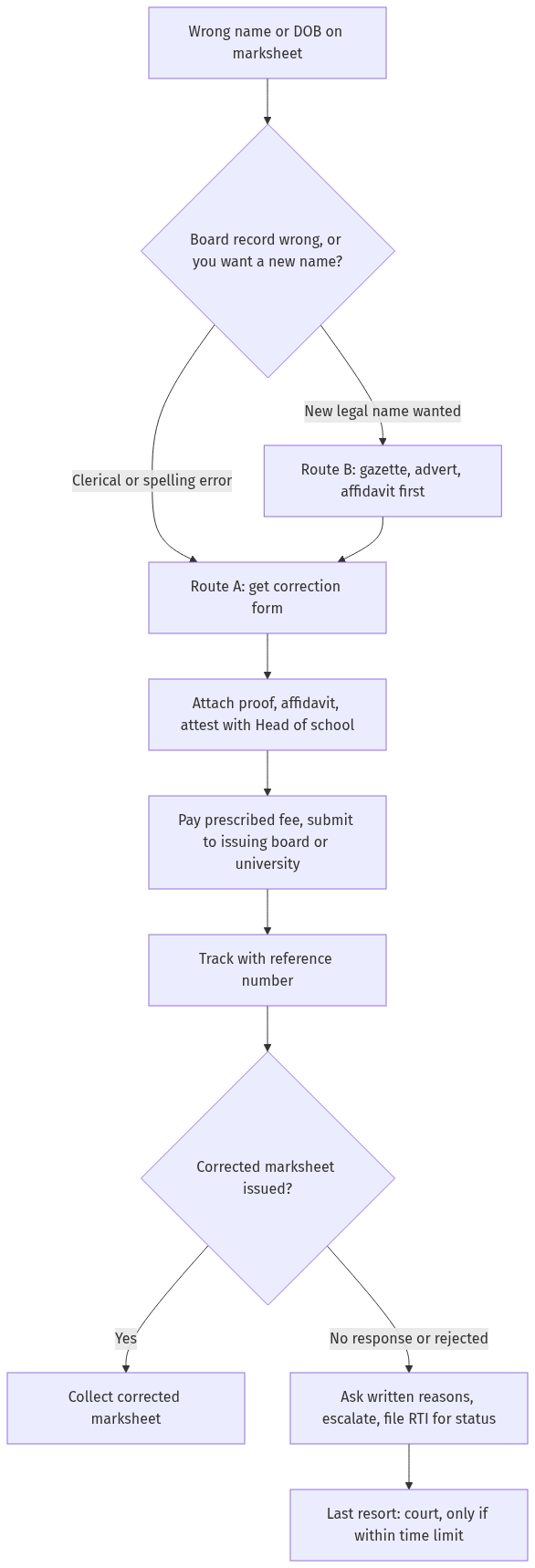
Figure: step-by-step flow. If a step stalls, use the grievance or RTI route shown.
If it stalls, goes silent, or is rejected
If weeks pass with no response, send a polite written reminder quoting your reference number and the date you applied. If the board still does not act, or rejects you without clear reasons, you can ask for those reasons in writing, escalate to the next authority, and use a Right to Information request to ask a public board what stage your file is at and why. For a full escalation plan, see our companion guide on what to do when a marksheet correction is rejected. Treat a court only as the last resort, and remember that, as the 2026 Delhi High Court ruling shows, a court will not rescue a request you let go time-barred.
While you are fixing one document, it is worth checking the others match. Our guides on the bonafide certificate and the gap certificate explain two records that often need the same name and dates, and if you are mid-application, keep your scholarship renewal details matching the corrected marksheet.
Frequently asked questions
Can I correct a spelling mistake in my marksheet online?
Many boards now accept the correction application online, but you still upload scanned proof and an attested form, and some boards require the originals by post. Start on your board or university portal and follow its exact instructions, because the steps differ.
Will the board change my date of birth?
Usually only to fix a clear clerical error, and only within a short window after your result. Boards do not treat DOB as freely changeable. If your real problem is a wrong entry in the birth register, fix that first under the Registration of Births and Deaths Act, then approach the board.
I want a completely new name, not a fix. What do I do?
That is a change of name, not a correction. Publish a gazette notification, place a newspaper advertisement, and swear a notarised affidavit, then apply to the board to update the record on the strength of the gazette.
How much does a marksheet correction cost?
A prescribed fee applies. CBSE's fee is around Rs 1,000 and includes the reissued document, but the amount varies by board and field corrected, so confirm the current fee on your own board or university portal before you pay.
What if my parent's name is wrong on the marksheet?
Boards allow it, but want more: typically the original admission form, the previous school leaving certificate, and the admission and withdrawal register page, all attested by the Head of school, plus an affidavit. Time limits apply here too.
My correction has been pending for months. Can I use RTI?
Yes. A public board is a public authority. You can file an RTI request asking the current status of your application, the reason for delay, and the name of the officer handling it. This often unsticks a silent file faster than another reminder.
Does the same process work for a university degree marksheet?
The principle is the same, but the rules sit in each university's examination ordinances and you apply to that university's Controller of Examinations, not to a school board. Check the awarding university's website for its specific form and documents.
Sources
Marksheet correction: How to fix errors in school/college certificates?
Errors in marksheets (name spelling, date of birth, marks, subjects) can cause problems in jobs and higher education. Here is the complete guide:
- Step 1: Common marksheet errors. (a) name spelling mistakes, (b) incorrect date of birth, © wrong marks/grades, (d) missing subjects, (e) wrong father/mother name, (f) wrong photograph, (g) wrong category (SC/ST/OBC).
- Step 2: CBSE/ICSE marksheet correction. (a) apply through the school where you studied, (b) fill the correction application form (available on the board's website), © submit: original marksheet, supporting documents (birth certificate for DOB, Aadhaar for name), (d) the board processes within 30-90 days, (e) fees: varies by board (CBSE Rs 1,000-2,000 depending on time elapsed).
- Step 3: State board marksheet correction. (a) apply through the school/college, (b) submit the correction form to the state board office, © the board issues a corrected marksheet or a correction letter, (d) some states allow online application through the board's portal.
- Step 4: University marksheet correction. (a) apply through the college to the university's examination branch, (b) submit: original marksheet, admission form copy, supporting documents, © the university issues a corrected marksheet within 30-60 days, (d) fees: varies by university (typically Rs 500-2,000).
- Step 5: Time limits. (a) CBSE: corrections possible within 10 years of the examination, (b) some boards have no time limit but charge higher fees for delayed corrections, © for DOB correction: supporting birth certificate must be issued before the date of the marksheet.
- Step 6: If board refuses correction. (a) file RTI asking for the status and reason for refusal, (b) file a complaint with the Board's grievance officer, © file a writ petition before the High Court (directing the board to correct the marksheet), (d) courts have ordered boards to correct marksheets based on documentary evidence.
- Step 7: File RTI. File RTI with the Board/University asking for: (a) the status of the correction application, (b) the reason for delay/refusal, © the number of correction applications pending.