Table of Contents
Gap Certificate for Admission/Job 2026

Reviewed on 2026-09-01 by Dr. Shrawan Kumar Pathak.
Quick Reply: No government office “issues” a gap certificate. It is a self-written sworn statement, called an affidavit, on non-judicial stamp paper, signed in front of a Notary Public under the Notaries Act 1952. You draft it, stamp it, get it notarised, and submit it. Cost and stamp value are set by your state.
Let us start with what a gap certificate actually is
Imagine you finished Class 12 in 2024 but joined college only in 2026. The college sees a two-year blank in your record and asks, “What were you doing?” A gap certificate is your written, signed answer to that question. It says, in plain words, “I had a gap from this date to this date, and here is why.”
Now the part that confuses most people. A gap certificate is not a printed card you collect from a counter. It is an affidavit. An affidavit simply means a statement you swear is true, the way you would swear in court. You write it yourself, then a Notary Public, an official appointed by the government to witness oaths, signs and stamps it to confirm you swore it in front of them. That signature and seal are what give the paper its weight.
So three plain ideas sit at the heart of this:
- You write the statement. It is your declaration, not the government's.
- It goes on non-judicial stamp paper, which is special paper on which you pay a small state tax (stamp duty) so the document is legally usable. “Non-judicial” just means it is for ordinary documents, not court fees.
- A notary witnesses your signature and adds an official seal under the Notaries Act 1952.
Why and when you need one
You usually need a gap certificate when there is a break between two stages of study or work and the next institution wants it explained. Common situations:
- You dropped a year to prepare for an entrance exam such as a medical or engineering test.
- You stopped studying due to illness, family duties, or money trouble, and now want to rejoin.
- You worked for some years and are returning to a course, or the reverse.
- A college, university, or employer in India or abroad asks for proof of what happened during the gap.
Here is the honest part many guides skip. No single central body, not the UGC, not any exam authority, prescribes one standard gap-certificate format that every institution must accept. Each college, counselling authority, or employer sets its own rule. Some accept a simple self-declaration. Others insist on a notarised affidavit on stamp paper of a particular value. So your very first step is not buying stamp paper, it is asking.
Step 0: ask the institution in writing first
Before you spend a rupee, email or message the admission office and ask three things: do they require a notarised affidavit or just a plain declaration, what stamp value they expect, and whether a scanned copy is enough or they want the original. Keep their reply. If they reject your certificate later, that written answer is your proof you followed instructions.
How to make a gap certificate, step by step
Step 1: buy non-judicial stamp paper
You can buy non-judicial stamp paper from a licensed stamp vendor, a sub-registrar office, or online as an e-stamp. An e-stamp is the same stamp duty paid electronically and printed on a certificate. The official e-stamping system is run by SHCIL (Stock Holding Corporation of India) at shcilestamp.com, available in many states. Some states instead use their own treasury or e-GRAS portal, so check which one covers your state.
The exact stamp value is set by your state, because stamp duty is a state subject. Do not trust a single all-India figure you read on a forum. Confirm the current value on your state stamp or registration department portal, or simply ask the vendor, before you print.
Step 2: draft the affidavit
On the stamp paper, write a short, factual statement. Keep it to one page. Include:
- Your full name, age, and address as on your ID.
- Your last qualification and the school or college that gave it.
- The gap period, written clearly as “from [month, year] to [month, year]”.
- The reason for the gap, stated plainly and truthfully.
- The name of the institution or employer where you are now applying.
- The date, and a space for your signature and the notary's seal.
If you are below 18, a parent or guardian usually swears and signs on your behalf. Write the truth. A false sworn statement is a punishable offence, so never invent a reason.
Step 3: get it notarised
Take the printed affidavit to a Notary Public, often found near a district court, with a photo ID. You sign in front of them, they administer the oath, then sign and apply their official seal and registration number. That act, under section 8 of the Notaries Act 1952, is what turns your paper into a notarised affidavit. A small notary fee applies. If you ever doubt whether a notary is genuine, the government notary portal at notary.gov.in lists notary information (currently for centrally appointed notaries); for a state-appointed notary, check with the appointing state's law or legal affairs department.
Step 4: attach proof and submit
Carry the originals and keep clear scans. Along with the notarised affidavit, attach:
- A photo ID such as Aadhaar, PAN, or passport.
- Your last marksheet or transfer certificate.
- Proof of the gap reason, for example medical papers, an exam admit card, or an employment or relieving letter.
Submit the set to the college, university, or employer exactly as they asked. If they wanted the original, do not send only a scan.
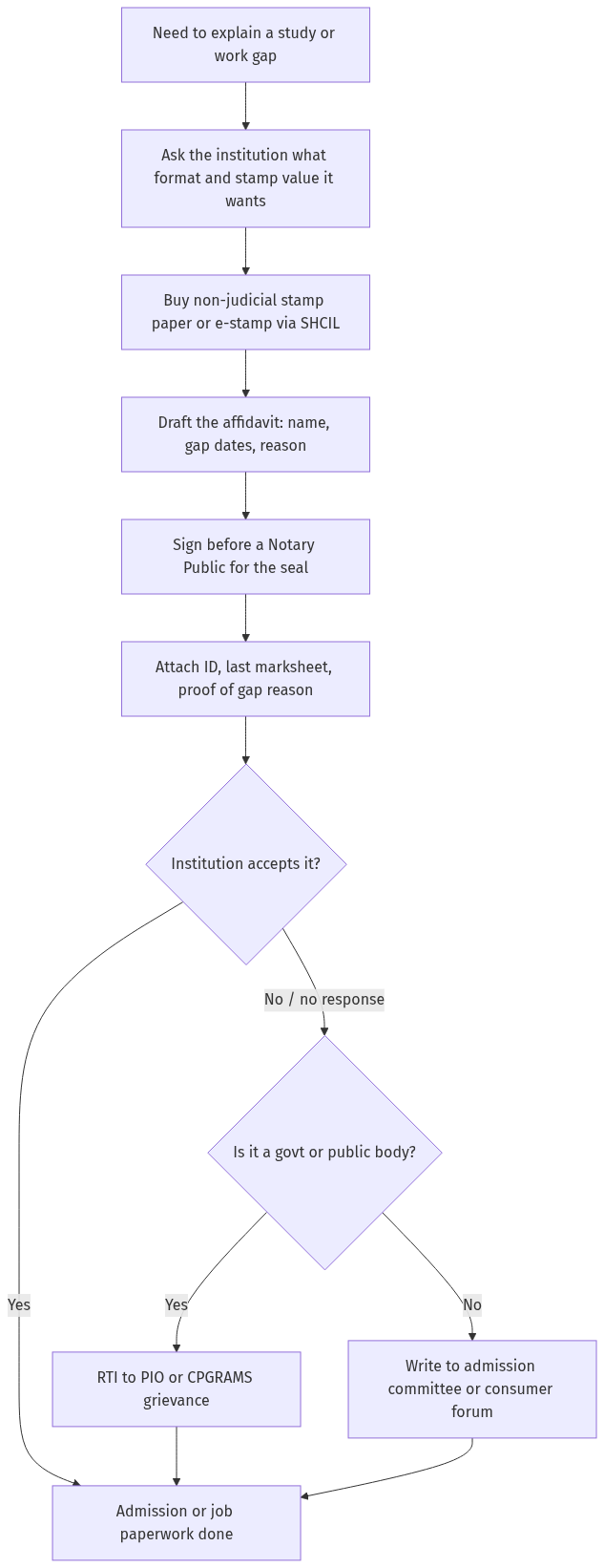
Figure: step-by-step flow. If a step stalls, use the grievance or RTI route shown.
If your certificate is rejected or admission stalls
The usual sticking point is not the notary. If one notary is unavailable, you simply go to another. The real trouble starts when the institution rejects your affidavit or sits on your admission without saying why.
First, get the objection in writing. Ask them to state which rule or format they are applying. Then:
- If it is a government or public body (a government college, a public university, or a government employer), you can file a Right to Information request with its Public Information Officer asking what rule governs gap acceptance and the status of your file. You can also raise a grievance on the central CPGRAMS portal at pgportal.gov.in. A short read on how to push a stuck file is our guide on a rejected document request.
- If it is a private institution, escalate in writing to the admission committee, attaching their own earlier reply. If it is a paid service and they deny what they promised, a consumer forum is an option.
For related paperwork students often need alongside a gap certificate, see our guides on the college migration certificate, the bonafide certificate, and a duplicate marksheet.
Frequently asked questions
Is a gap certificate issued by the government?
No. It is a self-declaration you write yourself. The government's only role is the Notary Public who witnesses your oath and the stamp duty you pay your state. There is no office that prints and hands you a gap certificate.
How much does a gap certificate cost in 2026?
The cost is the stamp paper value plus a small notary fee. Stamp duty is set by each state, so there is no single all-India price. Check the current stamp value on your state stamp or registration portal, or ask the vendor, before you pay.
Do I need stamp paper, or is plain paper fine?
It depends on the institution. Many insist on non-judicial stamp paper and notarisation; some accept a plain self-declaration. This is why you ask the institution first, in writing, and keep their reply.
Can I get the stamp paper online?
Yes, in many states. Non-judicial stamp duty can be paid as an e-stamp through the SHCIL portal at shcilestamp.com. Some states use their own treasury or e-GRAS portal instead, so confirm which one serves your state.
What reason should I write for the gap?
Write the real reason, briefly. Exam preparation, illness, family responsibility, or work are all acceptable. Never invent a reason, because an affidavit is sworn and a false statement is an offence.
I am under 18. Can I still make one?
Usually a parent or guardian swears and signs the affidavit on your behalf as the minor's guardian. Carry the guardian's ID along with yours when you visit the notary.
The college rejected my gap certificate. What can I do?
Get the objection in writing. If the college is government or public, file an RTI with its Public Information Officer asking which rule applies and lodge a grievance on pgportal.gov.in. If it is private, escalate to the admission committee with their earlier reply attached.
How long is a gap certificate valid?
It records a fixed gap period, so it does not expire as such. Most institutions accept a recently notarised one. If yours is old or the dates have changed, it is cheap to draft a fresh affidavit rather than risk a query.