Table of Contents
Education Loan Moratorium and Relief 2026
RBI Ombudsman as of 1 July 2026: Bank, certain NBFC, prepaid-instrument and credit-information complaints go under the Reserve Bank - Integrated Ombudsman Scheme, 2026, which replaced RB-IOS 2021 from 1 July 2026. First complain to the entity. If there is no reply in 30 days (or the longer NPCI/card-network window, if it applies) or you reject the reply, file free at cms.rbi.org.in within 90 days. The Ombudsman can award up to Rs 30 lakh for consequential loss and up to Rs 3 lakh for time, expenses and harassment. Complaints received before 1 July 2026 stay under the 2021 scheme. Source: RBI FAQ, updated 1 July 2026 and the RB-IOS 2026 FAQ PDF dated 1 July 2026.

Reviewed on 2026-06-20 by Dr. Shrawan Kumar Pathak.
Quick Reply: A moratorium is your repayment holiday while you study, plus up to one year after. During this holiday two government schemes can pay your interest for you. If your family income is up to Rs 4.5 lakh, CSIS or PM-Vidyalaxmi can cover the full interest. Apply through your bank or the Vidya Lakshmi portal.
What this guide is for
Most education loan guides tell you what a moratorium is and what to do when a bank breaks its promise. This guide answers a sharper question: during the moratorium, who actually pays the interest, and how do you make the government pay it for you? That is real money. On a Rs 10 lakh loan, interest over the study years can run into lakhs, and a subsidy can wipe it out.
If you are an existing borrower fighting a bank over moratorium terms or a wrong EMI, read our companion page on education loan moratorium rights and repayment. That page covers the complaint ladder and the RBI Ombudsman. This page covers getting your interest paid in the first place.
Moratorium in one minute
A moratorium is the gap between when your loan is sanctioned and when you must start full repayment. Under the standard model scheme, it runs for your course period plus one year after the course, or six months after you get a job, whichever comes earlier. You do not separately apply for it. It is built into your sanction letter.
The catch is interest. Interest keeps building on your loan during the moratorium even though you pay nothing. When repayment starts, that built-up interest is added to your loan, so your EMI is larger. The two relief schemes below exist to stop that from happening to lower-income families.
Scheme one: CSIS for EWS students
The Central Sector Interest Subsidy Scheme pays your full interest during the moratorium if you belong to the Economically Weaker Section.
Who qualifies for CSIS
- Annual family income up to Rs 4.5 lakh.
- Loan taken under the Indian Banks Association model education loan scheme.
- A technical or professional course pursued in India.
- Loan up to Rs 10 lakh (the ceiling was raised to this amount). Loans up to Rs 7.5 lakh need no collateral or guarantor.
What CSIS pays
It pays the entire interest for the whole moratorium period, your course duration plus one year. After the moratorium, you start paying EMIs on the principal, so your repayment burden is much lighter. Canara Bank is the nodal bank that releases the subsidy to your lending bank.
How to claim CSIS
- Get an income or EWS certificate from your authorised state government officer. This is mandatory and is the document students most often miss.
- Tell your lending bank you want CSIS noted on your loan account when the loan is sanctioned or at the start of the moratorium.
- Submit the certificate and the scheme claim form your bank gives you.
- Keep your acknowledgement. The bank forwards your claim to the nodal bank for the subsidy.
Scheme two: PM-Vidyalaxmi
PM-Vidyalaxmi is the newer scheme, approved by the Cabinet on 6 November 2024 and run by the Department of Higher Education. It is built around the country's top institutions.
Who qualifies for PM-Vidyalaxmi
You must get admission to one of the roughly 860 Quality Higher Education Institutions selected using NIRF rankings. This list covers institutions ranked in the top 100 in the NIRF overall, category and domain rankings, certain state institutions ranked just below them, and central government institutions. The exact list updates with NIRF each year, so check the current list before you count on it.
What PM-Vidyalaxmi gives you
- A collateral-free, guarantor-free loan covering full tuition and course costs.
- For loans up to Rs 7.5 lakh, a 75 per cent credit guarantee from the government, which helps the bank approve you.
- Family income up to Rs 4.5 lakh: the full interest subvention during the moratorium continues, delivered through the existing CSIS mechanism described above.
- Family income up to Rs 8 lakh, where you are not already getting another government scholarship or interest subvention: a new 3 per cent interest subvention on a loan up to Rs 10 lakh during the moratorium. This 3 per cent band, the credit guarantee and the digital loan product are what PM-Vidyalaxmi adds on top.
How to apply for PM-Vidyalaxmi
- Confirm your institution is on the current PM-Vidyalaxmi list.
- Register on the Vidya Lakshmi portal at vidyalakshmi.co.in.
- Fill the common education loan application form once. You can apply to up to three banks with it.
- Submit your admission letter, fee structure and income proof. The interest subvention is applied based on your income band.
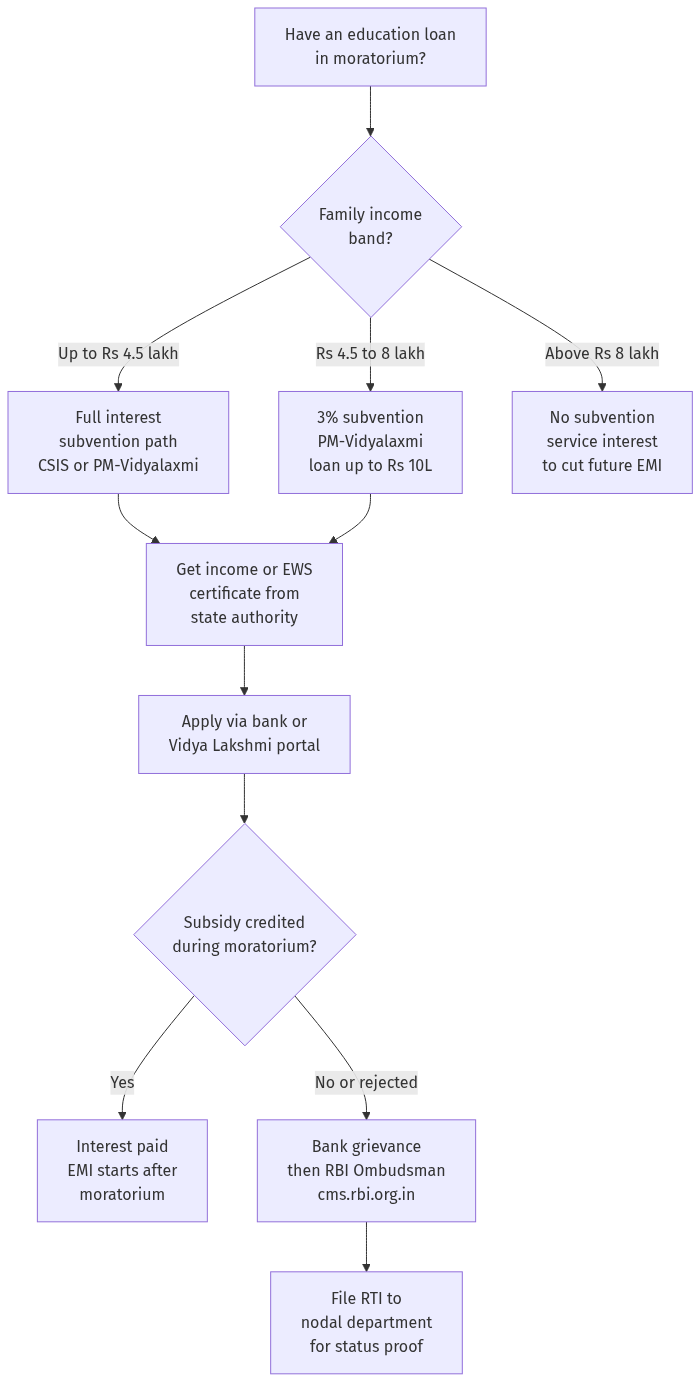
Figure: step-by-step flow. If a step stalls, use the grievance or RTI route shown.
Which scheme is right for you
If you are an EWS student on a professional course in India, CSIS is the established route to full interest relief. If you have a seat in a top-ranked institution, PM-Vidyalaxmi is built for you and adds the collateral-free loan and credit guarantee. You cannot stack the same benefit twice, so the 3 per cent PM-Vidyalaxmi band is meant for those not already covered by another scheme. When unsure, ask your bank which scheme your loan account is tagged under and verify on the Vidya Lakshmi portal.
If your subsidy is not credited
Sometimes the moratorium passes and the interest was never subsidised, or your claim is silently rejected. First raise a written complaint with your branch and keep the receipt. If there is no fix within 30 days, escalate to the RBI Ombudsman through the complaint portal at cms.rbi.org.in. To get proof of what the nodal department actually did with your claim, you can file an RTI asking for the status and any rejection reasons. Our guide on scholarship renewal shows the same paper-trail discipline for education benefits.
Frequently asked questions
Do I have to apply separately for the moratorium?
No. The moratorium is automatic and written into your sanction letter as the course period plus one year, or six months after employment, whichever is earlier. What you do apply for is the interest subsidy that pays the moratorium interest for you.
What is the income limit for free interest?
Family income up to Rs 4.5 lakh a year gets full interest paid during the moratorium under CSIS or PM-Vidyalaxmi. Income up to Rs 8 lakh can get a 3 per cent subvention under PM-Vidyalaxmi on a loan up to Rs 10 lakh, if you are not already covered by another scheme.
Which courses does CSIS cover?
CSIS covers technical and professional courses pursued in India under the banks' model education loan scheme, for students from the Economically Weaker Section. Confirm your exact course and current limits with your bank, as ceilings can change.
What document do students most often forget?
The income or EWS certificate from the authorised state government officer. Without it your CSIS claim cannot move. Get it early, before the loan is sanctioned if you can, and give a copy to your bank.
Where do I apply for PM-Vidyalaxmi?
On the Vidya Lakshmi portal at vidyalakshmi.co.in. You register once, fill the common application form, and can apply to up to three banks. Your institution must be on the scheme's current list of quality institutions.
Can I get both CSIS and PM-Vidyalaxmi?
You cannot claim the same interest benefit twice. The schemes are alternative routes, and the PM-Vidyalaxmi 3 per cent band is meant for students not already getting another government subvention. Ask your bank which one your account is tagged under.
What if the bank never credited my subsidy?
Complain in writing to your branch first and keep the receipt. If unresolved in 30 days, escalate to the RBI Ombudsman at cms.rbi.org.in, and file an RTI with the nodal department to get the documented status and any rejection reason.
Sources
Read our companion education loan moratorium rights page for the repayment and Ombudsman ladder, the scholarship renewal guide, and how a bonafide certificate and gap certificate support your education paperwork.
Education loan moratorium: RBI rules and student rights (2026)
- Step 1: What is an education loan moratorium? (a) Moratorium: (i) period during which borrower does not pay EMI, (ii) typically course duration + 6-12 months after, (iii) interest may accrue during moratorium — depends on scheme, (b) RBI rules: (i) moratorium is standard for education loans, (ii) interest subvention: Central Sector Interest Subvention Scheme — for loans up to Rs 10 lakh, (iii) credit guarantee: CGFSEL — for collateral-free loans up to Rs 7.5 lakh, © types: (i) full moratorium — no interest, no EMI, (ii) partial moratorium — interest accrues, pay after course, (iii) interest-only — pay interest during course, (d) authority: bank + RBI — rbi.gov.in, (e) law: RBI Master Directions on Education Loans.
- Step 2: Comparison table — education loan moratorium types. (a) Full moratorium: (i) interest: no interest charged, (ii) EMI: starts after course + 6-12 months, (iii) scheme: Central Sector Interest Subvention — EWS/SC/ST, (iv) amount: up to Rs 10 lakh, (v) example: student got full moratorium under CSIS — no interest during course, (b) Partial moratorium: (i) interest: accrues during moratorium, (ii) EMI: starts after course + 6 months, (iii) scheme: standard bank education loan, (iv) amount: up to Rs 20 lakh (India), Rs 30 lakh (abroad), (v) example: student's interest accrued during course — added to principal, © Interest-only: (i) interest: pay interest during course, (ii) EMI: starts after course, (iii) scheme: some banks offer, (iv) amount: standard, (v) example: student paid interest during course — reduced total burden, (d) Extended moratorium: (i) interest: accrues, (ii) EMI: starts after course + 12 months, (iii) scheme: for professional courses, (iv) amount: up to Rs 20 lakh, (v) example: medical student got 12-month moratorium after graduation, (e) Moratorium + grace: (i) interest: may accrue, (ii) EMI: starts after course + 6 months + bank grace, (iii) scheme: bank-specific, (iv) amount: standard, (v) example: student got 8 months grace after course. (Note: Moratorium is RBI-mandated — banks cannot deny it; interest subvention available for eligible students.)
- Step 3: How to claim education loan moratorium. (a) Step 1: Check loan agreement — moratorium clause, (b) Step 2: Apply for interest subvention — if eligible (EWS/SC/ST), © Step 3: Submit course completion proof — to start EMI clock, (d) Step 4: If bank denies moratorium — file RBI complaint, (e) Step 5: File RTI with bank for moratorium status, (f) Step 6: Escalate to Banking Ombudsman if bank non-compliant.
- Step 5: Practical tips. (a) moratorium is RBI-mandated — bank cannot deny, (b) interest subvention: apply early — EWS/SC/ST eligible, © keep course completion certificate — triggers EMI start, (d) CGFSEL: collateral-free up to Rs 7.5 lakh, (e) Example: A student's bank denied moratorium; filed RBI complaint; RBI directed bank to grant moratorium — bank complied.
- Step 6: Key legal provisions. (a) RBI Master Directions: Education Loans, (b) Central Sector Interest Subvention Scheme: full moratorium for eligible, © CGFSEL: credit guarantee — collateral-free, (d) RBI Ombudsman: rbi.org.in — complaint, (e) RTI: file with bank for moratorium/subvention status.
See Education Loan Moratorium and Coaching Centre Ads and How to File RTI and First Appeal and GST Refund.