Table of Contents
Bonafide Certificate: How to Apply 2026

Reviewed on 2026-06-20 by Dr. Shrawan Kumar Pathak.
Quick Reply: A bonafide certificate is issued by your own school, college or university to confirm you are a genuine student there. Apply on your institution student or ERP portal or at the office, state your exact purpose, attach your ID, and collect the signed and sealed copy. Fees and timelines are set by each institution.
You need it by Friday. The bank wants proof you are still a student, or the scholarship form has a blank that says “attach bonafide”. Good news: this is one of the fastest documents to get, because the people who issue it already have all your records. Here is the speed run.
The 60-second version
- Open your college or school student portal (or walk to the admin office).
- Find “Bonafide Certificate” under certificates, requests or services.
- Type your name, roll or enrolment number, course, year, and the exact purpose.
- Attach your ID card or admission proof, pay any small fee, and submit.
- Track approval, then download the e-copy or pick up the signed and sealed paper.
That is the whole thing. The rest of this guide is the fine print that stops you from doing it twice.
Who actually issues it
A bonafide certificate is not a government licence you queue for. It is issued by the institution you belong to, on its own letterhead, signed by the head, principal, registrar or an authorised officer. So there is no single national website. If you study at a college, it comes from the college. If you are at school, the principal signs it. If you are an employee asking for an employment bonafide, your employer issues it.
Because each institution runs its own process, the fee, validity and turnaround are set locally. Many places give the first copy free and charge a nominal amount for extra copies. Do not trust a number you read on a blog; verify the current figure on your institution's portal or notice board.
Write the purpose, do not leave it blank
The single thing that slows people down is the purpose line. The certificate usually prints why it was issued, and the body asking for it often wants that wording to match. Before you apply, know the exact reason: passport application, education loan, scholarship, hostel or rented house address proof, student bus or metro pass, visa, or admission elsewhere. Write that purpose in your own words and keep it specific. A vague “for personal use” gets bounced back.
What to keep ready
You rarely need much, because the office already holds your file. Keep these handy so you finish in one sitting:
- Your student ID card or admission or enrolment proof.
- Your roll number or enrolment number.
- The latest fee receipt, if the portal asks for it.
- The exact purpose and, if a specific body needs it, the name of that body.
Check the certificate the moment you receive it. Your name spelling, roll number, course and the duration of study must be correct, and it must carry the institution seal and an authorised signature. A bonafide without the seal is just a printout.
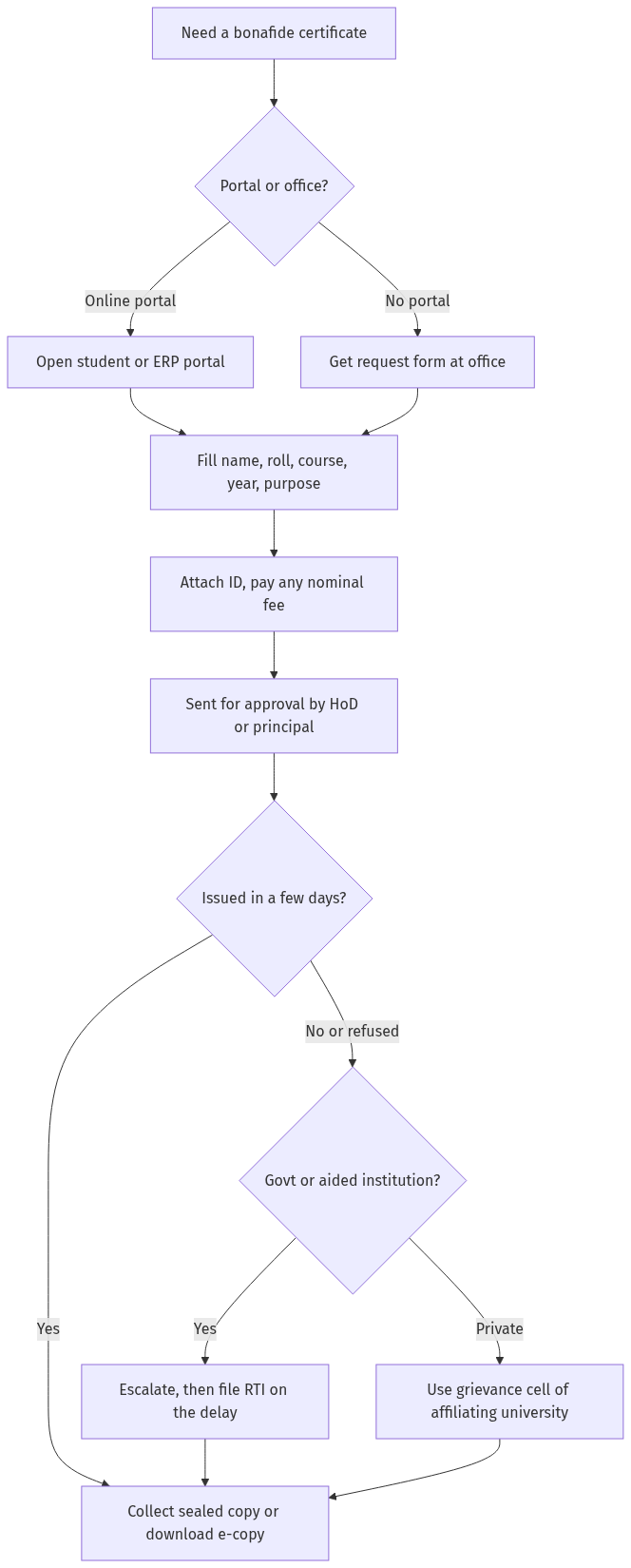
Figure: step-by-step flow. If a step stalls, use the grievance or RTI route shown.
Do not confuse it with the state bonafide
In a few states the word “bonafide” also means a residence certificate issued by the Revenue Department through the Tehsildar or SDM, and a domicile certificate proves permanent residence in a state. Those are different documents for a different purpose and are not signed by your college. If a form is actually asking for proof that you live in a particular state, go to your state revenue or eDistrict portal, not your institution. This guide is about the student bonafide your institution issues.
When it is stuck or refused
Most requests clear in a few days. If yours does not, the route depends on who you study with.
First, follow up in writing. Email or message the office, quote your application or reference number, and ask for the expected date. Keep it polite and on record.
If a government or government-aided school, college or university sits on your application or refuses without reason, you have a real lever: it is a public authority under the Right to Information Act, 2005. You can escalate to the principal or registrar, then to the institution's grievance cell or the state education department, and you can file an RTI asking the status of your application and the reason for any delay. See our guide on filing for a duplicate marksheet via RTI for the same approach applied to records.
If it is a purely private, unaided institution, RTI does not apply directly. Use the institution's own grievance process, the affiliating university's student grievance redressal cell, and, where the issue involves fees or service, your state consumer or education grievance forum.
If you are gathering documents for a scholarship, line up the bonafide early, because the NSP scholarship renewal window does not wait. Students moving between institutions usually need this alongside a school transfer certificate or a college migration certificate, and a study break may need a gap certificate too, so request them in one trip.
Frequently asked questions
Is a bonafide certificate free?
Often the first copy is free and extra copies carry a small fee, but there is no national rate. Each institution sets its own charge, so verify the current figure on your institution's portal or office notice.
How long is a bonafide certificate valid?
There is no fixed national validity. The body asking for it, such as a bank, passport office or scholarship portal, decides how recent a certificate it will accept. Confirm the acceptable date with that body before you apply.
Can I apply for a bonafide certificate online?
Yes, where your institution runs a student or ERP portal you can apply, pay and often download it online. Where there is no portal, you submit a written request at the office and collect the signed and sealed copy.
What is the difference between a bonafide and a domicile certificate?
A student bonafide proves you genuinely study at an institution and is signed by that institution. A domicile or state residence certificate proves permanent residence in a state and is issued by the Revenue Department through the Tehsildar or SDM.
Do I need a bonafide certificate for a passport?
A passport application does not always require one, but some applicants are asked for proof of current student status. Treat it as commonly asked for, not always mandatory, and carry it only if the passport office or your situation calls for it.
Can I get a bonafide certificate after I have left the institution?
A current bonafide confirms present enrolment, so once you have left you usually need a study or course completion certificate instead. Ask the institution which document fits your purpose.
What should I do if the office keeps delaying my certificate?
Follow up in writing with your reference number. For a government or aided institution you can escalate and file an RTI on the delay. For a private institution, use its grievance process and the affiliating university's grievance cell.