Table of Contents
Blood Group Compatibility: Who Can Donate to Whom
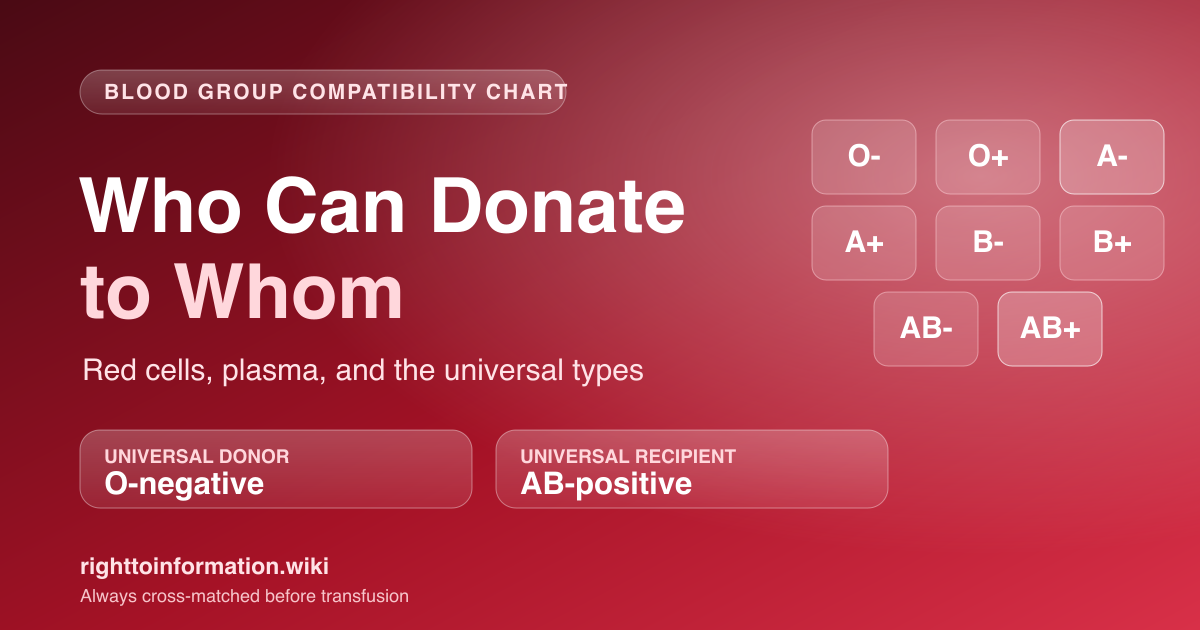
Quick Reply: O-negative is the universal donor and AB-positive the universal recipient. See the full blood group compatibility chart for who gives and receives red cells.
Your blood group decides who you can give blood to and who you can receive it from. The short version: O-negative is the universal donor (its red cells suit every patient), and AB-positive is the universal recipient (it can receive from everyone). The full chart below shows every combination for red cells, the reverse rule for plasma, and why O-negative and AB matter so much in an emergency.
The full red-cell compatibility chart
This is the master chart for red blood cells, the most common transfusion. Find your blood type in the first column.
| Your blood type | Can give red cells to | Can receive red cells from |
|---|---|---|
| O-negative | Everyone (universal donor) | O-negative |
| O-positive | O+, A+, B+, AB+ | O+, O- |
| A-negative | A-, A+, AB-, AB+ | A-, O- |
| A-positive | A+, AB+ | A+, A-, O+, O- |
| B-negative | B-, B+, AB-, AB+ | B-, O- |
| B-positive | B+, AB+ | B+, B-, O+, O- |
| AB-negative | AB-, AB+ | AB-, A-, B-, O- |
| AB-positive | AB+ | Everyone (universal recipient) |
Important: this chart is for general understanding. Before any real transfusion, a blood bank always does a cross-match test on your actual sample. Never rely on a chart alone in a medical emergency.
Universal donor and universal recipient
Two blood types do special work.
- O-negative is the universal donor. It carries no A, B or Rh antigens, so its red cells will not trigger a reaction in any patient. This is why ambulances and trauma units stock O-negative for emergencies, when there is no time to test the patient first.
- AB-positive is the universal recipient. A person with AB-positive blood can receive red cells from any group, which makes transfusion planning easier for them.
Because O-negative suits everyone, it is always in high demand and often in short supply. If you are O-negative, your donation is especially valuable.
Plasma works the opposite way
Plasma compatibility is the mirror image of red cells.
- AB is the universal plasma donor. AB plasma carries no anti-A or anti-B antibodies, so it suits any recipient.
- O is the universal plasma recipient.
So an AB-positive person, who can receive red cells from anyone, is at the same time a universal plasma donor. This is why blood banks value every group, not only O-negative.
Why your type matters when you donate
When you give one unit of whole blood, it is separated into red cells, plasma and platelets, and each part follows its own compatibility rule. That single donation reaches up to three patients. The rarer your match, the more your donation counts:
- O-negative keeps emergency stocks alive.
- AB plasma helps patients of every group.
- Every common type keeps the everyday supply steady for surgeries, childbirth and thalassaemia care.
Ready to give? Check the eligibility rules and what to expect when you donate, then find a blood bank or camp on the government eRaktKosh portal at eraktkosh.mohfw.gov.in.
Your pre-donation checklist
- Know your blood group, or let the blood bank test it for you.
- Confirm you meet the basic criteria: 18 to 65 years, 45 kg or more, feeling well.
- Eat a meal and drink water before you go.
- Carry a photo ID.
- Find a centre or camp on eRaktKosh.
Frequently asked questions
Which blood group is the universal donor?
O-negative is the universal red-cell donor. It has no A, B or Rh antigens, so its red cells can be given safely to a patient of any blood group. This is why O-negative is used in emergencies before the patient's own type is known, and why it is always in high demand.
Which blood group is the universal recipient?
AB-positive is the universal recipient for red cells. A person with AB-positive blood can receive red cells from every blood group. For plasma the rule reverses, so the universal plasma donor is AB and the universal plasma recipient is O.
Who can O-positive donate to?
O-positive red cells can be given to O+, A+, B+ and AB+ recipients, that is, to any Rh-positive group. An O-positive person can receive red cells from O-positive and O-negative donors. O-positive is the most common blood type, so it carries much of the everyday transfusion load.
Can A donate to B or B donate to A?
No. A red cells are not compatible with a B recipient, and B red cells are not compatible with an A recipient, because each would react against the other's antigen. A and B can both give to AB recipients, and both can receive from O donors.
Why is the plasma rule the opposite of red cells?
Red-cell compatibility depends on antigens on the cells, while plasma compatibility depends on antibodies in the fluid. AB plasma carries no anti-A or anti-B antibodies, so AB is the universal plasma donor. O red cells carry no A or B antigen, so O is the universal red-cell donor. The two systems run in opposite directions.
Does the compatibility chart replace a blood test?
No. The chart explains how groups relate, but a blood bank always cross-matches your actual sample against the donor unit before a transfusion. This catches rarer incompatibilities the basic ABO and Rh chart does not show. Always rely on the medical test, not the chart.
Sources
- American Red Cross, Blood Types and compatibility, redcrossblood.org.
- Ministry of Health and Family Welfare, eRaktKosh Centralised Blood Bank Management System, eraktkosh.mohfw.gov.in.
- National Blood Transfusion Council (NBTC), NACO, donor eligibility, nbtc.naco.gov.in.
Related reading
- The RTI Playbook for using your information rights with public hospitals and blood banks.
- AI RTI Drafter to ask a blood bank or hospital for records.