Table of Contents
Atal Pension Yojana APY: Rs 1,000-5,000 Pension
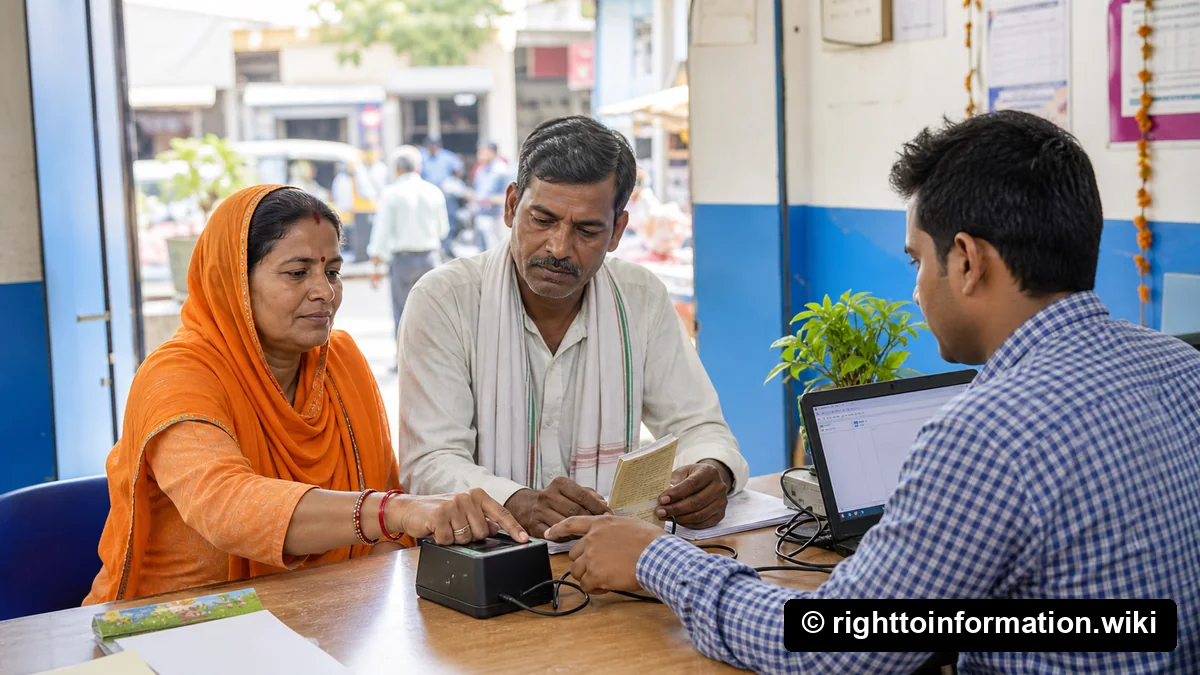
Quick Reply: Atal Pension Yojana pays a government-guaranteed monthly pension of Rs 1,000 to Rs 5,000 after age 60 for unorganised workers. Join at 18 to 40. RTI help here.
If you are between 18 and 40 and you want a fixed pension in old age, here are the first five things to do. You can finish most of this at your own bank branch in a single visit.
- Confirm you qualify today. You need to be an Indian citizen aged 18 to 40 with an active savings bank or post office account. If you file income tax, you cannot open a new account since 1 October 2022, so this scheme is built for unorganised workers who are outside the tax net.
- Decide your pension slab. Pick the monthly pension you want after 60, from Rs 1,000, Rs 2,000, Rs 3,000, Rs 4,000, or Rs 5,000. The younger you join, the smaller the monthly contribution for the same pension.
- Fill the APY form at your bank. Ask for the Atal Pension Yojana registration form, or open it through your bank's net banking or mobile app. Give your Aadhaar, your savings account number, and a mobile number.
- Turn on auto-debit. Choose monthly, quarterly, or half-yearly deductions. The contribution is pulled from your savings account on its own, so keep enough balance on the due date.
- Save the acknowledgement and the PRAN. You get a Permanent Retirement Account Number. Keep the acknowledgement slip, because it is the reference you will quote if a deduction fails or a statement goes missing.
That is the whole action list. The rest of this guide explains what you will receive, what each age pays, and what to do when a bank sits on your file.
Atal Pension Yojana gives a government-guaranteed minimum pension of Rs 1,000, Rs 2,000, Rs 3,000, Rs 4,000, or Rs 5,000 per month from age 60, based on the slab you pick and the age at which you join. Your spouse continues the pension after you, and the full corpus goes to your nominee after both of you.
Launched: 2015 · Administered by: Pension Fund Regulatory and Development Authority (PFRDA)
A quick before and after
Think of a 25 year old who drives a shared auto and stitches nothing aside for old age. Every rupee goes on rent, fuel, and the children's school. The worry that sits in the background is what happens at 60, when the body slows down and there is no salary and no employer pension. For most unorganised workers there has never been a simple, safe way to build a small monthly income for that stage.
Now look at the same worker after opening an APY account. A fixed amount leaves the savings account each month on auto-debit, small enough that it does not hurt the household budget. Decades later, from the 60th birthday, a guaranteed monthly pension lands in the same account for life. If the worker dies, the spouse keeps drawing the same pension. When both are gone, the accumulated corpus passes to the nominee. The old-age worry has a floor under it. That floor is the point of the scheme.
Who is eligible
- Indian citizen aged 18 to 40 at the time of joining. The upper age of 40 is firm, because the scheme needs at least 20 years of contribution before the pension starts at 60.
- An active savings bank account or post office savings account. The account is where the contribution is auto-debited and where the pension is later credited.
- Aadhaar and a mobile number for registration and for account updates.
- Not an income tax payer. Since 1 October 2022, any citizen who is or has been an income tax payer as on the date of application cannot join. This change was made so the scheme stays targeted at low income and unorganised workers.
If you enrolled before that cut-off and later started paying income tax, your existing account is not disturbed. The bar applies to new enrolment from 1 October 2022 onward. Government and formal-sector staff who are already covered by other statutory pension arrangements are generally outside the intended group as well.
What you get after 60
The core benefit is a fixed monthly pension for life from your 60th birthday, in whichever slab you chose. The pension is a minimum that the Union government guarantees. If the invested contributions earn more than needed, the extra can raise the pension, but the floor is assured.
- Lifelong pension to you at Rs 1,000, Rs 2,000, Rs 3,000, Rs 4,000, or Rs 5,000 a month.
- Same pension to your spouse for life after your death.
- Return of the accumulated corpus to your nominee after both you and your spouse have passed away.
The indicative corpus that builds up for the nominee rises with the slab. For the Rs 1,000 pension the return of corpus is about Rs 1.7 lakh, for Rs 2,000 it is about Rs 3.4 lakh, for Rs 3,000 about Rs 5.1 lakh, for Rs 4,000 about Rs 6.8 lakh, and for the Rs 5,000 pension it is about Rs 8.5 lakh. These are the figures published in the official APY contribution chart.
What each age pays: the contribution chart
Your monthly contribution depends on two things, the pension slab you choose and your age when you join. The earlier you start, the less you pay each month for the same pension, because your money has more years to grow.
Here is the official chart for someone who joins at the youngest age, 18 years, and contributes for the full 42 years to age 60.
| Pension after 60 | Monthly contribution at entry age 18 | Corpus to nominee |
|---|---|---|
| Rs 1,000 | Rs 42 | about Rs 1.7 lakh |
| Rs 2,000 | Rs 84 | about Rs 3.4 lakh |
| Rs 3,000 | Rs 126 | about Rs 5.1 lakh |
| Rs 4,000 | Rs 168 | about Rs 6.8 lakh |
| Rs 5,000 | Rs 210 | about Rs 8.5 lakh |
The cost climbs steeply if you wait. A person who joins at the oldest allowed age of 40 pays Rs 291 a month for the Rs 1,000 pension and Rs 1,454 a month for the Rs 5,000 pension, for only 20 years of contribution. So the Rs 5,000 pension that costs Rs 210 a month at 18 costs almost seven times as much at 40. The lesson is plain. If you are eligible, an early start is the cheapest route to the same pension. For your exact age and slab, check the full age-wise chart on the official portal before you sign.
How to apply, step by step
- Visit your bank or post office where you hold the savings account, or open the APY section inside your bank's net banking or mobile app.
- Ask for the APY registration form and fill your name, Aadhaar number, savings account number, mobile number, and nominee details.
- Choose the pension slab from Rs 1,000 to Rs 5,000 and the contribution frequency of monthly, quarterly, or half-yearly.
- Authorise auto-debit so the contribution is deducted on its own from your savings account on the due date.
- Collect the acknowledgement and your PRAN. The bank confirms enrolment and gives you a Permanent Retirement Account Number for the account.
There is no separate fee to open an APY account. If anyone asks you to pay a charge to enrol you, treat it as a warning sign and enrol directly through your own bank.
Documents you need
| Document | Why it is needed |
|---|---|
| Aadhaar | For identity and registration |
| Active savings bank or post office account | For auto-debit of contributions and later credit of pension |
| Mobile number | For confirmation messages and account updates |
| Nominee details | To record who receives the corpus |
Auto-debit, penalties, and keeping the account healthy
The contribution is collected by auto-debit, so the single most common problem is an empty account on the due date. When the balance is short, the bank cannot pull the contribution and the account falls into arrears.
There is a small overdue charge. For a delayed contribution the bank levies about Rs 1 for every Rs 100 of contribution, or part thereof, for each month of delay, and this is added back into your pension corpus. The amount is minor for a single missed month, but repeated defaults over a long period eat into the final corpus, and a long run of unpaid dues can lead to the account being frozen and later closed with the balance returned to you. The fix is simple. Keep a little buffer in the savings account around the auto-debit date.
Exit, and changing your pension slab
APY is a long-term retirement product, so the normal design is that the money stays locked until 60, when the pension begins. On the death of the subscriber before 60, the spouse can either continue the account until the subscriber would have turned 60 and then draw the pension, or take the accumulated corpus at once. There are defined provisions for exit in special situations such as terminal illness, and the rules on voluntary exit have been revised over the life of the scheme. There is also a facility to increase or decrease your pension slab after you have joined. Because these exit and slab-change rules have changed more than once, confirm the current version on the official portal or with your bank before you act, rather than relying on an old summary.
Where this scheme came from
Atal Pension Yojana was launched in 2015 by the Union government led by Prime Minister Narendra Modi, to give unorganised sector workers a guaranteed old-age pension in place of no pension at all. It is administered by the Pension Fund Regulatory and Development Authority. You can see it next to every other central and state welfare scheme on the All Modi-era Sarkari Yojana index 2014 to 2026.
Common problems and how to fix them
- Auto-debit keeps failing. Keep enough balance around the due date. If the deduction fails even with balance, ask the branch to check the mandate and clear any accumulated overdue charge.
- You think you might be a tax payer. If you have filed income tax, you are not eligible to open a new account since 1 October 2022. If you enrolled earlier and only later became a tax payer, your existing account continues.
- You want to change the pension amount. There is a facility to move up or down between slabs. Ask your bank for the current process and any window that applies.
- You have moved or changed banks. Your APY account and PRAN stay with you. Get the account details updated so the auto-debit continues from the account you now use.
- A statement or the pension credit is missing. Ask the bank in writing for a current statement of contributions and corpus. If the bank does not respond, the RTI route below is built for exactly this.
Benefit delayed or an answer refused? File an RTI
When a bank or the record-keeping agency sits on your request and a phone call leads nowhere, a written Right to Information request usually moves the file, because the public authority must then answer in writing within the statutory time or explain why it cannot. Ask narrow, factual questions about the status of your account, the officer handling it, and the reason for any delay.
- Draft it in minutes: AI RTI Drafter
- Full filing and appeal process: The RTI Playbook
Frequently asked questions
Is the pension truly guaranteed?
The Union government guarantees the minimum pension in your chosen slab. If the invested contributions fall short of what is needed, the government makes up the difference, so the floor of Rs 1,000 to Rs 5,000 a month is assured.
What happens if I die before 60?
Your spouse can either continue the account until you would have turned 60 and then draw the same pension for life, or take the accumulated corpus at that point. After both of you, the corpus goes to your nominee.
Can I join if I pay income tax?
No. Since 1 October 2022, a person who is or has been an income tax payer cannot open a new APY account. If you enrolled before that date, your account continues even if you later start paying tax.
How much do I pay at my age?
It depends on your entry age and slab. At 18 the Rs 5,000 pension costs about Rs 210 a month, while at 40 the same pension costs about Rs 1,454 a month. Check the full age-wise chart on the official portal for your exact figure.
Can I increase my pension amount later?
There is a facility to move between pension slabs after joining. Ask your bank for the current process, since the rules on changing the amount have been revised over time.
What if my auto-debit fails?
The bank adds a small overdue charge of about Rs 1 per Rs 100 of contribution per month of delay, credited into your corpus. Keep a buffer in your savings account around the due date to avoid repeated defaults.
Summary and next step
Bottom line: A government-guaranteed monthly pension of Rs 1,000 to Rs 5,000 from age 60 for unorganised workers who join between 18 and 40. The younger you join, the less you pay. Your spouse continues the pension and your nominee gets the corpus. If a benefit is delayed, an RTI usually clears it.
- Apply at your bank or check the portal: npscra.nsdl.co.in
- If delayed, draft an RTI: AI RTI Drafter
- All government schemes: Sarkari Yojana index
Related schemes
Sources
- Scheme administrator: Pension Fund Regulatory and Development Authority, pfrda.org.in
- Official APY portal and contribution chart: npscra.nsdl.co.in
- Government of India Jan Suraksha portal: jansuraksha.gov.in
- PFRDA APY FAQ on eligibility, income tax payer bar from 1 October 2022, spouse and nominee benefits, and late payment charge
- APY subscriber helpline: Protean CRA APY toll-free 1800 889 1030
By Dr. Shrawan Kumar Pathak.
Last reviewed: 1 July 2026.