Table of Contents
Income Tax Notice? How to Reply 2026

Reviewed on 2026-06-20 by Dr. Shrawan Kumar Pathak.
Quick Reply: A tax notice is not a penalty, it is a chance to explain. Log in to incometax.gov.in, open Pending Actions then e-Proceedings, read the section quoted and the due date, and submit your reply with proof before that date. If you need more time, seek an adjournment first.
A notice from the Income Tax Department lands like a summons, but in law it is an invitation to answer. You have a clear right to be heard, a fixed window to reply, and a ladder of remedies if the reply is ignored or the order goes against you. This brief sets out the notice, your rights, and the remedy ladder in order.
Step one: identify the section and the deadline
Every notice quotes a section. The section tells you what is being asked and how long you have. Read the top of the notice, then check the due date printed on it, because that date, not any general rule, governs your reply.
The common notices and what each one means
- Section 143(1) intimation. The routine after-processing summary. It shows a refund, a demand, or no change. A 143(1)(a) version proposes an adjustment for a mismatch, and you usually get 30 days to agree or disagree.
- Section 139(9) defective return. Your return has an error. You normally have 15 days to correct and resubmit it, or the time stated in the notice.
- Section 142(1) inquiry. The officer wants documents or a return you did not file. Ignoring it can attract a penalty, so reply.
- Section 143(2) scrutiny. Your case is picked for detailed assessment. This notice can be issued only within 3 months from the end of the financial year in which you filed.
- Section 148 reassessment. Income is alleged to have escaped tax. Strict outer limits apply, broadly 3 years 3 months from the end of the assessment year, or 5 years 3 months for larger escaped amounts.
Confirm the exact figure and limit on the notice itself and verify the current rule on incometax.gov.in, as time limits have changed in recent years.
Your rights when a notice arrives
You hold real, enforceable rights. Knowing them keeps you calm and keeps the officer accountable.
- The right to the document. You can view and download the full notice from the portal, not just the SMS or email alert.
- The right to reply electronically. Replies are made online through e-Proceedings, so you do not need to visit any office under the faceless system.
- The right to be heard before any adverse order. An adjustment or addition cannot be finalised without giving you a chance to respond.
- The right to seek time. If you cannot gather proof by the due date, you may Seek Adjournment and ask for an extension before the date passes.
- The right to escalate. If your reply is ignored or the order is wrong, you can rectify, raise a grievance, or appeal.
The new Income-tax Act, 2025 came into force on 1 April 2026. Income from that date is governed by the new Act, while notices for earlier years still run under the Income-tax Act, 1961, so your notice may quote either. The reply process on the portal is the same.
How to reply on e-Proceedings
This is the core remedy, and it is straightforward.
- Log in at incometax.gov.in with your PAN and password.
- Go to Pending Actions, then e-Proceedings, then View Notices.
- Open the relevant notice, read it in full, and note the due date.
- Click Submit Response. Choose Full Response for a single reply, or Partial Response if you will reply in parts or have more than ten categories.
- Attach your proof. Each file can be up to 5 MB, with up to 10 files and a total of 50 MB.
- Submit, then save the acknowledgement and reference number.
For a mismatch notice, your strongest evidence is usually your tax credit statement, so cross-check your Form 26AS and AIS and your Form 16 Part A and Part B before you reply. If the notice flags an unverified return, complete e-verification of your ITR first.
If you cannot meet the date
Do not let the deadline lapse in silence. Open the notice, click Seek or View Adjournment, pick the date you need, give an honest reason, and submit it before the due date. A timely adjournment protects you far better than a late reply.
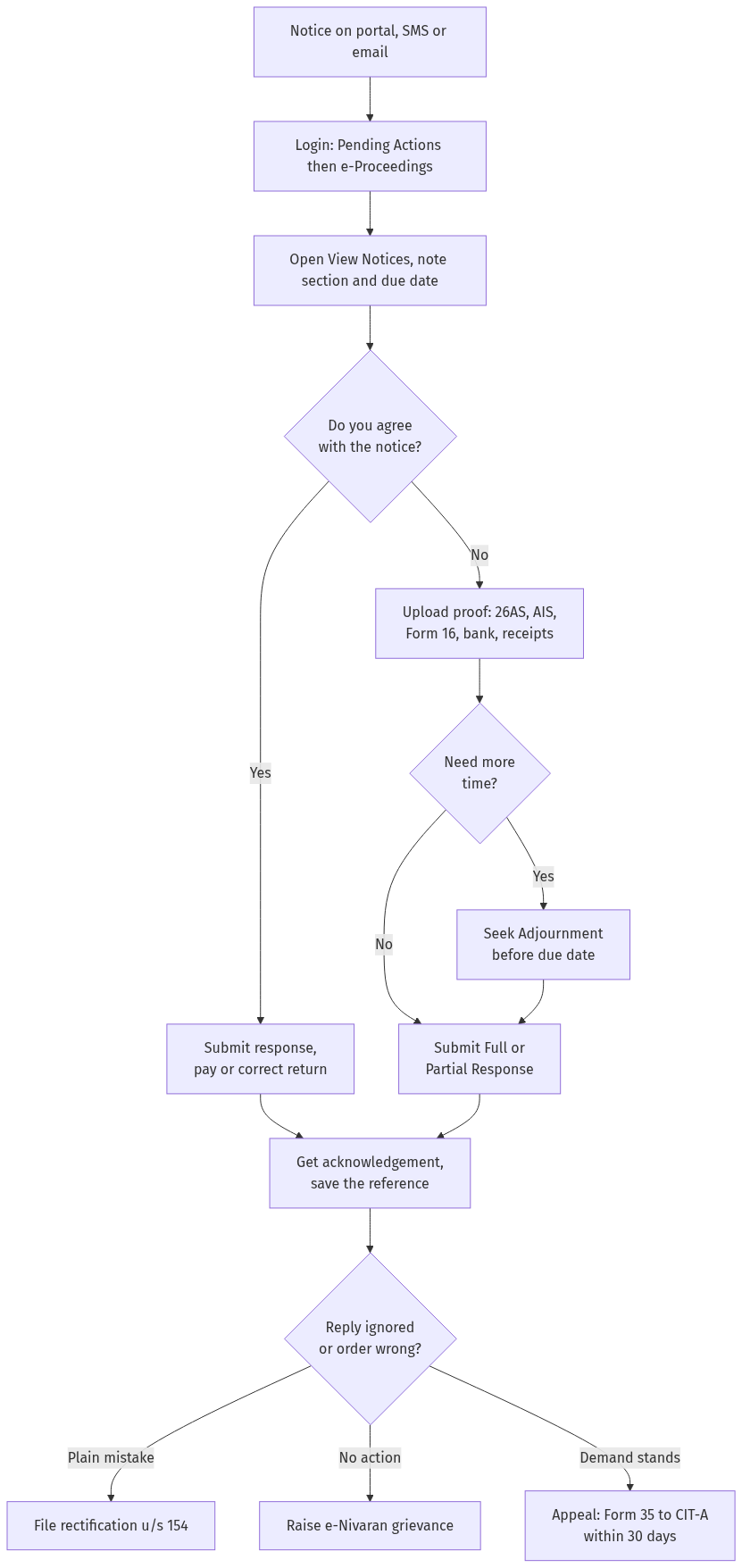
Figure: step-by-step flow. If a step stalls, use the grievance or RTI route shown.
The remedy ladder if things go wrong
If you replied and the outcome still feels unfair, climb the ladder in order. Each rung is a distinct right.
Rung one: rectification under section 154
If the order has a plain, obvious mistake, a wrong figure carried over or a credit not given, file a rectification under section 154 from the Services menu on the portal. This is faster than an appeal and right for arithmetic or clerical errors.
Rung two: e-Nivaran grievance
If your reply was simply not acted on, or the demand looks wrong but is not a clean error, raise a grievance through e-Nivaran under the Grievance menu. It routes to the CPC or your officer, and the department generally responds within about a month. For faceless matters, dedicated grievance email addresses also exist.
Rung three: first appeal to CIT(A)
If a demand stands and you genuinely dispute it, file a first appeal in Form 35 before the Commissioner of Income-tax (Appeals) under section 246A, online on the portal, within 30 days of service of the order or the section 156 demand notice. If you are late for a good reason, the CIT(A) can condone the delay. To track demand and refund movement while you contest, watch your ITR refund and demand status. A defective-return notice often just needs a corrected return, so see revised and belated ITR.
A short checklist before you click submit
- You have read the section and the due date on the notice itself.
- Your reply matches the question, with proof attached within the size limits.
- You agreed or disagreed clearly, and gave reasons where you disagreed.
- You saved the acknowledgement and reference number.
- If you needed time, you sought adjournment before the date, not after.
Never ignore a notice. Silence can cost you a penalty and forfeit your right to be heard. A calm, on-time reply with the right paper usually closes the matter.
Frequently asked questions
What happens if I ignore an income tax notice?
Ignoring a notice can lead to a penalty, a best-judgment assessment based on the officer's estimate, and loss of your chance to explain. A 142(1) failure alone can attract a penalty, so always reply or seek time before the due date.
How many days do I get to reply to a 143(1)(a) notice?
A proposed-adjustment notice under section 143(1)(a) usually gives 30 days to agree or disagree on e-Proceedings. The date on your notice is final, so verify it on incometax.gov.in and reply before it lapses.
Can I get more time to respond?
Yes. Open the notice in e-Proceedings and click Seek Adjournment before the due date, choose the date you need, and give a reason. Do this before the deadline, not after it passes.
My reply was correct but the demand still stands. What now?
Use the remedy ladder. File a section 154 rectification for an obvious mistake, raise an e-Nivaran grievance if your reply was not acted on, or file a Form 35 appeal to the CIT(A) within 30 days of the order or demand.
Is the notice fake or genuine?
Genuine notices carry a Document Identification Number (DIN) and appear inside your portal under Pending Actions. Verify any notice using the Authenticate Notice or Order option on incometax.gov.in before you act or pay.
Do I need a chartered accountant to reply?
Not for simple matters. A mismatch or defective-return notice can be answered yourself with your 26AS, AIS and Form 16. For scrutiny under 143(2), reassessment under 148, or an appeal, professional help is wise.
Does the new Income-tax Act, 2025 change how I reply?
The reply process on e-Proceedings is the same. Income from 1 April 2026 falls under the 2025 Act, while older years stay under the 1961 Act, so your notice may quote either. Follow the section and date on the notice.
Sources
Income tax notice reply: How to respond to IT notice (2026)
- Step 1: How to reply to an income tax notice? (a) IT notice: (i) income tax department sends notice — for various reasons, (ii) types: Section 143(1) intimation, Section 142(1) inquiry, Section 148 reassessment, Section 139(9) defective return, (iii) reply: must respond within deadline — online via incometax.gov.in, (b) key rules: (i) Income Tax Act 1961: notices under various sections, (ii) deadline: typically 15-30 days — section-specific, (iii) non-response: penalty + best judgment assessment, © common scenarios: (i) Section 143(1) — intimation after processing, (ii) Section 142(1) — inquiry before assessment, (iii) Section 148 — reassessment — income escaped assessment, (iv) Section 139(9) — defective return — correction needed, (v) Section 133(6) — call for information, (d) replies: (i) Section 143(1): check intimation — pay demand or claim refund, (ii) Section 142(1): provide details + documents, (iii) Section 148: file return + challenge if time-barred, (iv) Section 139(9): correct defect + re-file, (v) Section 133(6): provide information sought, (e) authority: Jurisdictional AO + CPC + CIT(Appeals), (f) law: Income Tax Act 1961 + IT Rules 1962.
- Step 2: Comparison table — IT notice types. (a) 143(1): (i) issue: intimation after processing, (ii) reply: check + pay/refund, (iii) timeline: as per intimation, (iv) example: received; checked; paid, (b) 142(1): (i) issue: inquiry before assessment, (ii) reply: provide details + documents, (iii) timeline: 15-30 days, (iv) example: received; replied; closed, © 148: (i) issue: reassessment — income escaped, (ii) reply: file return + challenge if time-barred, (iii) timeline: 30-60 days, (iv) example: received; challenged; dropped, (d) 139(9): (i) issue: defective return, (ii) reply: correct + re-file within 15 days, (iii) timeline: 15 days, (iv) example: defective; corrected; accepted, (e) 133(6): (i) issue: call for information, (ii) reply: provide information, (iii) timeline: as per notice, (iv) example: received; provided; closed. (Note: Respond within deadline. Online reply via incometax.gov.in. Non-response = penalty.)
- Step 3: How to reply to IT notice. (a) Step 1: Login incometax.gov.in — e-Proceeding, (b) Step 2: Select notice — view + download, © Step 3: Prepare reply — with documents, (d) Step 4: Submit online — e-Proceeding portal, (e) Step 5: Keep acknowledgment — of submission, (f) Step 6: AO response — check regularly.
- Step 5: Practical tips. (a) respond within deadline — avoid penalty, (b) submit online — e-Proceeding portal, © keep all documents — ready, (d) consult CA for complex notices — Section 148, (e) Example: A taxpayer received Section 143(1) with demand; checked calculation; demand was erroneous; replied; dropped.
- Step 6: Key provisions. (a) Income Tax Act 1961, (b) Section 143(1): intimation, © Section 142(1): inquiry, (d) Section 148: reassessment, (e) Section 139(9): defective return.
See IT Notice Reply and RTI for ITR Refund and How to File RTI.