Table of Contents
Municipal Grievance: Get It Fixed 2026

Reviewed on 2026-06-20 by Dr. Shrawan Kumar Pathak.
Quick Reply: First log your civic complaint on your own city or ULB portal (or the Swachhata app for sanitation), and keep the complaint number. If it is not fixed in the time your portal promises, escalate, then file an RTI with the municipal Public Information Officer for the action-taken report. A central escalation on CPGRAMS is resolved in 21 days.
A pothole, an overflowing bin, a broken streetlight, a blocked drain. You raise it, nothing moves, and you do not know who to chase. This guide is a checklist. Tick each box in order. The last box, an RTI to your municipality, is the one that usually unsticks a stalled complaint, because it forces a written reply.
First, get the basics right
Municipal services are a state and local subject. There is no single all-India complaint window for a broken streetlight. Your first stop is your own urban local body, the ULB, which means your municipal corporation, municipality, or nagar panchayat. So before you complain, find your own portal and keep proof of everything.
Your pre-complaint checklist
- [ ] Find your ULB. Search your city corporation or municipality name plus “grievance” or “complaint”. Most have a website, a mobile app, or a city helpline number.
- [ ] Pick the right channel. For garbage, public toilets, dead animals, or yellow spots, the national Swachhata-MoHUA app routes straight to your city sanitary staff. For water, drains, roads, streetlights, or property tax, use the ULB portal or helpline.
- [ ] Note the exact location. Ward number, street name, a landmark, and a photo. A vague complaint gets a vague reply.
- [ ] Have your details ready. Name, mobile number, and your property or consumer ID if the issue is tied to a holding. You will reuse this when you pay holding or property tax.
Step one: log the complaint and capture the number
Submit the complaint on your chosen channel. The single most important thing you do here is save the complaint or ticket number. Without it you cannot track or escalate.
Logging checklist
- [ ] Write a short, factual subject. “Streetlight pole 14, Ward 7, dark for 10 days.”
- [ ] Add one or two photos showing the problem and a recognisable spot.
- [ ] Submit and screenshot the acknowledgement. Note the complaint number, date, and time.
- [ ] Save the SLA shown to you. Many portals display a promised resolution time when you submit. That promise is your deadline. If none is shown, treat a couple of weeks as a fair wait.
The Swachhata app sends you a push notification when a sanitary inspector marks your complaint resolved, often with a photo. If the work is genuinely done, accept it. If it is not, you can usually reopen the complaint before you accept or reject it.
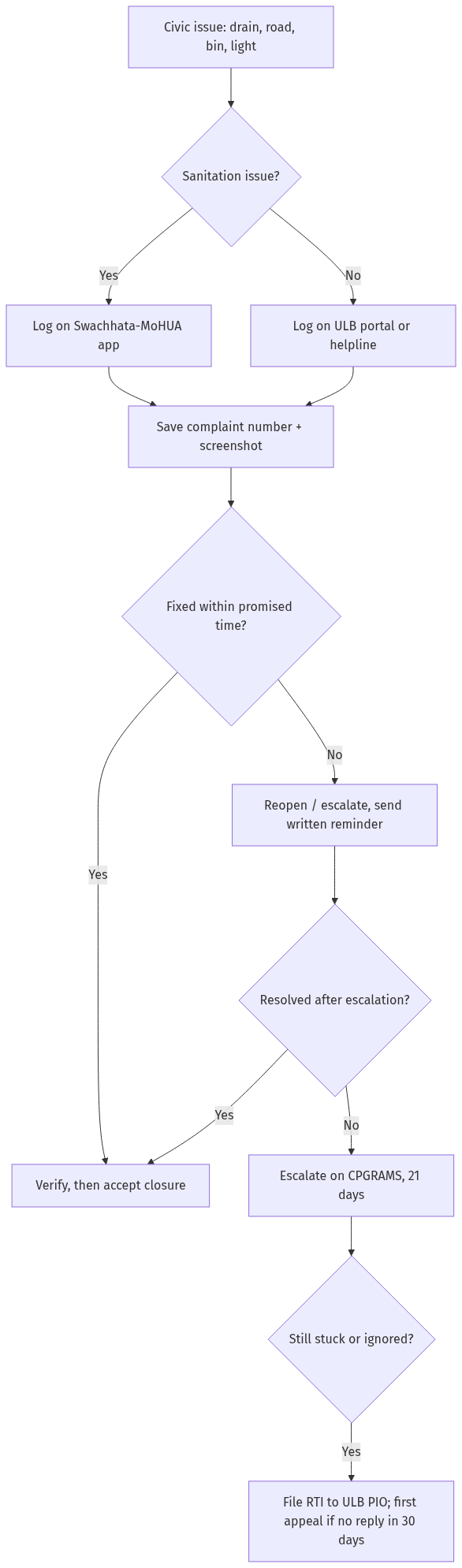
Figure: step-by-step flow. If a step stalls, use the grievance or RTI route shown.
Step two: chase and escalate inside the system
If your promised time passes with no fix, do not file a fresh complaint. That just resets the clock. Escalate the existing one.
Escalation checklist
- [ ] Check the status on the portal or app using your complaint number.
- [ ] Use the reopen or escalate button if there is one. Many state and ULB systems run a tiered ladder, where an unresolved complaint auto-moves from the field officer up to a senior officer after a set time. Check the timeline your own portal publishes; it varies by state and city.
- [ ] Call the city helpline and quote the complaint number. Ask which officer and which ward it sits with.
- [ ] Send one written reminder by email to the ULB grievance cell, attaching your acknowledgement screenshot. This builds a paper trail.
Some states route civic complaints through a chief minister helpline or a state grievance app as well. If your city is covered, log there too and keep that number.
Step three: escalate to CPGRAMS if a higher department is involved
If your issue spills into a central or larger department, for example a centrally run scheme, you can escalate on the national CPGRAMS portal at pgportal.gov.in, or through the UMANG app.
CPGRAMS facts you can rely on
- Resolution timeline is 21 days. The Centre cut it from 30 to 21 days under its 2024 grievance guidelines, and 21 days remains the prescribed limit as on 31 January 2026.
- You get a registration number to track status.
- Attachments must be in PDF, with a short subject and description; check the current per-file size and number-of-files limit shown on pgportal.gov.in when you upload.
- You can appeal if you are dissatisfied after closure. File the appeal within 30 days; appeals are ordinarily closed within 30 days.
CPGRAMS is the escalation rail, not the first stop for a local pothole. Use it when the ULB has clearly failed or a central body is in the picture.
Step four: file an RTI when nobody responds
This is the box that works. Your municipal corporation is a public authority under the Right to Information Act, 2005. When a complaint stalls, an RTI to the municipal Public Information Officer (PIO) forces a dated, signed, written reply that the casual complaint never produced.
What to ask in your RTI
- The action-taken report on complaint number dated .
- The name and designation of the officer responsible for resolving it.
- The file movement and current status, with dates.
- The timeline or SLA the ULB committed to for this category of complaint.
- Certified copies of the inspection report, if any inspection was done.
Address it to the PIO of your municipal corporation or municipality. Pay the RTI fee, which is a small amount fixed by your state RTI rules; people below the poverty line are usually exempt. If you get no reply in 30 days, or a useless one, file a first appeal to the First Appellate Officer of the same ULB.
An RTI does two things at once. It pulls out the facts, and it tells the office that you are watching, which on its own often gets the work done before the reply is even drafted. The same approach works when a water connection is delayed or a building plan approval has been stuck after fees were paid.
Keep your paper trail tidy
Whatever the issue, keep one simple folder. It carries you from a polite complaint to a formal RTI without losing a single fact.
- Complaint number, date, and acknowledgement screenshot.
- Photos of the problem, with a visible landmark.
- The SLA or promised time your portal showed.
- Copies of every reminder and helpline call note.
- The RTI application and its postal or online receipt.
If your grievance is about a licence rather than a service, the same escalation logic applies; see how to handle a trade licence with the municipality when the office sits on your file.
Frequently asked questions
Where do I file a municipal complaint first?
On your own ULB, meaning your municipal corporation, municipality, or nagar panchayat. Search your city name plus “grievance” to find its portal, app, or helpline. For sanitation, the national Swachhata-MoHUA app routes complaints straight to your city's sanitary staff.
Is there one national portal for all civic complaints?
No. Municipal services are a state and local subject, so the first window is always your own ULB. CPGRAMS is a central escalation portal you use when a higher department is involved or the ULB has clearly failed, not the first stop for a local pothole.
How long should a municipal complaint take to resolve?
It depends on your city and the type of issue, and many portals show a promised time when you submit. Save that as your deadline. For central escalations on CPGRAMS, the prescribed timeline is 21 days as on 31 January 2026, with an interim reply if it will take longer.
What if my complaint is marked resolved but it is not?
On most apps, including Swachhata, you can reopen the complaint before you accept or reject the closure. Reopen it, add a fresh photo proving the problem still exists, and quote the original complaint number so it does not reset.
Can I file an RTI about my own municipal complaint?
Yes. Your municipal body is a public authority under the RTI Act, 2005. Ask the Public Information Officer for the action-taken report, the responsible officer's name, the file status, and the committed timeline. A small state RTI fee applies, and BPL applicants are usually exempt.
What do I do if the RTI gets no reply?
If there is no reply within 30 days, or the reply is unsatisfactory, file a first appeal to the First Appellate Officer of the same ULB. If that fails too, you can approach your State Information Commission.
How do I appeal a CPGRAMS grievance I am unhappy with?
Once your CPGRAMS grievance is closed, the appeal option opens if you are dissatisfied. File the appeal within 30 days of closure. Appeals are ordinarily closed within 30 days.