Table of Contents
Failed NEFT/UPI: Get Your Refund 2026
Reviewed on 2026-06-20 by Dr. Shrawan Kumar Pathak.
Quick Reply: Money debited but the transfer failed? For UPI person-to-person and IMPS, your bank must auto-reverse the amount by T+1 day or pay you Rs 100 a day in compensation, automatically. If it does not, raise a dispute in your app, then escalate to the RBI Ombudsman at cms.rbi.org.in.
RBI Ombudsman as of 1 July 2026: Bank, certain NBFC, prepaid-instrument and credit-information complaints go under the Reserve Bank - Integrated Ombudsman Scheme, 2026, which replaced RB-IOS 2021 from 1 July 2026. First complain to the entity. If there is no reply in 30 days (or the longer NPCI/card-network window, if it applies) or you reject the reply, file free at cms.rbi.org.in within 90 days. The Ombudsman can award up to Rs 30 lakh for consequential loss and up to Rs 3 lakh for time, expenses and harassment. Complaints received before 1 July 2026 stay under the 2021 scheme. Source: RBI FAQ, updated 1 July 2026 and the RB-IOS 2026 FAQ PDF dated 1 July 2026.
The two minutes that feel the worst
Before: you tap pay, the money leaves your account, and the screen says failed or simply freezes. The shopkeeper says nothing arrived. Your balance is short. You stare at the phone wondering if the money is just gone.
After: within a day or two, the same amount lands back in your account on its own, often with a small extra credit if the bank was slow. That after is not luck. It is a rule the Reserve Bank of India wrote, and this guide walks you from the first to the second.
This page is about a failed transfer, where money is debited but the right person never gets credited. That is different from a wrong transfer, where the money reached the wrong but real account. A wrong transfer needs the recipient to agree to return it. A failed transfer is the bank's job to fix.
Step one: wait for the auto-reversal first
Most failed transfers fix themselves. The RBI Harmonisation of Turn Around Time circular (RBI/2019-20/67, dated 20 September 2019) sets fixed deadlines that every bank must follow.
What the deadline is for your transfer type
- UPI person-to-person and IMPS: if the beneficiary is not credited, your bank must auto-reverse the money to you by T+1 day (T is the transaction day).
- UPI merchant payment, debit and credit card payments, and ATM cash not dispensed: auto-reversal within T+5 days.
- NEFT: if the receiving bank cannot credit the beneficiary, it must return the amount, usually within two hours of the relevant settlement batch, after which it flows back to you.
Before you do anything, give the system this window. Many refunds land in 24 to 48 hours with no effort from you at all.
The part banks hope you do not know
If the bank misses the deadline, it owes you Rs 100 for each day of delay beyond the limit, and it must pay this automatically, without you asking. For a delayed NEFT credit, the bank instead owes penal interest at the RBI repo rate plus 2 percent for the delay period. Check the current repo rate on rbi.org.in.
So the before is a short, debited account. The after, if the bank dragged its feet, should be your money back plus that daily compensation sitting in your statement. If the compensation is missing, that itself is a complaint you can make.
Step two: raise a dispute if T+1 passes
If the deadline passes and nothing comes back, stop waiting and act.
- Open the same UPI app you paid from. Go to the transaction, tap on it, and choose raise complaint or report an issue. Note the UPI transaction ID (a 12 digit reference) and the date, time and amount.
- Your app provider must escalate the matter to your bank and to NPCI. Under the UPI chargeback rules updated in 2025, your bank can pull the money back through a chargeback when a transfer genuinely failed.
- If the app route stalls, call or write to your bank directly with the UPI ID or NEFT/IMPS reference number. Ask them to trace the transaction and process the refund and any compensation due.
Keep every screenshot, ticket number and SMS. The before-and-after of a complaint is decided by paperwork, not by how loudly you ask.
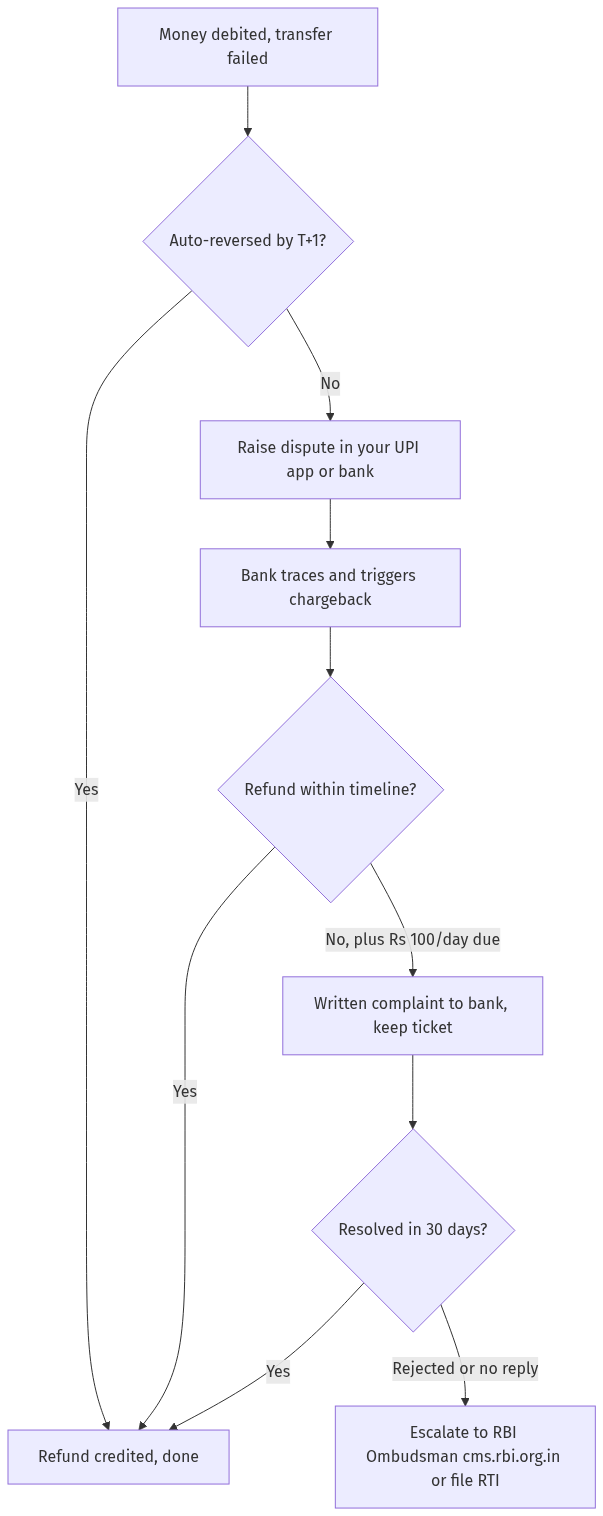
Figure: step-by-step flow. If a step stalls, use the grievance or RTI route shown.
Step three: written complaint, then the Ombudsman
If the bank still has not refunded you, move to a formal written complaint. This is the step that unlocks the regulator.
Lodge it in writing with your bank
Send a written complaint (email or the bank's grievance portal) describing the failed transfer, the amount, the reference number and the compensation owed. Note the date you sent it. You now start a 30 day clock.
Escalate to the RBI Ombudsman
Under the RBI Integrated Ombudsman Scheme, 2026, you can escalate if the bank rejects your complaint or does not reply within 30 days. File free of cost at cms.rbi.org.in, or call the toll-free helpline 14448. The Ombudsman can direct the bank to refund you and pay compensation. There is no fee, and you do not need a lawyer.
If even the basic information you need is being withheld by a public-sector bank, you can also use a right to information request to ask for the transaction trail and the bank's grievance records.
A small habit that saves the headache
Before your next big transfer, screenshot the confirmation and the reference number the moment it goes through. After a failure, that one screenshot is the difference between a same-day refund and a month of follow-ups. For deeper banking issues, see how the account freeze and cheque bounce remedy processes work, how to recover an dormant account, and how a deceased account claim is settled.
Frequently asked questions
How long does a failed UPI refund take?
For a person-to-person UPI transfer where money was debited but not credited, your bank must auto-reverse it by T+1 day. In practice many refunds arrive within 24 to 48 hours. Merchant payments can take up to T+5 days.
What is the Rs 100 per day compensation?
If your bank misses the reversal deadline (T+1 for UPI P2P and IMPS, T+5 for merchant, card and ATM), it must pay you Rs 100 for every extra day of delay, automatically, under the RBI TAT circular dated 20 September 2019.
My money is debited but the merchant says not received. What do I do?
First wait for the T+5 day window for merchant payments. If it does not reverse, raise a complaint in your UPI app with the transaction ID, then escalate to your bank, and finally to the RBI Ombudsman if 30 days pass without resolution.
Is a failed transfer the same as sending money to the wrong person?
No. A failed transfer means the money never reached the intended account, and the bank must reverse it. A wrong transfer means it reached a real but incorrect account, which can only be returned with that person's consent or a court order.
What if my NEFT transfer failed?
The receiving bank must return an uncreditable NEFT amount, usually within two hours of the settlement batch, and it then returns to you. For a delayed credit the bank owes penal interest at the repo rate plus 2 percent. Verify the current repo rate on rbi.org.in.
The bank is ignoring my complaint. Where do I escalate?
Send a written complaint and wait 30 days. If the bank rejects it or stays silent, file free at the RBI Ombudsman portal cms.rbi.org.in or call 14448. You can also file an RTI with a public-sector bank for the transaction records.
Do I need to ask for the compensation or does it come automatically?
The RBI rule says compensation is paid suo motu, meaning the bank must credit it on its own without a request. If it does not appear, raise that as a separate complaint, because the bank is in breach of the TAT rules.