Table of Contents
Section 8 — Exemptions from Disclosure

Quick Reply: Section 8 of the RTI Act — the exemption clause. All 10 sub-clauses a-j explained with post-DPDP 2025 analysis, Supreme Court and CIC rulings, and practitioner.
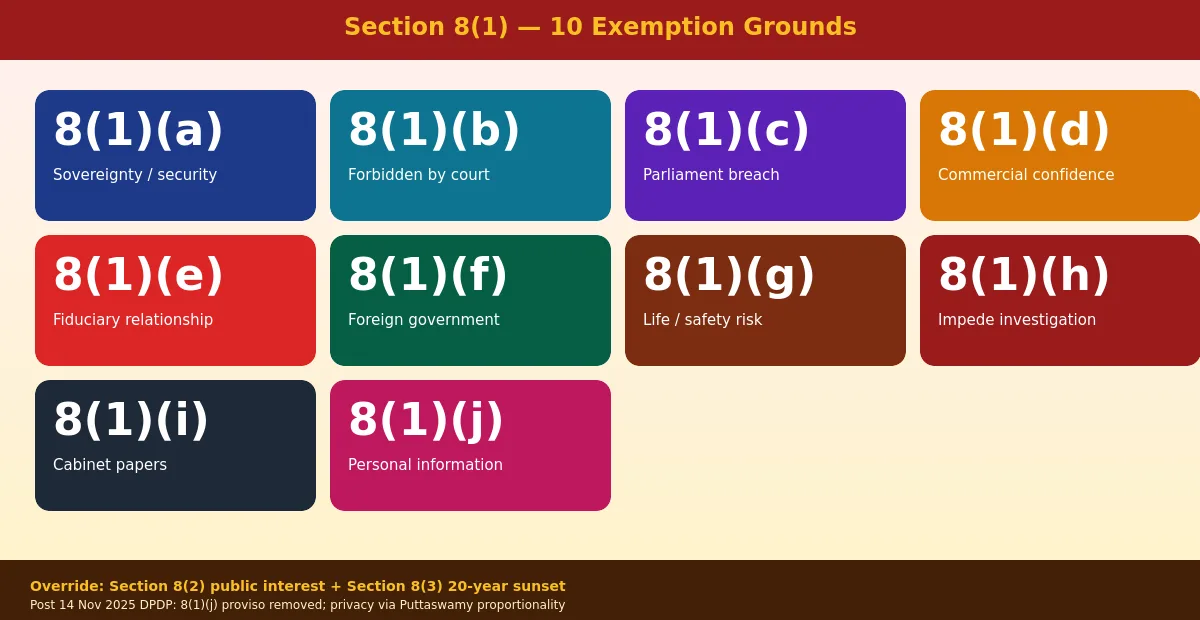
In one line: Section 8 lists 10 exemption grounds (a)-(j) that a PIO can invoke to refuse. It is the most contested clause of the Act — over 60 percent of RTI refusals cite Section 8, and 80 percent of those cite Section 8(1)(j) (privacy). Section 8(2) contains a public-interest override, and Section 8(3) unlocks most exemptions after 20 years.
The 10 exemption grounds
| Clause | Protects | Typical wrong use |
|---|---|---|
| 8(1)(a) | Sovereignty, integrity, security, strategic, scientific, economic interests | Over-used for any “sensitive”-sounding matter |
| 8(1)(b) | Information expressly forbidden to be published by court or tribunal | Used to block sub judice matters that are not actually forbidden |
| 8(1)© | Breach of privilege of Parliament or State Legislature | Rare and narrow |
| 8(1)(d) | Commercial confidence, trade secrets, intellectual property | Shield for tender / contractor details; overcome via public interest |
| 8(1)(e) | Information available in fiduciary relationship | Most litigated; see RBI v. Jayantilal Mistry |
| 8(1)(f) | Foreign government information received in confidence | Narrow |
| 8(1)(g) | Endanger life or physical safety of a person | Legitimate shield for informants |
| 8(1)(h) | Impede investigation, apprehension, prosecution | Bhagat Singh requires how it impedes; bare assertion fails |
| 8(1)(i) | Cabinet papers (opens after decision taken / matter complete) | Often over-broadly claimed |
| 8(1)(j) | Personal information, no public interest (narrowed by DPDP 2025) | The most-invoked exemption |
Two override mechanisms
- Section 8(2) — disclosure is permitted if the public interest in disclosure outweighs the harm to the protected interest. Applies to every 8(1) sub-clause except (a) and (e).
- Section 8(3) — after 20 years, most 8(1) exemptions drop away. Exceptions: (a) sovereignty/security, © Parliament privilege, (i) Cabinet papers (but only so long as matter is live).
The 14 November 2025 DPDP amendment
Section 44(3) of the DPDP Act, 2023 substituted the proviso to Section 8(1)(j) on the date the DPDP Rules, 2025 were notified (14 November 2025). The earlier proviso — “information which cannot be denied to Parliament or a State Legislature shall not be denied to any person” — stands removed. Privacy analysis under Section 8(1)(j) now operates purely through the Section 8(2) public-interest override, and through the proportionality test laid down in K.S. Puttaswamy v. UoI, (2017) 10 SCC 1.
See the full DPDP 2025 practitioner note and PIO reply after DPDP 2025.
Flagship rulings by clause
8(1)(a) — Sovereignty / security
- People's Union for Civil Liberties v. UoI, (2003) 4 SCC 399 — Article 19(1)(a) right to know overlaps with 8(1)(a); sovereignty claim requires specific factual basis.
8(1)(d) — Commercial confidence
- S.N. Deshmukh v. UoI, CIC — tender evaluations are disclosable once the contract is awarded; pre-award confidentiality is temporal.
8(1)(e) — Fiduciary
- RBI v. Jayantilal N. Mistry, (2016) 3 SCC 525 — RBI is not in a fiduciary relationship with banks it regulates; supervisory reports are disclosable.
- ICAI v. Shaunak H. Satya, (2011) 8 SCC 781 — exam-related materials in certain professional contexts can fall under 8(1)(e).
8(1)(h) — Investigation
- Bhagat Singh v. CIC, Delhi HC (2007) — bare claim that investigation is ongoing does not trigger 8(1)(h); PIO must show how disclosure would impede.
8(1)(j) — Privacy
- Girish Ramchandra Deshpande v. CIC, (2013) 1 SCC 212 — the foundational test; information unrelated to any public activity is presumptively personal.
- K.S. Puttaswamy (Retd.) v. UoI, (2017) 10 SCC 1 — privacy as a fundamental right; proportionality test (legitimate aim, suitability, necessity, balancing).
- Madras HC judgment on public servants assets (2024) — assets of public servants disclosable through 8(2) public interest.
8(2) — Public interest override
- Bihar Public Service Commission v. Saiyed Hussain Abbas Rizvi, (2012) 13 SCC 61 — public-interest test requires balancing exercise by the PIO and review by the Commission.
8(3) — 20-year sunset
- Rarely litigated; generally accepted per the text. Old Cabinet and security records become disclosable unless specifically re-protected.
Drafting counter-strategies (per clause)
Every refusal under Section 8 must satisfy the speaking-order requirement under 7(8) — name the sub-clause, apply to your facts, consider severance under Section 10, and weigh Section 8(2). Absent any of these, the refusal is non-speaking and appealable.
For the 8(1)(j)-specific counter after DPDP 2025, see the 5-question test for PIOs.
Call to action
When faced with a Section 8 refusal:
- Identify the sub-clause invoked.
- Check if the refusal applies the test to your facts.
- Check if Section 8(2) public interest was weighed.
- Check Section 10 severance was considered.
- If any answer is “no”, file a first appeal using the First Appeal template with the non-speaking-order ground.
Related
Sources
- RTI Act, 2005, Section 8.
- DPDP Act, 2023, Section 44(3); DPDP Rules, 2025 (notified 14 Nov 2025).
- K.S. Puttaswamy v. UoI, (2017) 10 SCC 1.
- Girish Ramchandra Deshpande v. CIC, (2013) 1 SCC 212.
- RBI v. Jayantilal N. Mistry, (2016) 3 SCC 525.
- ICAI v. Shaunak H. Satya, (2011) 8 SCC 781.
- Bhagat Singh v. CIC, Delhi HC (2007).
- Bihar PSC v. Saiyed Hussain Abbas Rizvi, (2012) 13 SCC 61.
Last reviewed on: 21 April 2026